The tale of Yoshitsune
Yoshitsune no Monogatari (義経の物語)
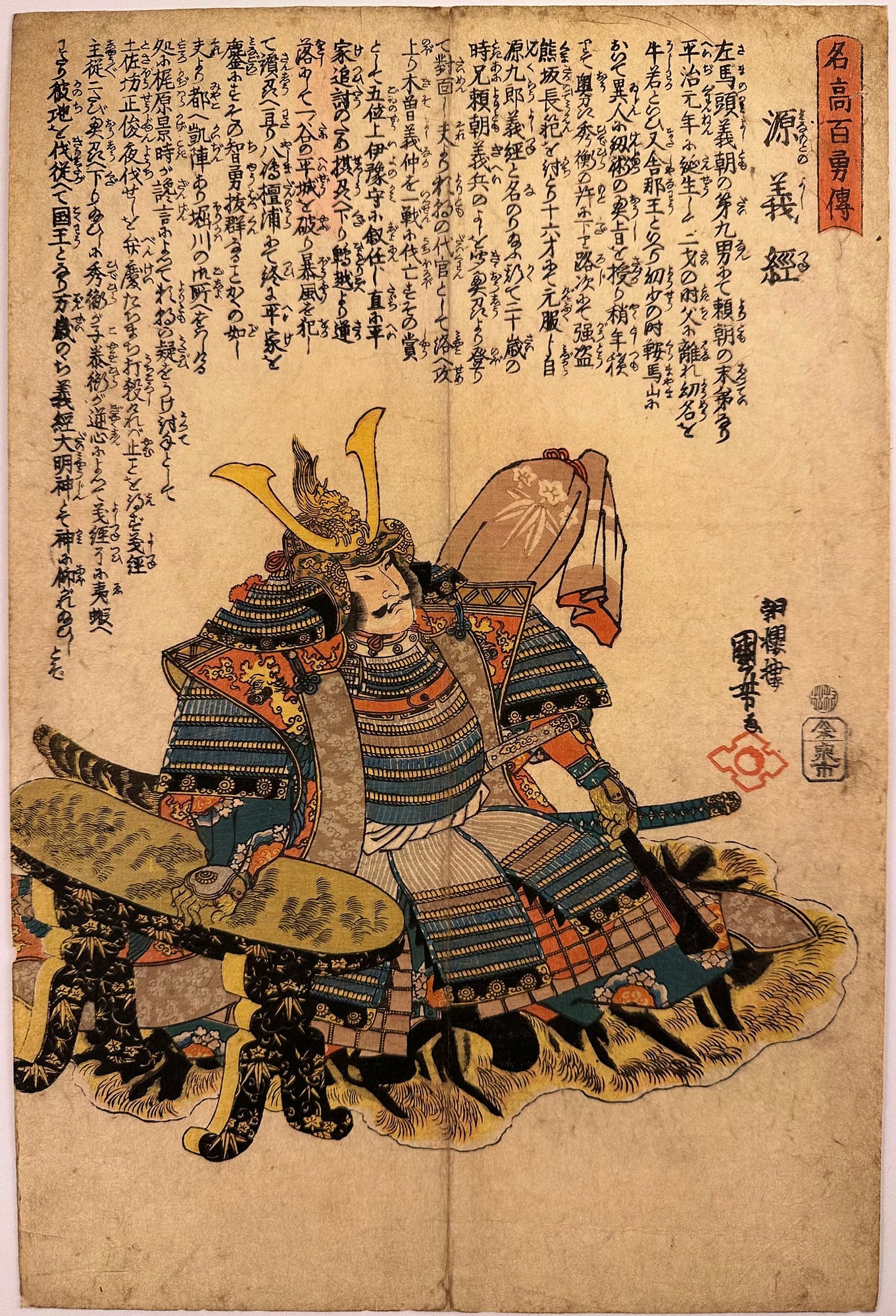
Minamoto no Yoshitsune (1159-1189) was a famous warrior whose tragic life and historical deeds quickly merged with folklore, transforming him into a tragic, superhuman hero. These legends became central subjects for ukiyo-e artists, play writes and novelists alike, and over the centuries storytellers added layers of myth—tengu mentors, impossible feats, and heroic duels—creating a legendary figure whose life straddles history and folklore.
Youthful exploits of Yoshitsune and Benkei
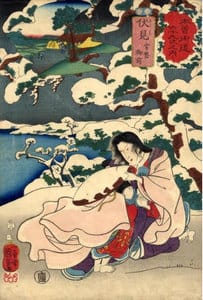
The early life of Minamoto no Yoshitsune begins, as many good stories do, in flight and misfortune. His mother, Tokiwa-gozen, famed for her beauty, fled through the snow with her three young sons after the death of Minamoto no Yoshitomo in the Heiji War (1160). The infant Yoshitsune was carried in her arms (S65.1, S74.52). Survival—rather than dignity—dictated her eventual submission (becoming his concubine) to Taira no Kiyomori (T155), thus securing her children’s lives at the cost of her own independence.
The boys were separated and sent into monastic life, their heads shaved and futures seemingly decided. The youngest, first called Ushiwaka-maru (牛若丸 -“young ox”), later Shanaō, and finally Minamoto no Kurō Yoshitsune, was placed at Kuramayama monastery. Monastic discipline, however, proved ill-suited to a boy destined for rather less contemplative pursuits.
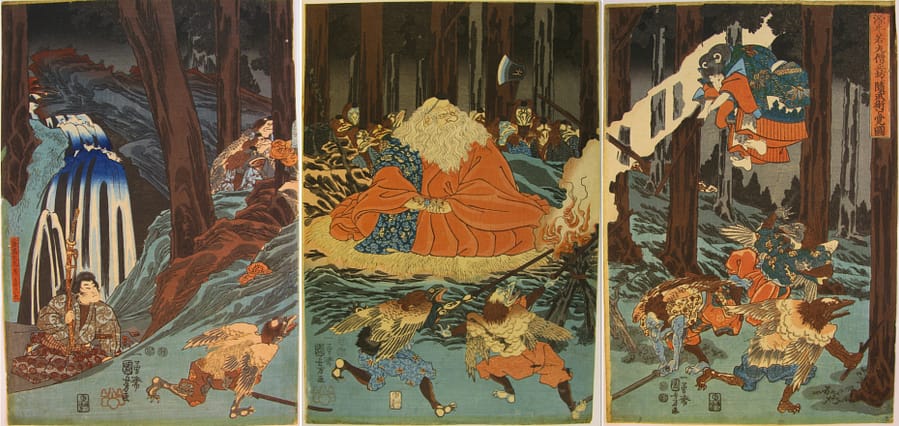
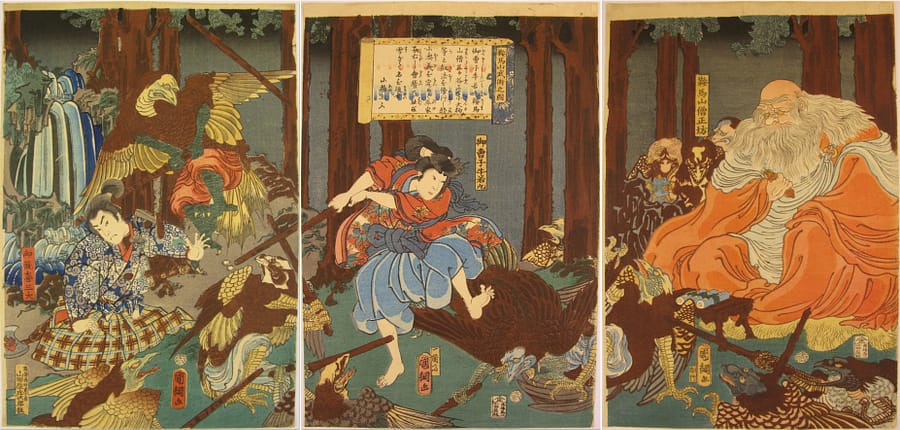
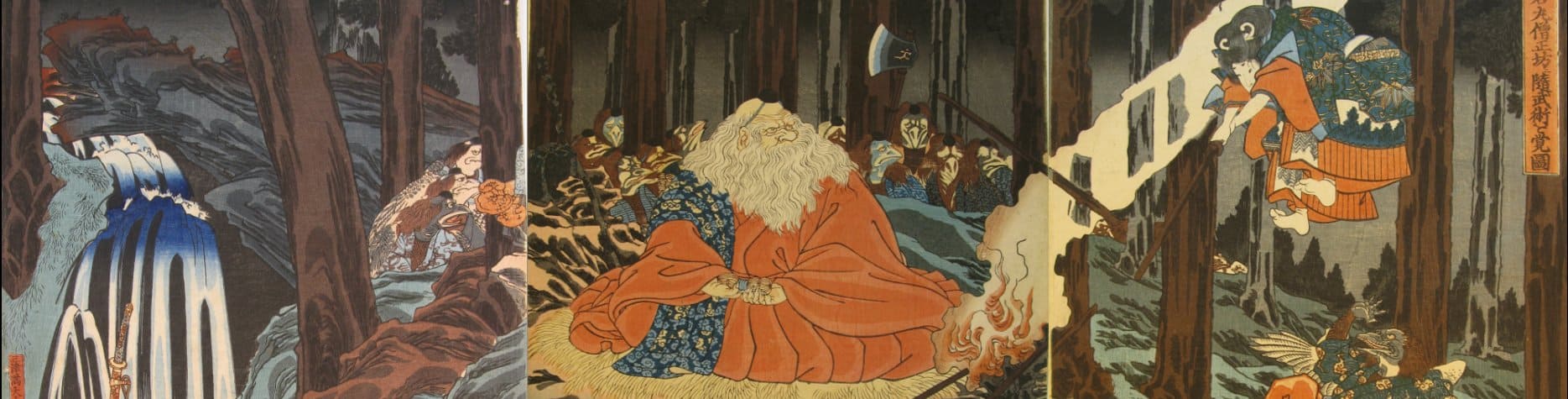
Slipping out by night into the surrounding pine forests, he is said to have trained under the tutelage of the tengu and their king, acquiring near-superhuman skill with the sword (S65.2, S74.15, S88.8, T20, T264, T351).
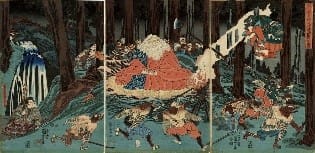
One suspects the monastery records did not note this extracurricular activity. Eventually, Yoshitsune abandoned monastic life altogether and set out northwards toward Mutsu in the company of a gold merchant.
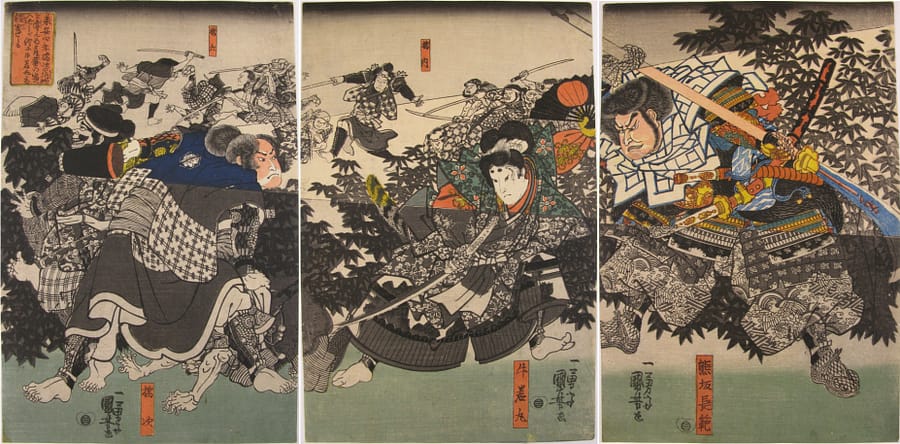
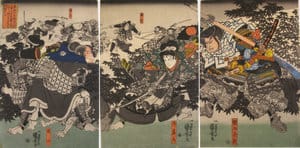
Along the way, he encountered danger early: attacked at an inn in Mino province (likely) by the bandit-monk Kumasaka Chōhan, he displayed precocious martial prowess, killing the giant outlaw and scattering his followers (S65.5, T5, T40, T53, T224).
A more lyrical interlude followed when he heard a koto being played with exquisite refinement. Producing his own flute, Taitō-maru, he joined in, earning an invitation inside and the affections of Jōruri-hime. Their brief idyll lasted ten days before Yoshitsune continued on his journey—leaving tragedy in his wake, as Jōruri is said to have drowned herself in the Yahagi River.
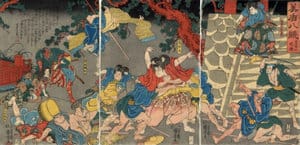
Reaching Hiraizumi, Yoshitsune entered the service of Fujiwara no Hidehira (T93), gaining both patronage and instruction in military affairs. Meanwhile, another formidable figure was emerging: Musashi-bō Benkei. The son of a monk of Kumano and raised in similarly monastic surroundings, Benkei proved even less suited to religious life. After a series of altercations—culminating in a rather comprehensive assault on his fellow monks (T178)—he departed for Kyoto, where he embarked on an ambitious project: the collection of one thousand swords, acquired by means not always strictly consensual.
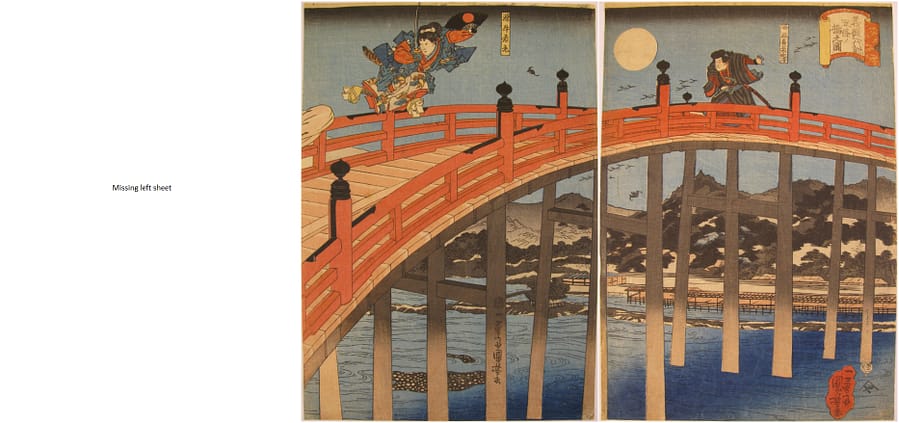
Their inevitable meeting took place on Gojō Bridge. Benkei, one sword short of his goal, attacked the seemingly slight youth before him. What followed is one of the most celebrated encounters in Japanese legend: Yoshitsune, drawing upon his tengu-trained agility, completely outmatched the giant warrior (S28.4, S65.9, S65.10, S76.1,T47, T54, T194).
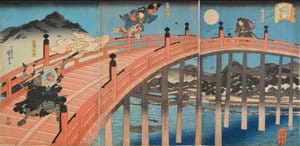
Benkei, discovering the limits of his invincibility rather abruptly, pledged lifelong loyalty on the spot. A later episode illustrates both Benkei’s strength and a certain lack of restraint. Attempting to donate the great bell of Miidera to his former monastery, he simply removed it from Onjōji — after it had been bestowed upon Hidesato by the Dragon King for slaying the giant centipede of Seta (S44.54, T354) —and dragged it away (S49.1, S84.5, T150).
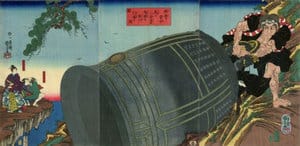
When the bell stubbornly insisted, in mournful tones, on returning home, Benkei resolved the matter by throwing it into a valley, from which it was eventually retrieved by its rightful custodians.
Yorimasa and the beginning of the Taira-Minamoto war (Genpei war)
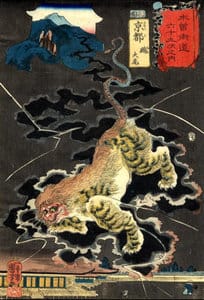
The broader stage now shifts to the Genpei War. Minamoto no Yorimasa, a veteran warrior, and fifth descendant of Raiko, first distinguished himself by slaying the monstrous Nue—a composite creature of monkey, badger, tiger, and snake—after it had haunted the imperial palace (S48.6, T112; S74.72, T7).
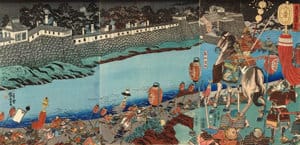
His reward included a fine sword and the hand of Lady Ayame (T107). Yet in 1180, rebelling against Taira dominance alongside Prince Mochihito, Yorimasa was defeated by vastly superior numbers at Uji river, despite the warrior-monks Tsutsui Jōmyō and Ichirai Hōshi making a valiant stand at the broken Uji river bridge (S8.3, S73.10).
Retiring to a nearby temple, he composed a death poem and committed seppuku (S46.8). Minamoto no Yoritomo soon took up the cause, launching his campaign from Izu (S92.4, T88, T123, T239, T312).
Though initially defeated at Ishibashiyama (T39), his fortunes improved, aided by dramatic incidents such as the defection of Kajiwara Kagetoki (S73.9, T320). Yoshitsune, upon hearing of the uprising, hastened south from Mutsu, and the brothers united their efforts (T56).
Another figure briefly rose to prominence: Kiso Yoshinaka (T25), cousin to Yoshitsune and Yoritomo. Raised in the mountains, he achieved spectacular victories, including the rout of Taira forces at Kurikara, where oxen bearing flaming straw caused chaos among enemy ranks (T300, T146, T303).
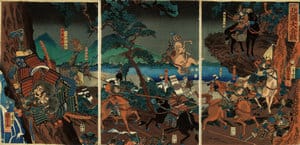
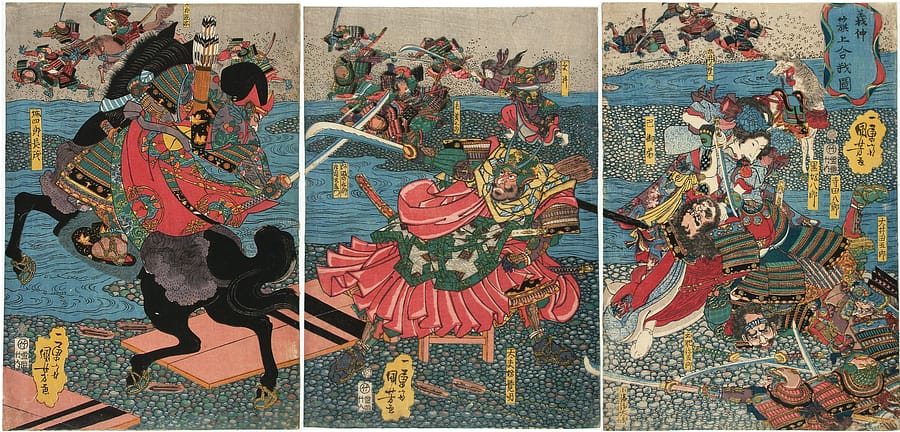
Yet success bred excess. After seizing Kyoto, his undisciplined troops reduced the capital to disorder, prompting Yoritomo to dispatch Yoshitsune and Noriyori against him. Yoshinaka made his final stand at Awazu, supported by the formidable Tomoe-gozen (T265, T315), but was defeated and killed in 1184 (S73.8).
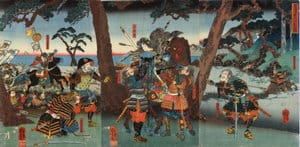
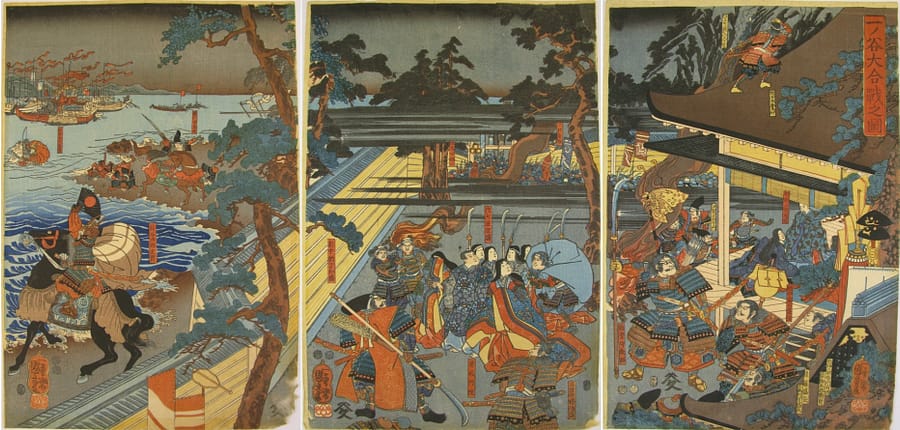
With Yoshinaka removed, attention turned fully to the destruction of the Taira. Yoshitsune’s campaign began with the assault on Ichi-no-tani, where a daring descent of the Hiyodori Pass allowed Minamoto forces to strike from the rear, “like the Persians at Thermopylae” (T65, T84). The Taira, though thrown into confusion (T226), fought fiercely before retreating to their ships.
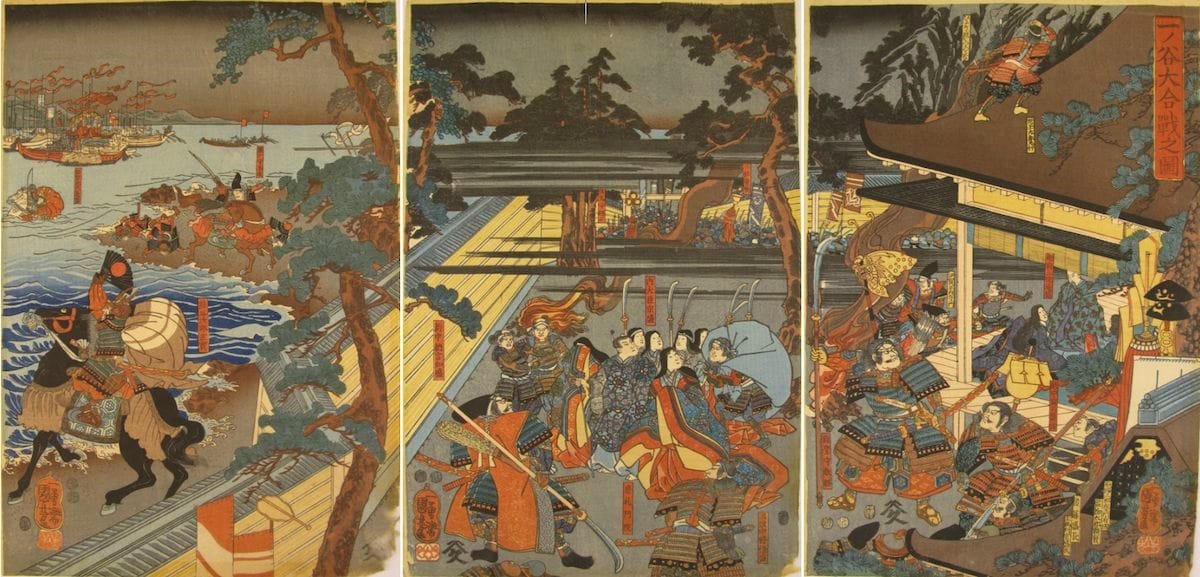
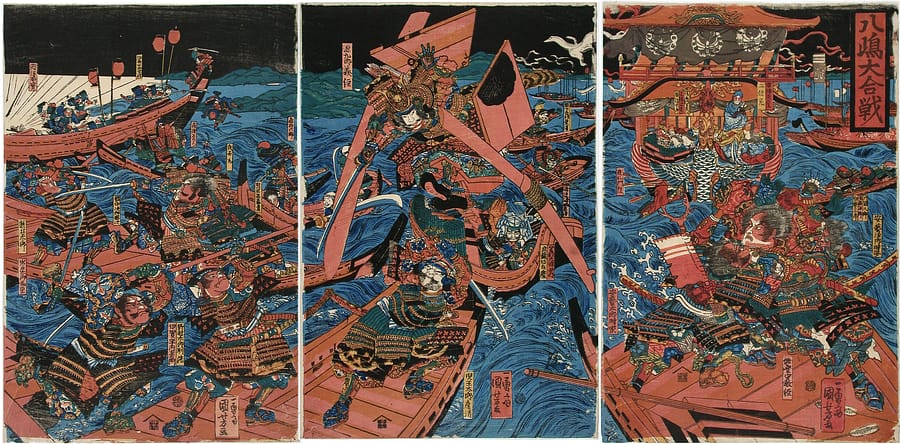
Among the fallen was the young Atsumori, slain by Kumagaya Naozane despite initial hesitation (S65.12, T228, T66), an act that would later lead the victor to take religious vows (S44.23, T48). The campaign continued at Yashima, where Yoshitsune’s speed again caught the Taira off guard. There, in one of the most iconic episodes, Nasu no Yoichi rode into the sea and struck down a fan mounted on a distant boat with a single arrow (S21.3, T179).
The battle also saw acts of loyalty and sacrifice, such as Satō Tsuginobu’s interception of a deadly arrow meant for Yoshitsune (T109, T256). Yoshitsune himself, not entirely immune to impulsive decisions, risked his life retrieving his bow from the sea (T221, T339), later dismissing criticism of this behaviour with characteristic nonchalance.
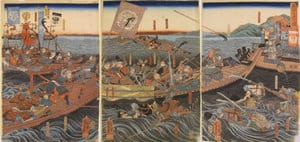
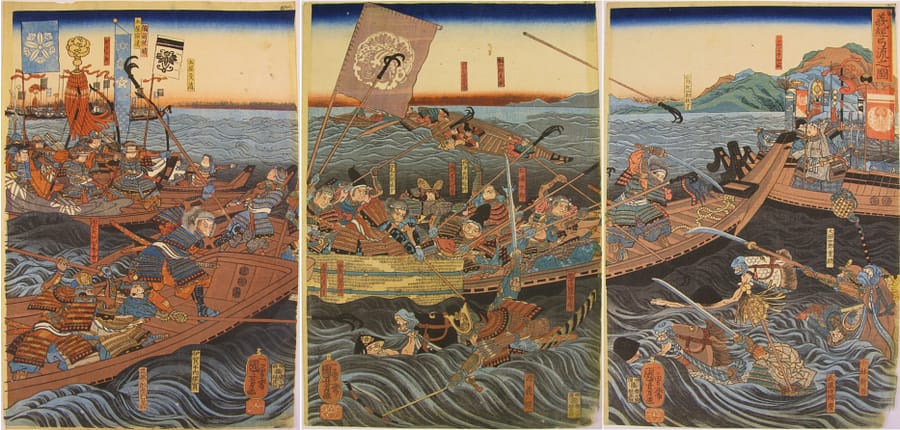
The campaign reached its inevitable and decisive conclusion at Dan-no-ura, fought in the straits of Shimonoseki on 25 April 1185. Here, tide and fortune alike favoured the Minamoto. As the fleets closed—numbering, according to the Heike monogatari, some 1,000 Taira vessels against 3,000 Minamoto, though many were little more than crowded transports—the battle quickly dissolved into chaos upon the water.
The Taira, bearing their customary red banners, initially held the advantage. Yet an omen—never to be underestimated in such matters—appeared in the form of a white cloud, descending like a banner upon a Minamoto ship, to the visible dismay of their opponents. Defections further weakened the Taira position, while their vessels were burdened with court attendants and nobles ill-suited to naval warfare.
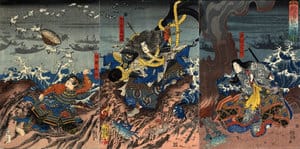
At the heart of the Taira fleet lay its most tragic burden: the child-Emperor Antoku. As defeat became inevitable (T96), Kiyomori’s widow, Ni no Ama, resolved upon an act at once loyal and terrible.
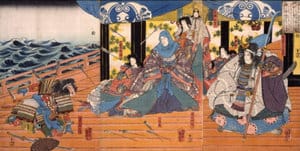
Taking with her the Imperial regalia—the Sword, the Mirror, and the Jewel—and clasping her grandson in her arms, she cast herself into the sea. The Emperor was eight years old.
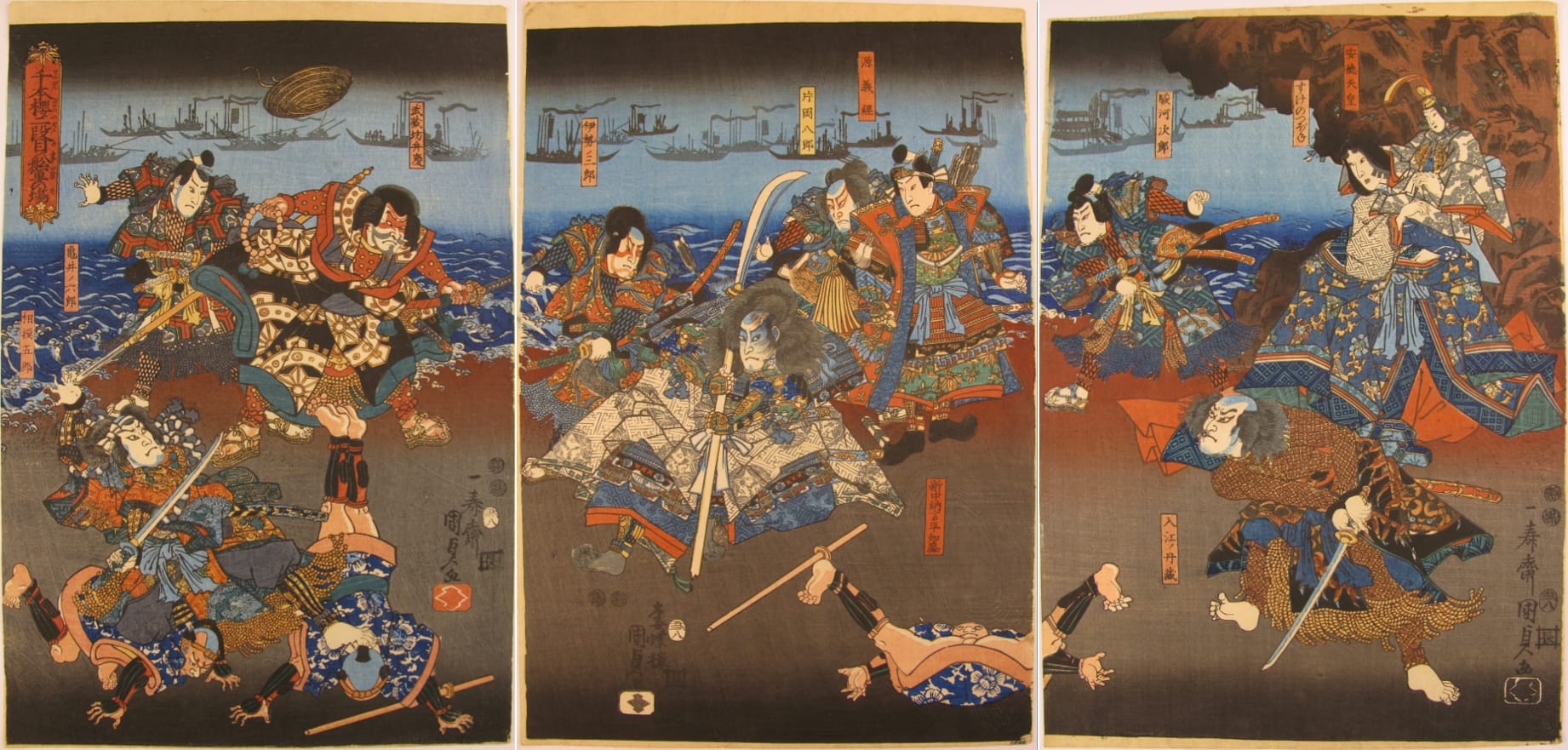
Around them, the final moments of the Taira unfolded in acts of desperation and defiance. Noritsune made a last attempt upon Yoshitsune’s life, but the latter escaped with characteristic agility, leaping from boat to boat (T17, T68, T222, T230).
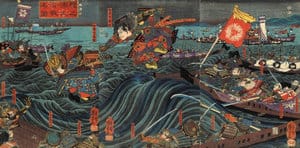
Denied his quarry, Noritsune seized two Minamoto warriors and plunged with them into the sea. Tomomori, mortally wounded, bound himself to an anchor and followed (T144, S36.68, S45.40). One by one, the Taira champions fell, often taking their enemies with them.
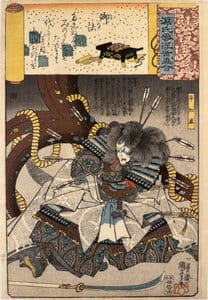
There was little mercy in the aftermath. Survivors—among them Munemori, nominal head of the clan—were captured and later executed, while Taira sympathisers across the country were systematically hunted down. Thus ended the great rivalry that had defined an age.
Yet if the Taira vanished from power, they did not entirely depart from memory. The waters of Dan-no-ura, it is said, have never quite settled and have remained haunted for 800 years. Along that coast strange crabs are found, their shells bearing what appear to be human faces—the so-called Heike crabs (T144), believed to be the lingering spirits of the fallen. Fishermen speak of pale lights (called oni-bi or ‘demon fires’) drifting over the waves on dark nights, and of distant shouting carried on the wind, like the echo of battle not entirely concluded.
One might reasonably suppose that such a victory would secure harmony within the Minamoto ranks. Yoshitsune, after all, had delivered triumph after triumph; his loyalty, brilliance, and daring had turned the tide of war. It would not be unreasonable to expect gratitude—perhaps even reward.
This, however, would be to misunderstand Yoritomo entirely.
Power, Suspicion, and the Fall of Yoshitsune
Even before the echoes of Dan-no-ura had faded, court politics and whispered accusations began to gather force. Chief among those fostering suspicion was Kajiwara Kagetoki, who proved adept at poisoning the mind of the elder brother against the younger. Yoshitsune, returning in triumph, found himself barred from Kamakura (T45), detained instead at Koshigoe, where he composed a deeply moving letter protesting his loyalty and recounting his services (T117). It did him little good. (Indeed, it was here, with grim symmetry, that his severed head would later be displayed.)
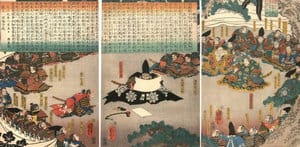
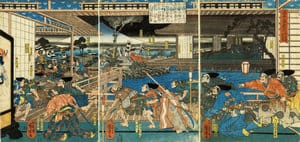
Directed away to Kyoto, Yoshitsune took up residence in the Horikawa palace—hardly a refuge, as it soon proved. Yoritomo secretly dispatched the warrior-monk Tosa-bō Shōshun to eliminate him. By chance, the plot was uncovered by Yoshitsune’s retainer Yeda Genzō, who raised the alarm. Yoshitsune himself, characteristically untroubled until the last moment, was roused from sleep by his mistress Shizuka (T16, T97, T135). The ensuing clash was fierce (T267).
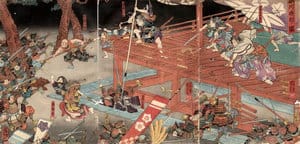
Yeda Genzō fell defending his lord (S4a.18, S76.6), but Benkei captured Shōshun, who was promptly executed (T282).
From this point, Yoshitsune’s story becomes one of flight rather than triumph.
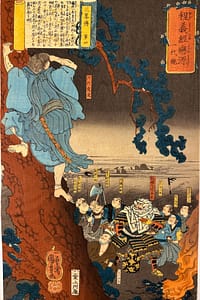
Attempting escape by sea, he encountered not merely storm but something far less tangible. In Daimotsu Bay, the waters themselves seemed to rise against him: ghostly fires flickered over the waves, and the spirits of the Taira—those drowned at Dan-no-ura—rose to drag his vessel down (T1, T70, T147, T242, T266).
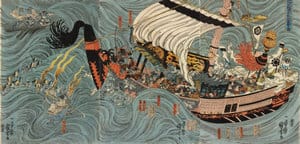
Whether apparition or imagination, the danger was real enough. Benkei, drawing upon his religious training, subdued the supernatural assault—whether by prayer or arrow is a matter of tradition—and the storm abated.
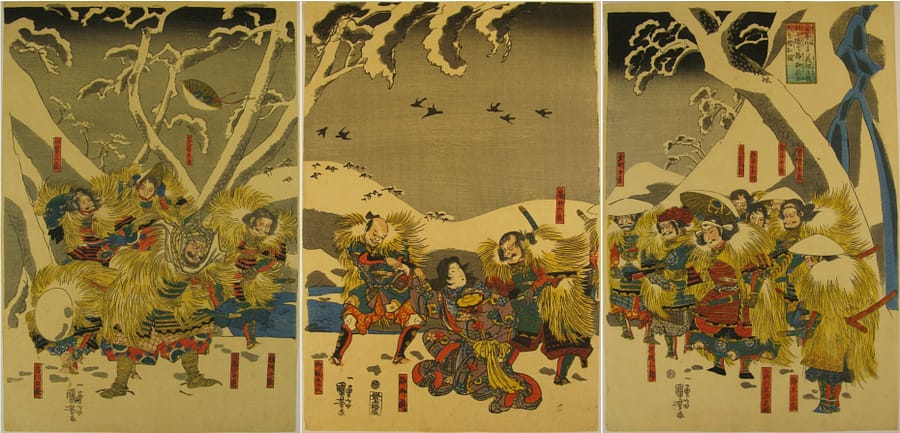
The fugitives pressed on, eventually reaching the snows of Mount Yoshino (T133). Here occurred another of the tale’s quieter tragedies: Yoshitsune parted from his faithful companion Shizuka (S21.2, T127).
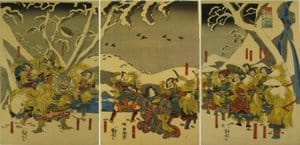
Her fate was no kinder than his. Captured and brought before Yoritomo, she was compelled—despite her condition—to dance for his court (T86). Her child, born soon after, was put to death.
Even in these circumstances, loyalty endured. Satō Tadanobu, whose brother had already died for Yoshitsune at Yashima, now sacrificed himself in turn. Disguising himself as his master, he donned Yoshitsune’s armour and held off pursuing warrior-monks, allowing his lord to escape (S8.2, S65.16, S89.8, T2, T257).
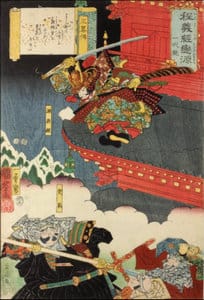
Betrayed later in Kyoto, he fought desperately with nothing more than a go-board (S4a.15, S16.2, S46.31, T168, T321) before taking his own life.
One of the most celebrated episodes of this final journey followed at the Ataka Barrier. Disguised as itinerant monks, Yoshitsune’s party fell under suspicion. Benkei, with remarkable presence of mind, beat his own master to maintain the disguise (T164, T327), then convincingly recited a fictitious subscription list (S95d.2, T126). The ruse succeeded. The episode—Kanjinchō—would later become a favourite subject of dramatic retelling.
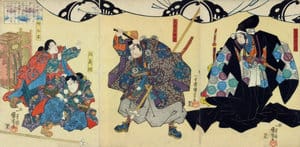
For a time, refuge was found in the north under Fujiwara no Hidehira. But this, too, proved temporary. Upon Hidehira’s death, his sons, seeking favour with Yoritomo, betrayed their guest. Yoshitsune was attacked at Takadachi (T124, T338), and at the final battle of Koromogawa on 16 May 1189, after a heroic resistance, his small band was overwhelmed by vastly superior forces – said to be 30,000 men. His retainers fought to the end (S4a.1), many choosing seppuku. Benkei himself died at his post, pierced by arrows—an image so striking that it scarcely requires embellishment.
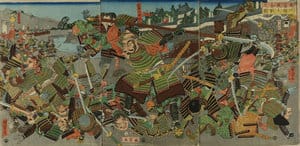
Yoshitsune, denied both escape and honourable surrender, chose his own end by taking his own life, as well as that of his wife and two children. In doing so, he denied his enemies the satisfaction of capture, though not of possession: his head was taken and sent to Kamakura. Yoritomo’s reaction—reportedly one of anger rather than satisfaction—was characteristically opaque; the messengers who brought the grisly token were themselves beheaded. In the following year, his forces completed the work by destroying the northern domain of Hidehira’s sons that had harboured his brother (T268).
Thus ended the life of Minamoto no Yoshitsune: brilliant, ill-fated, and enduringly compelling.
For artists such as Kuniyoshi, his story offered everything—heroism, betrayal, supernatural encounter, and tragic inevitability. It is perhaps no surprise that these episodes were returned to again and again, each retelling adding another layer to a legend that, much like the waters of Dan-no-ura, has never entirely settled.
The bushidoboutique collection of Yoshitsune related prints
Single sheets

Triptychs