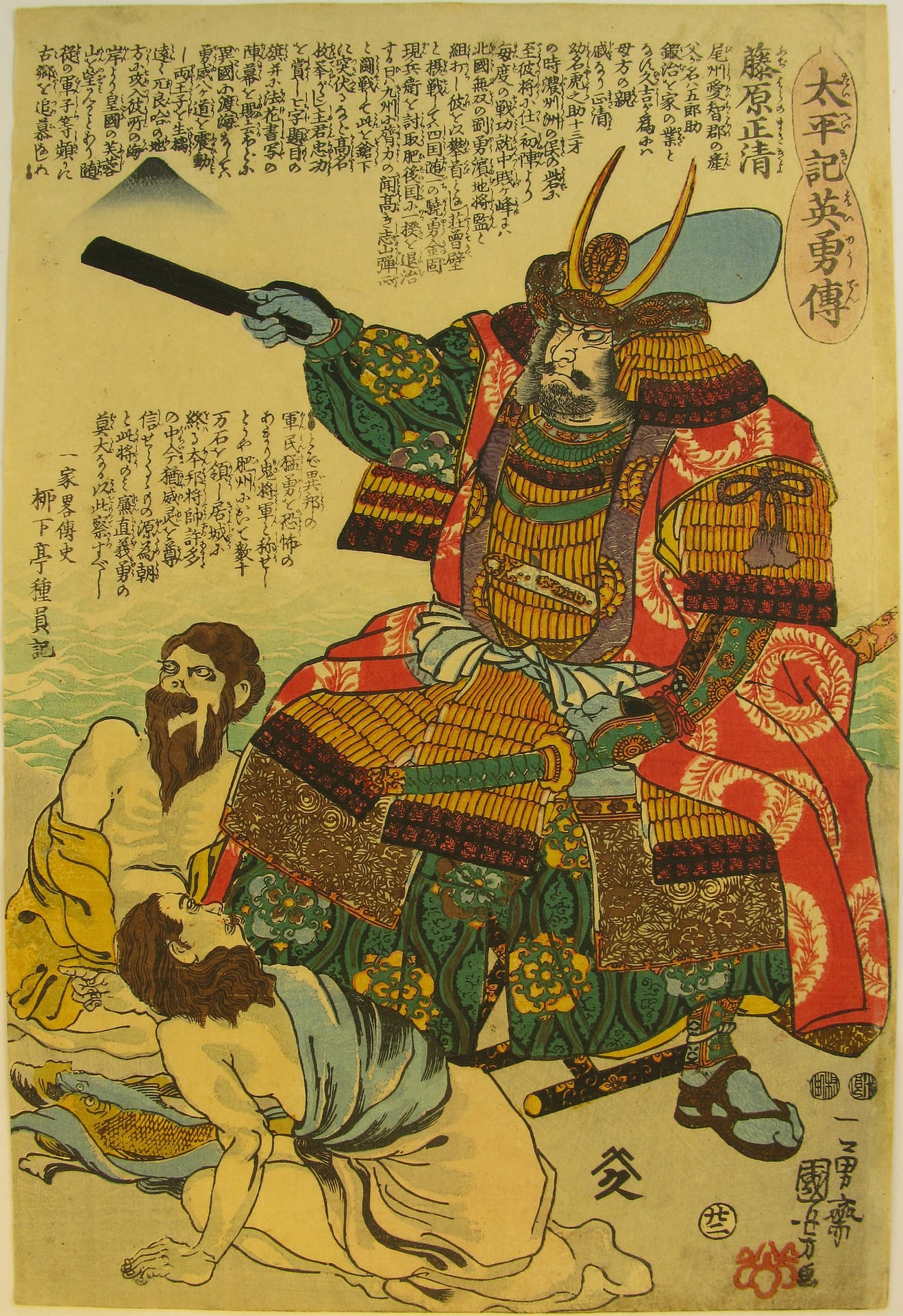
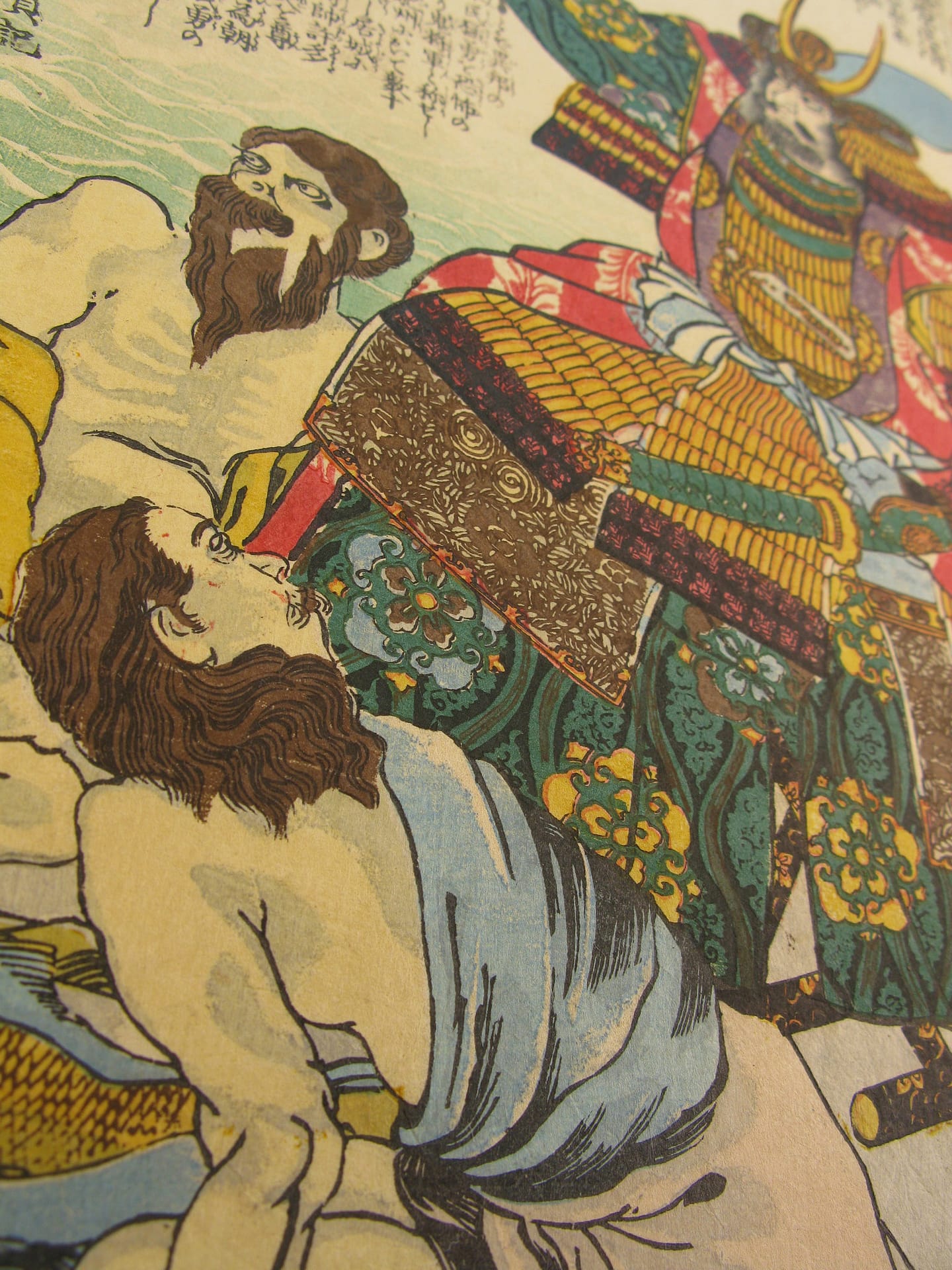
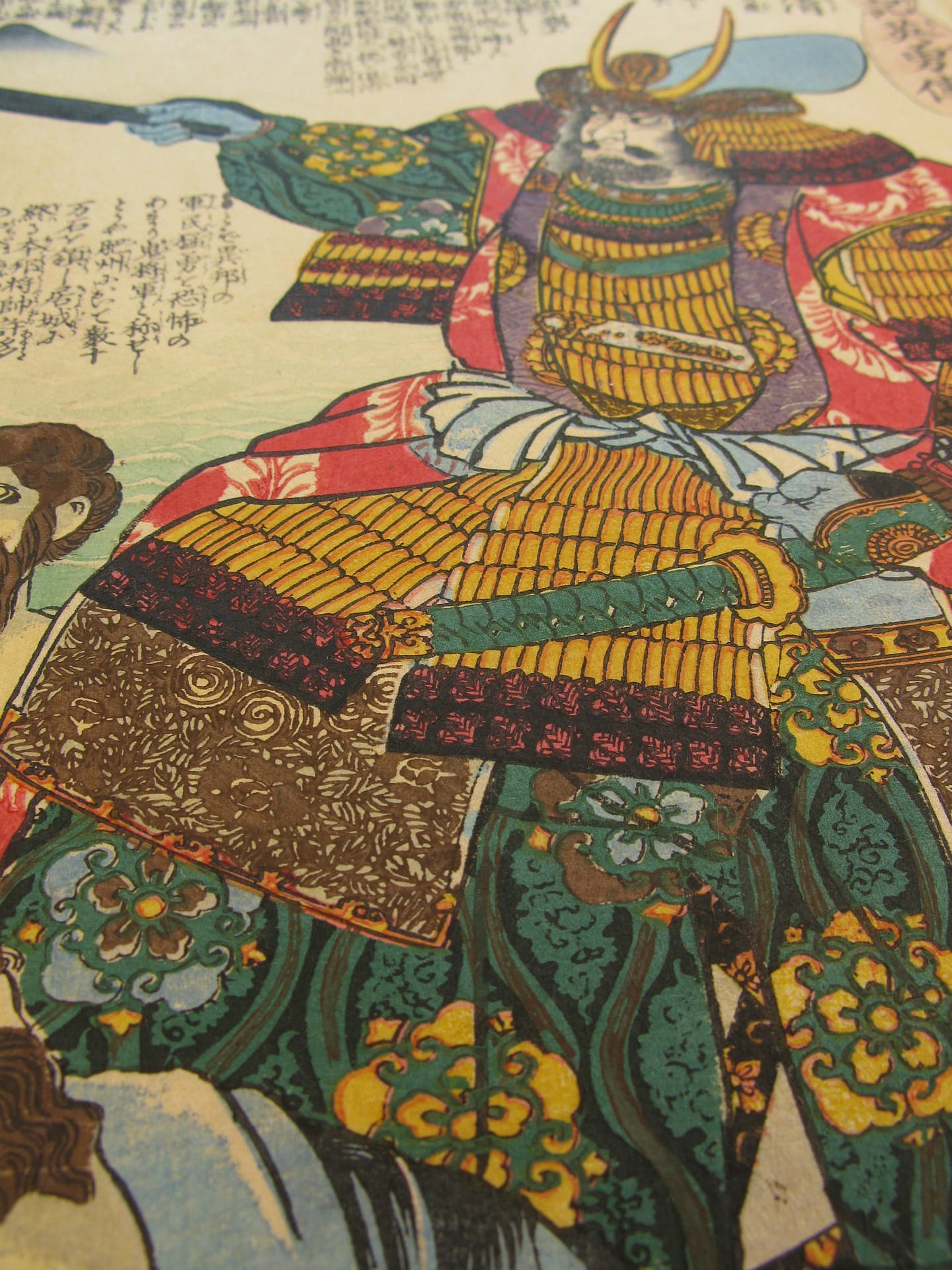
Subject: Fujiwara no Masakiyo in full armour seated on a camp-stool on the shore in Korea pointing over the sea with his fan to the summit of Mount Fuji, with two Koreans at his feet depicted in western style.
Series: Taiheiki eiyū den. Heroes of the Grand Pacification
Print No: 22
Artist: Utagawa Kuniyoshi (1797-1861)
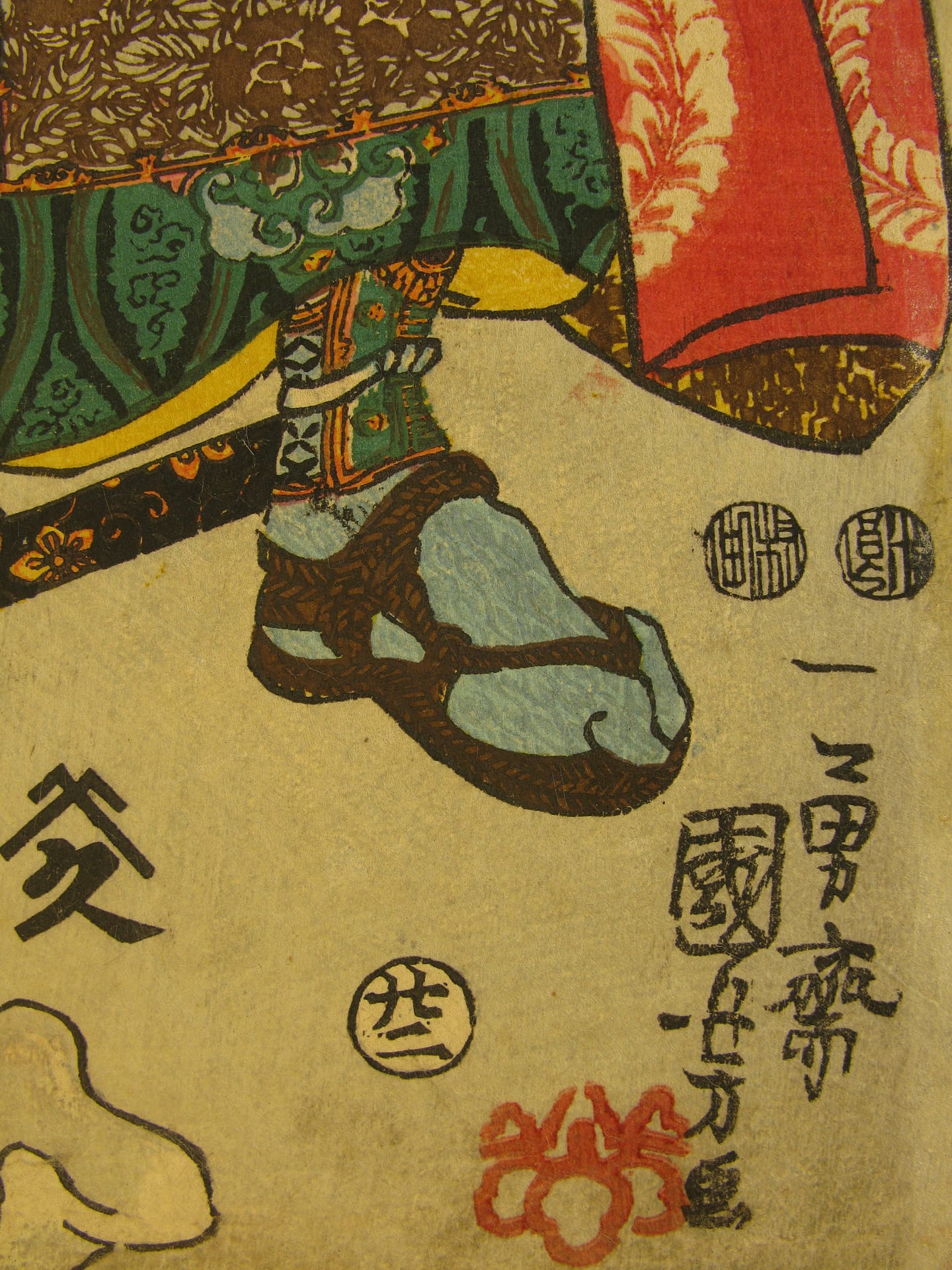
Signature: Ichiyusai Kuniyoshi ga and kiri seal
Date: 1846-1847
Cens: Mera, Murata
Publisher: Yamamoto-ya Heikichi
Size: Oban tate-e, 36.2 x 26.7 cm
Condition: Good impression, colour and condition. Some marks and soiling. Ex B. W. Robinson collection. Numbered
Price: TBC
References: Robinson S62.22;
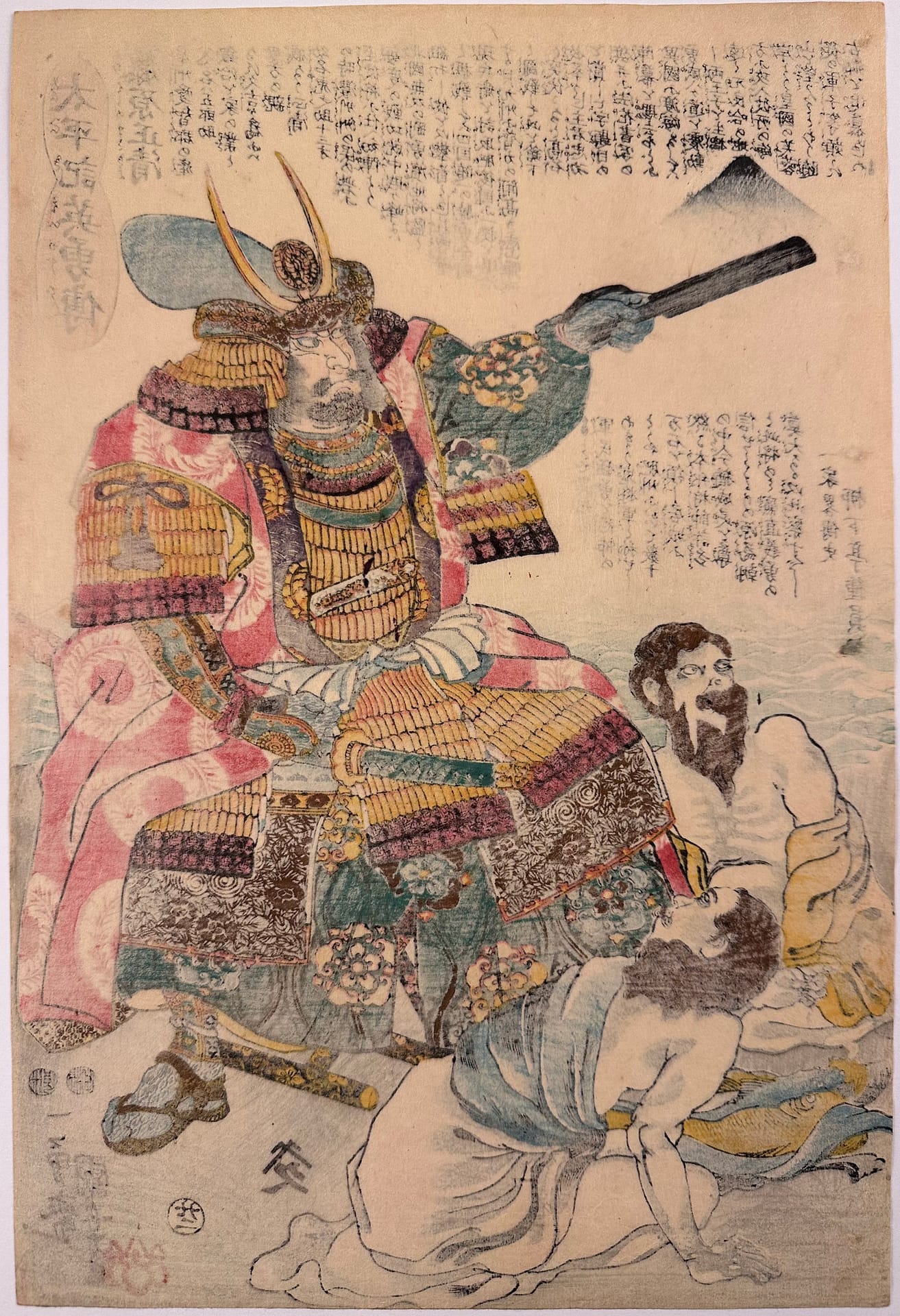
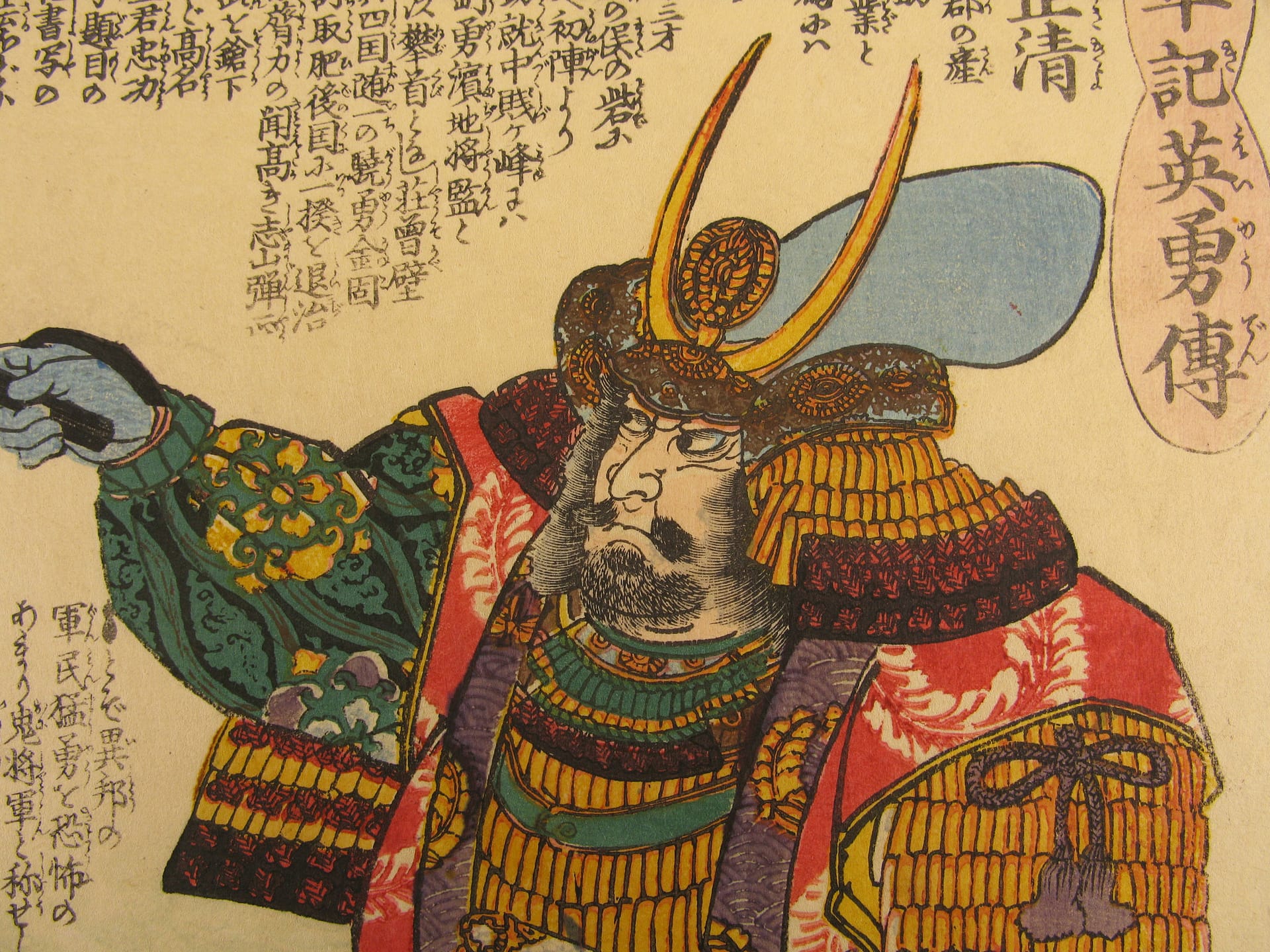
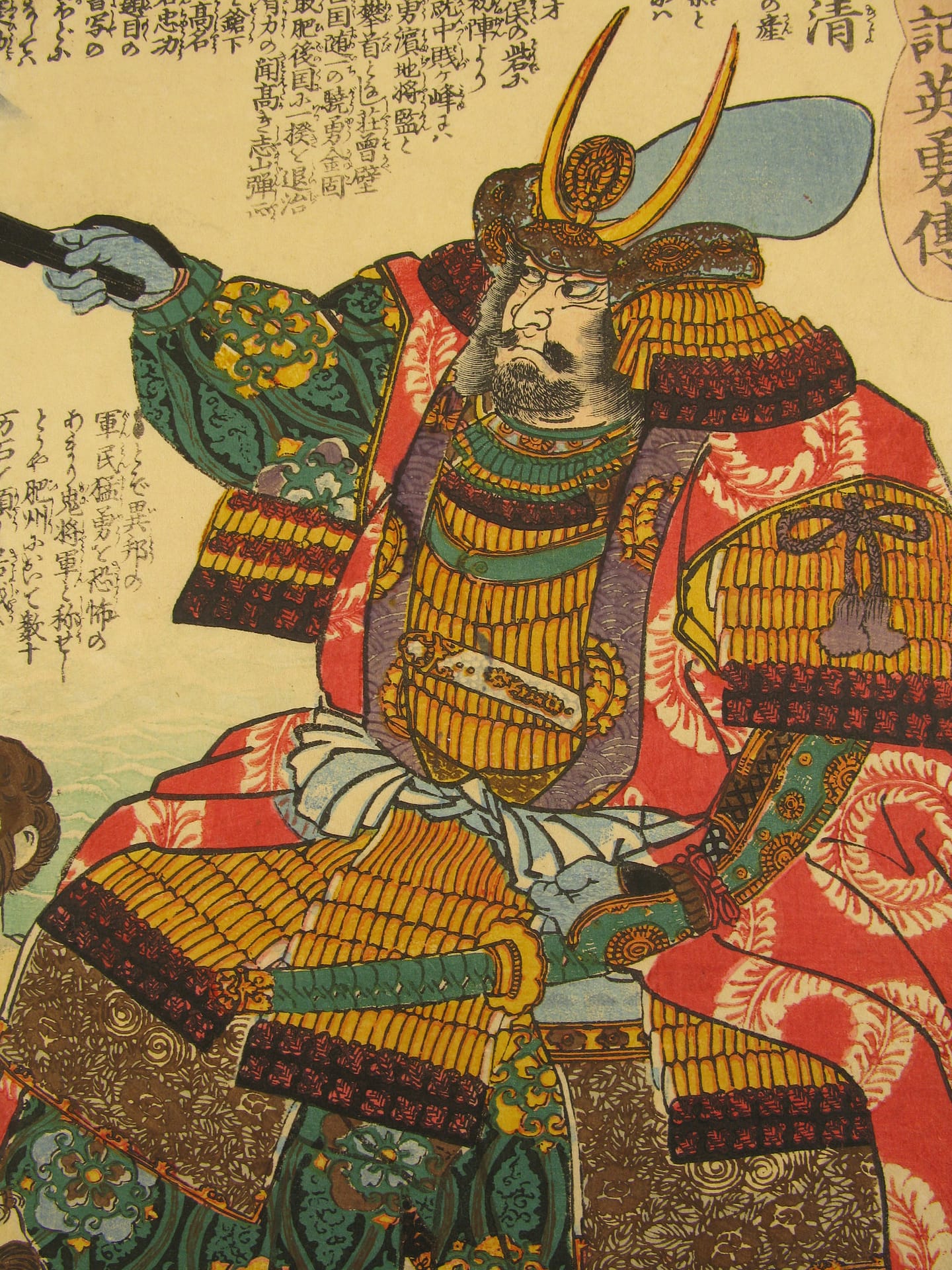
The tale of the print – Fujiwara no Masakiyo (藤原正清), the blacksmith’s kid who became a battlefield supernova, terrified Korea, and made Mount Fuji appear out of sheer homesickness.
Fujiwara no Masakiyo did not start life as a noble warrior. He was born in Aichi, in Owari Province, to a family of blacksmiths — people who made swords, not people who were supposed to swing them at terrifying speeds. But Masakiyo had talent, ambition, and a family connection to Hisayoshi on his mother’s side, which is Edo‑period shorthand for “this kid is going places.”
As a child he was called Toranosuke, and at thirteen he marched into Sunomata Castle to serve Toyotomi Hideyoshi. Most thirteen‑year‑olds are still figuring out how to carry a bucket of water without spilling it. Toranosuke was figuring out how to decapitate enemy champions.
From his very first battle, he racked up achievements like he was collecting trading cards. But his breakout performance came at the Battle of Shizugamine, where he: fought the legendary Hamaji Shōgen, grabbed him, and cut off his head like it was the most natural thing in the world.
He then fought Shōsokabe, killed Kaneko Genpee (the bravest man in Shikoku), crushed a revolt in Higo, and on Kyūshū knocked down the famously strong Shiyama Danjō with a single spear thrust before taking his head too.
At this point, Masakiyo’s résumé was so long it needed its own horse to carry it. Hideyoshi rewarded him with: a banner inscribed with a seven‑character prayer, a camp curtain covered in Lotus Sutra text, which is basically the medieval Japanese version of getting both a medal and a motivational poster.
Then Masakiyo crossed the sea to Korea, where his reputation exploded. He captured two Korean princes, marched deep into Orangi, and from the coastline gazed longingly toward home — claiming he could see Mount Fuji in the distance. (He absolutely could not. But homesickness gives a man vision.)
The locals, understandably alarmed by a man who collected heads like seashells, called him the “devil‑general.” Masakiyo took it as a compliment.
He eventually ruled a domain in Higo worth 100,000 koku, lived in his castle, and died there — still revered as one of Japan’s great commanders. The chroniclers insist that only Minamoto no Tametomo could match him in loyalty, bravery, and sheer “I can’t believe he just did that” energy.
And honestly? They’re not wrong.
For an excellent analysis of the prints and series, I would encourage you to get the book:Heroes of the grand pacification Kuniyoshji’s Taiheiki eiyu den by Elena Varshavskaya.