Mountain mist
Title/text: Mitate hakkei (美盾八競 ) – seiran, (晴嵐).
Note: this has also been referred to as ‘Glorious sunset’ however, I believe it is better translated as ‘Mountain mist (in clear weather)’, it describes the mist or haze that forms on mountains during clear weather after a storm. Most likely a parody on ‘Clearing Weather’ – the sprays of water from the huge mill wheel alluding to the sprays of mist of vapour – and of course the bathhouse mists and vapour and Musashi’s escape – getting clear of the danger .. it all fits very nicely.
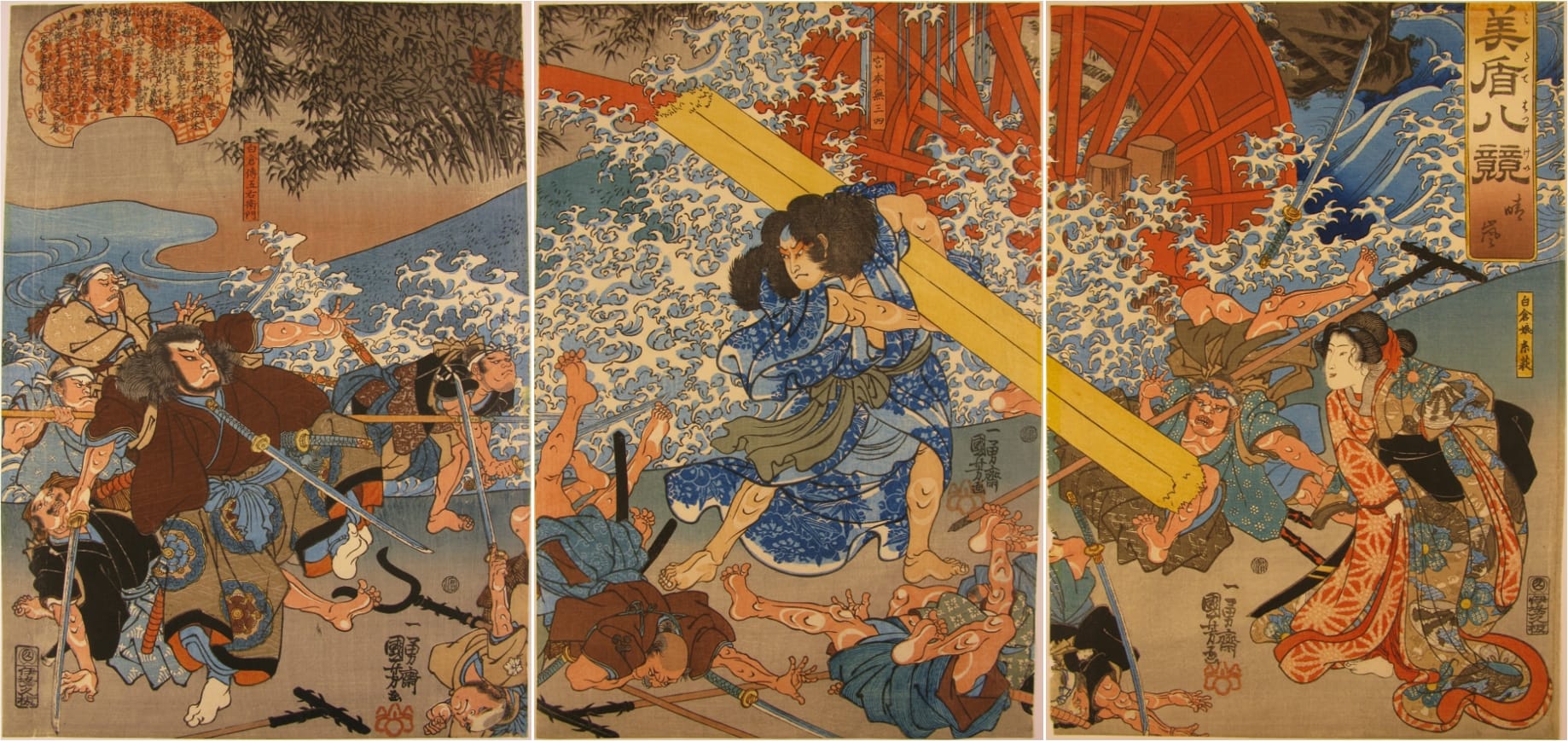
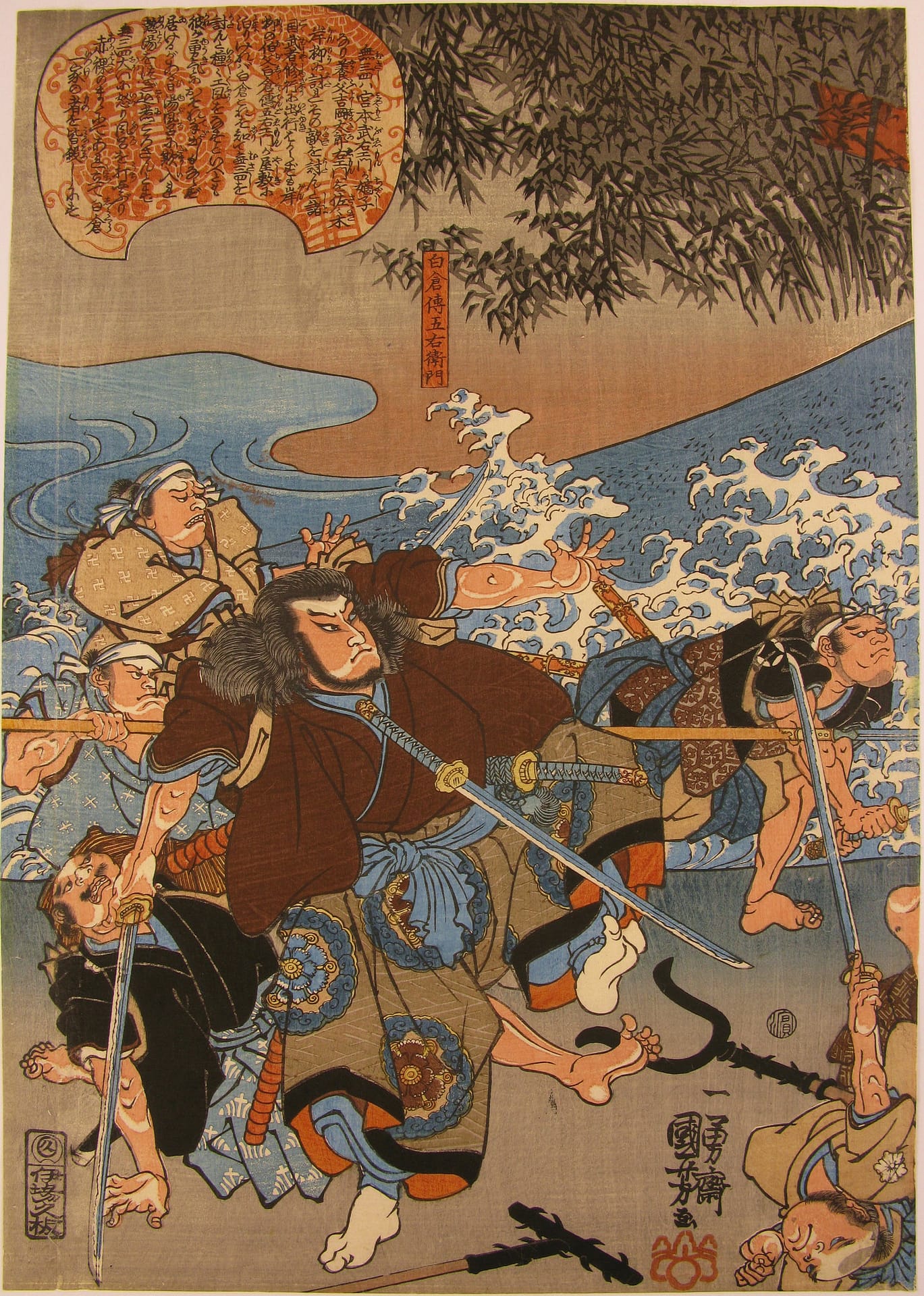
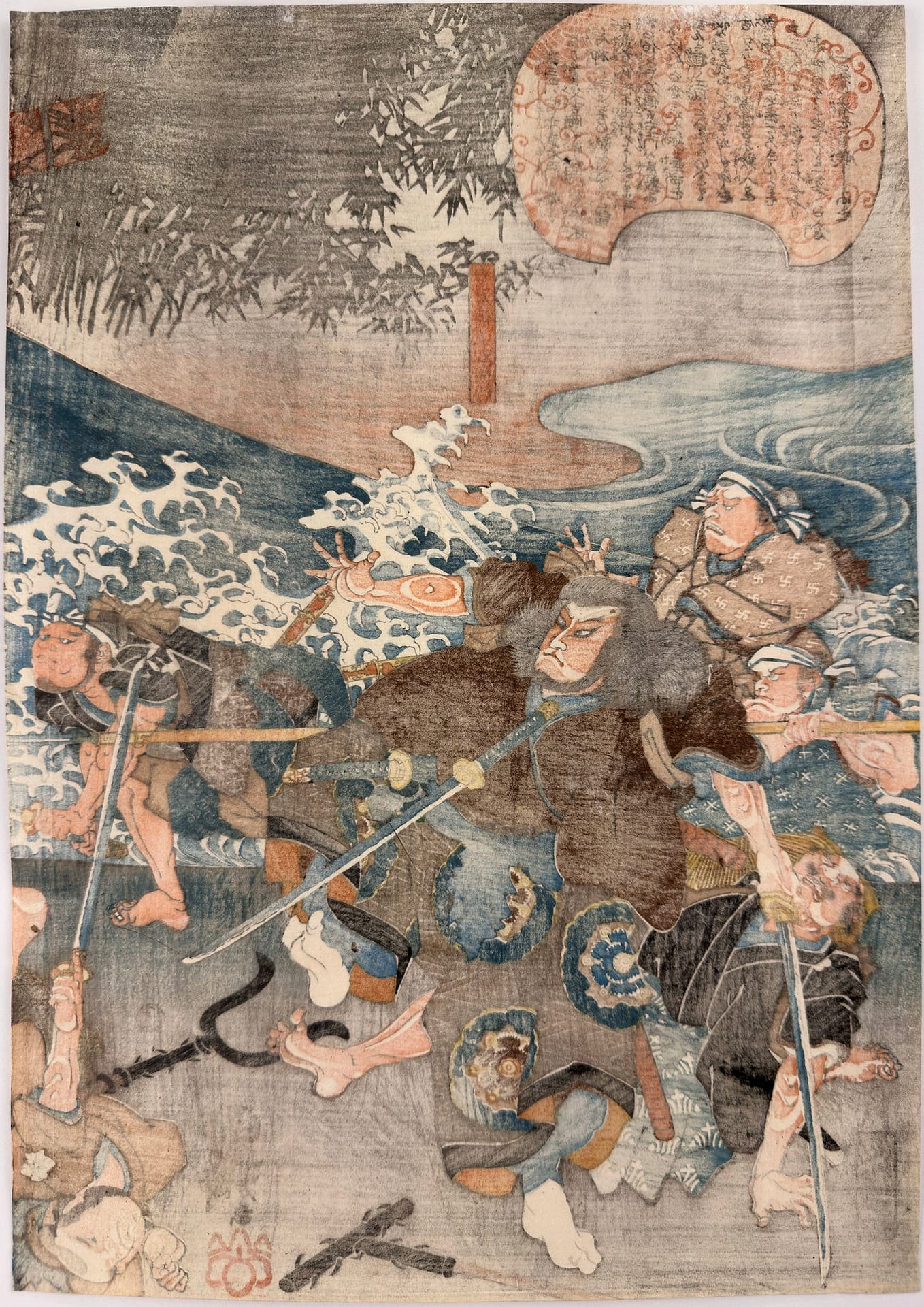
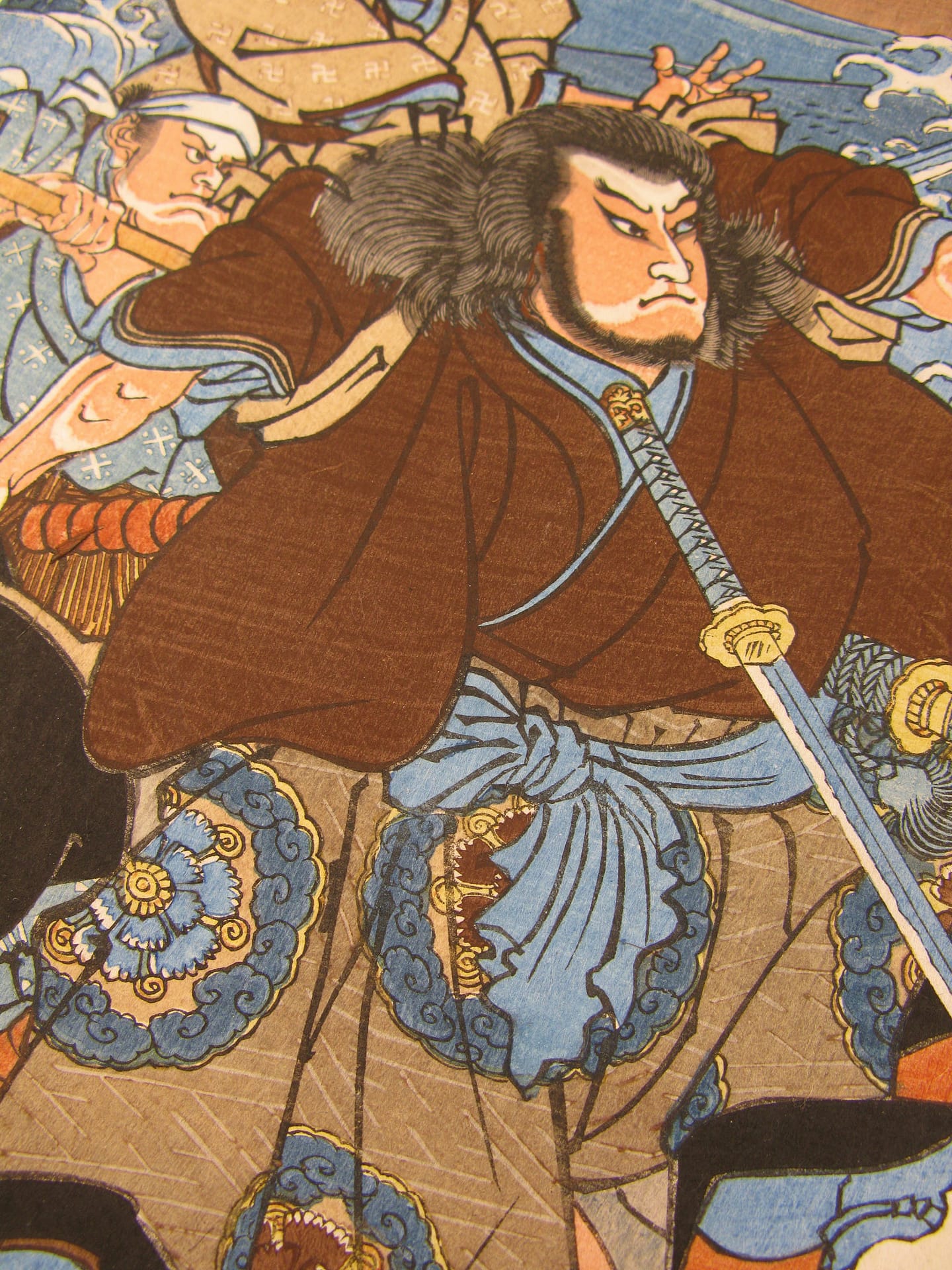
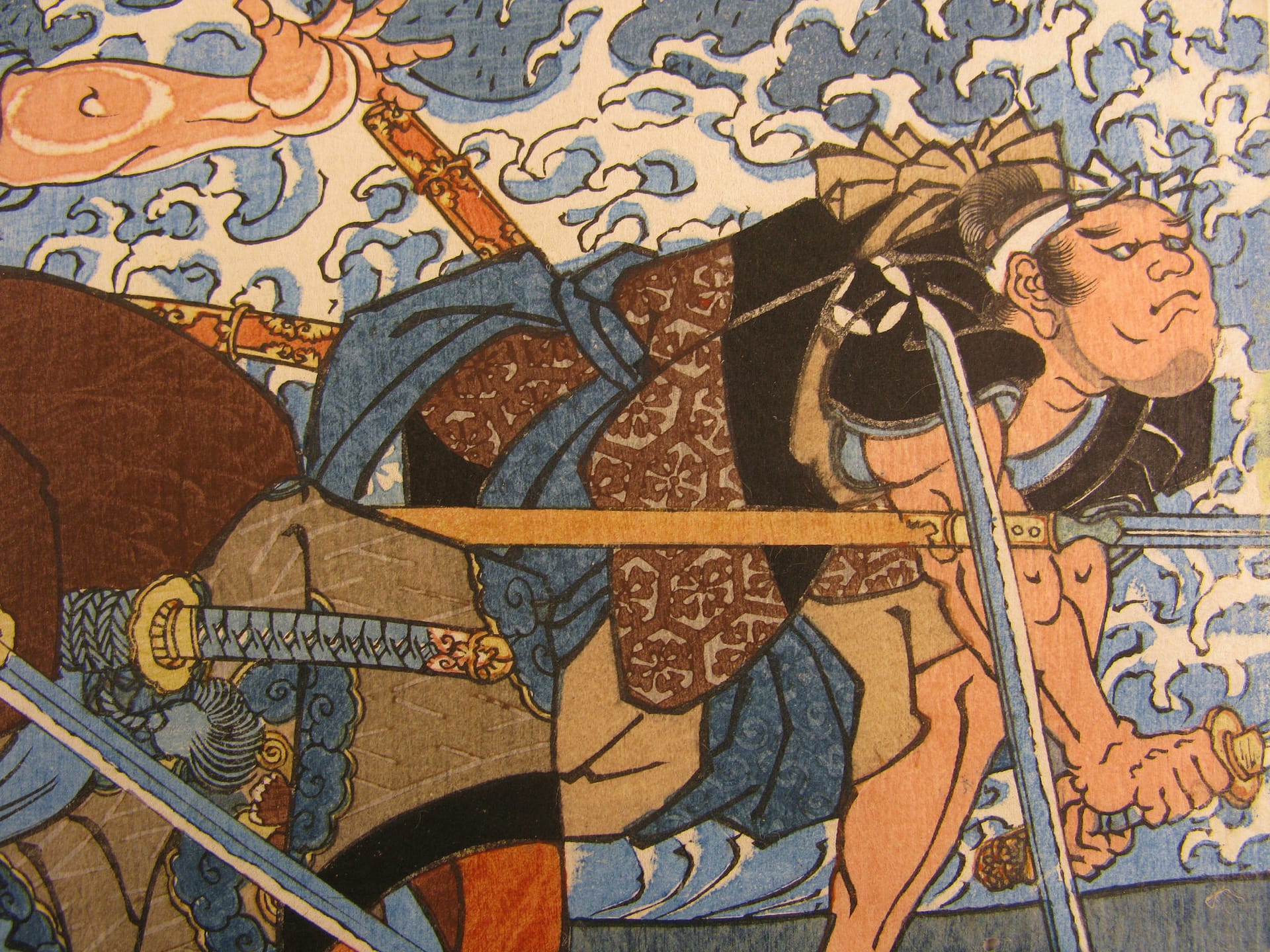
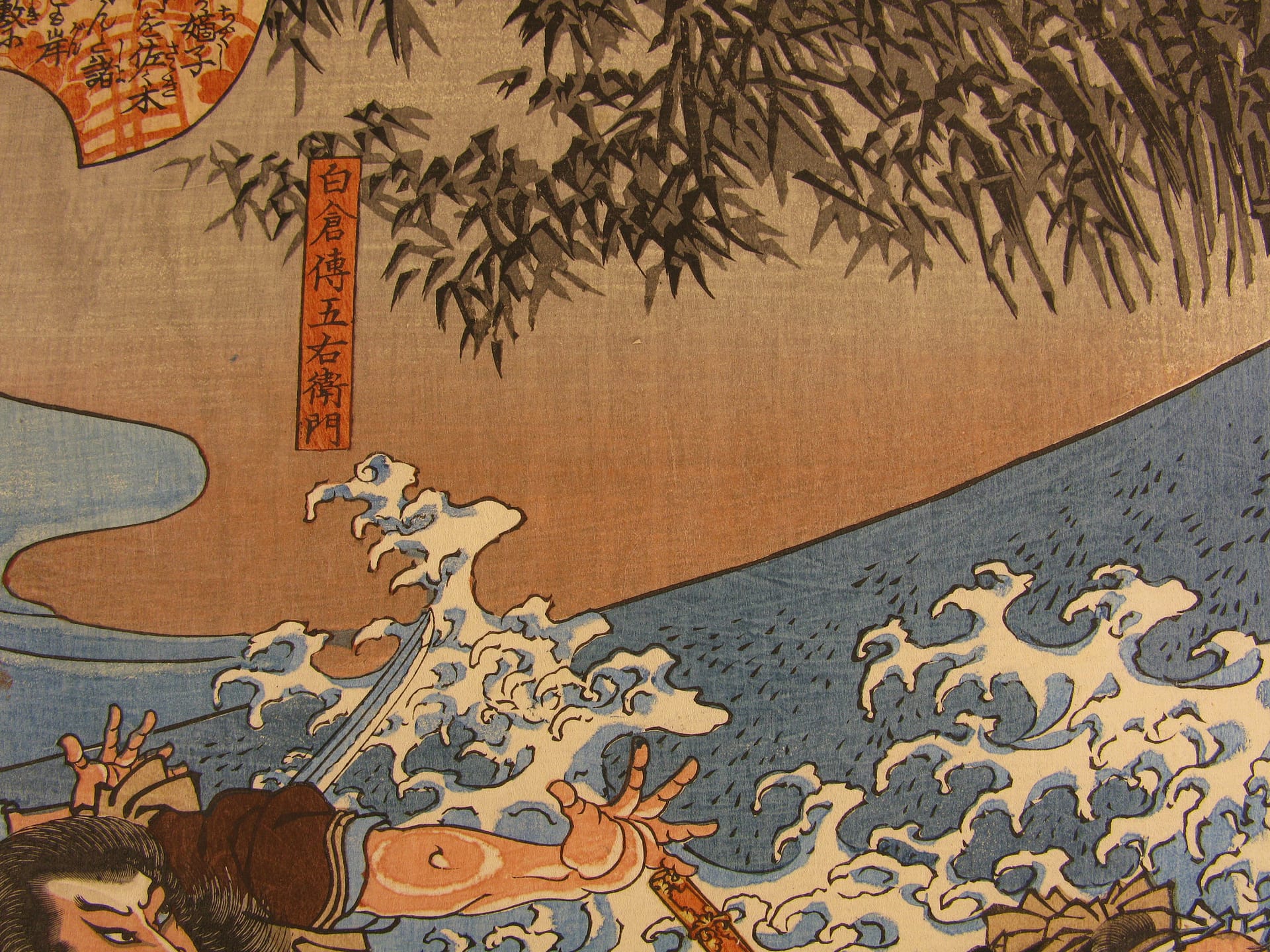
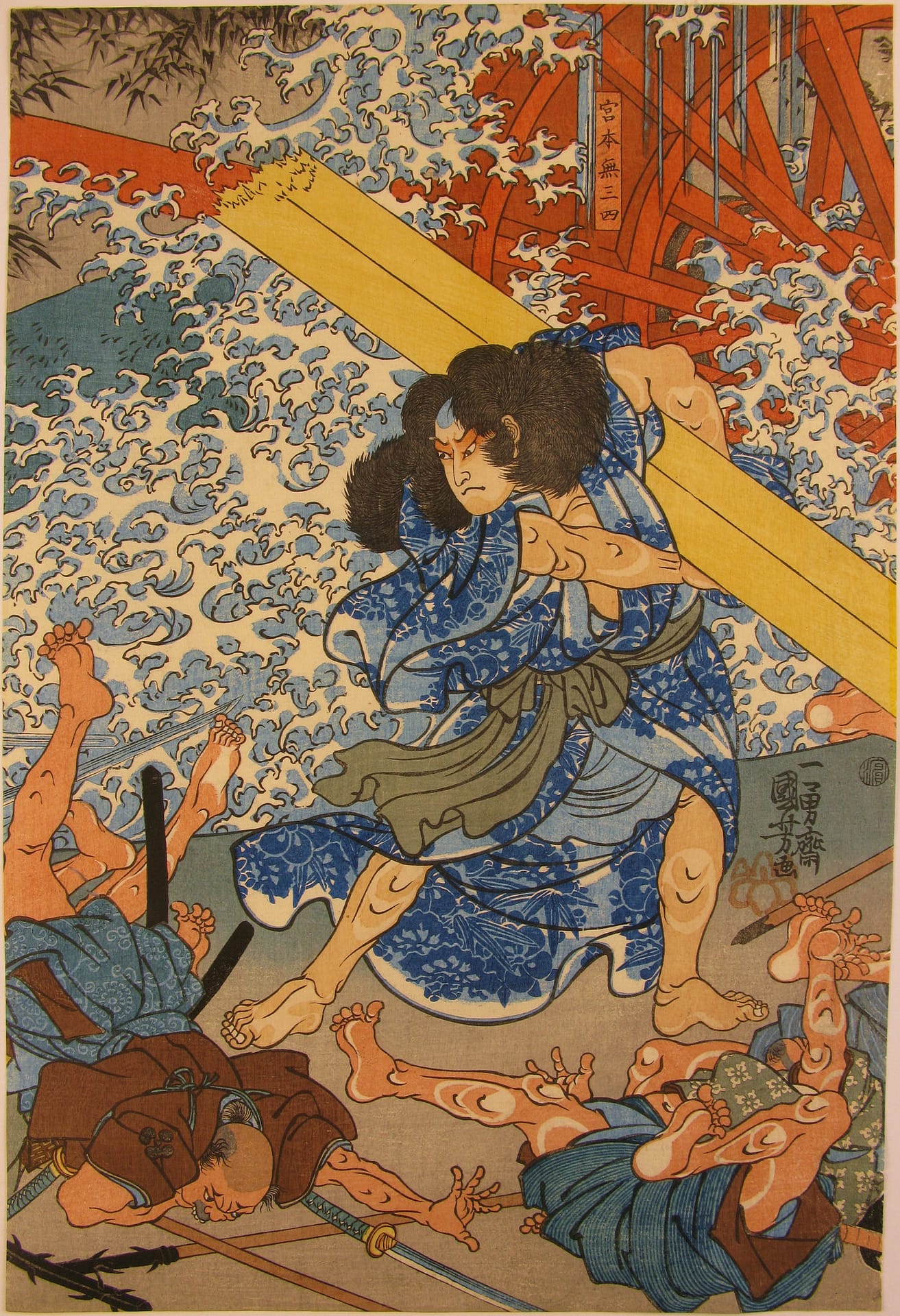
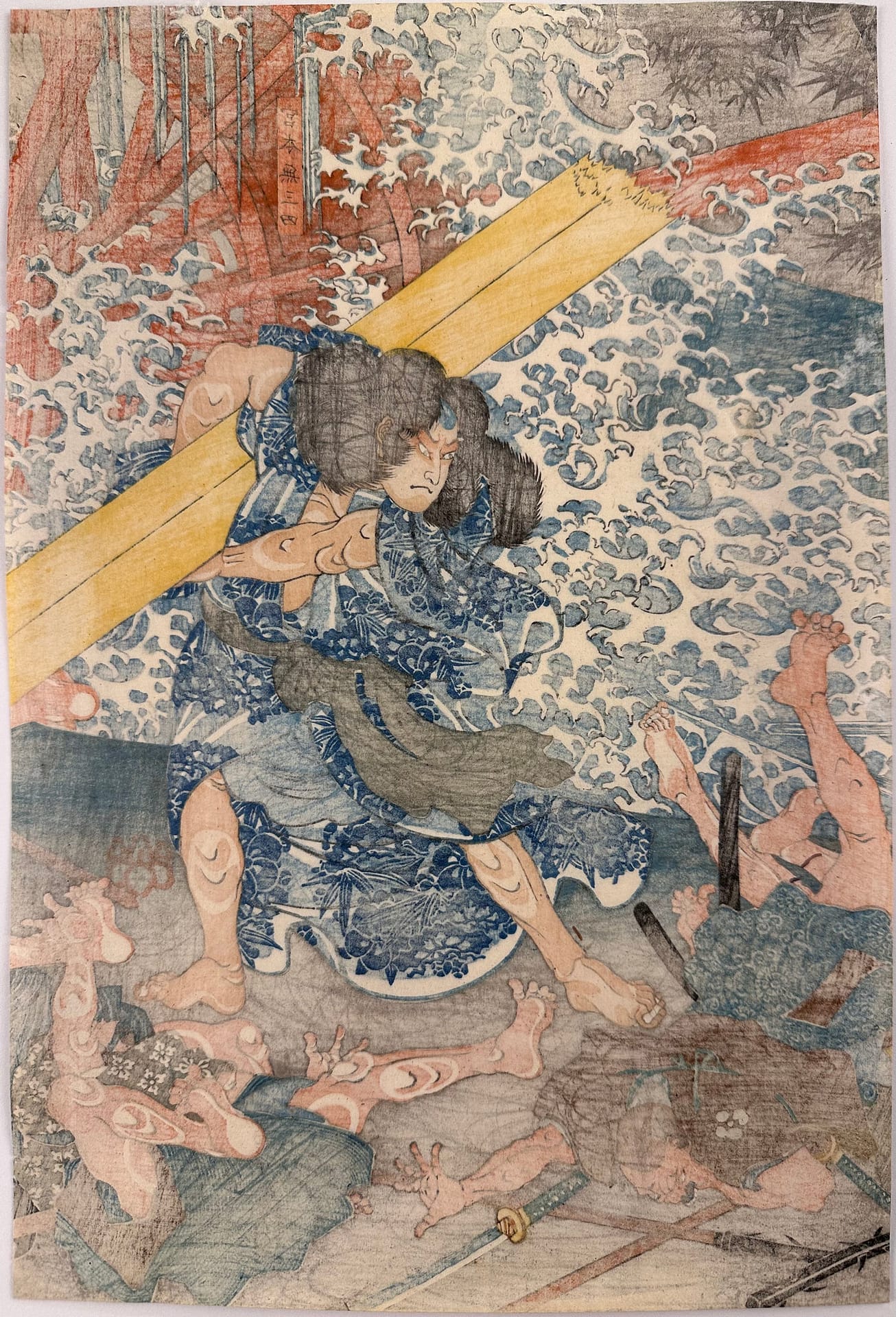
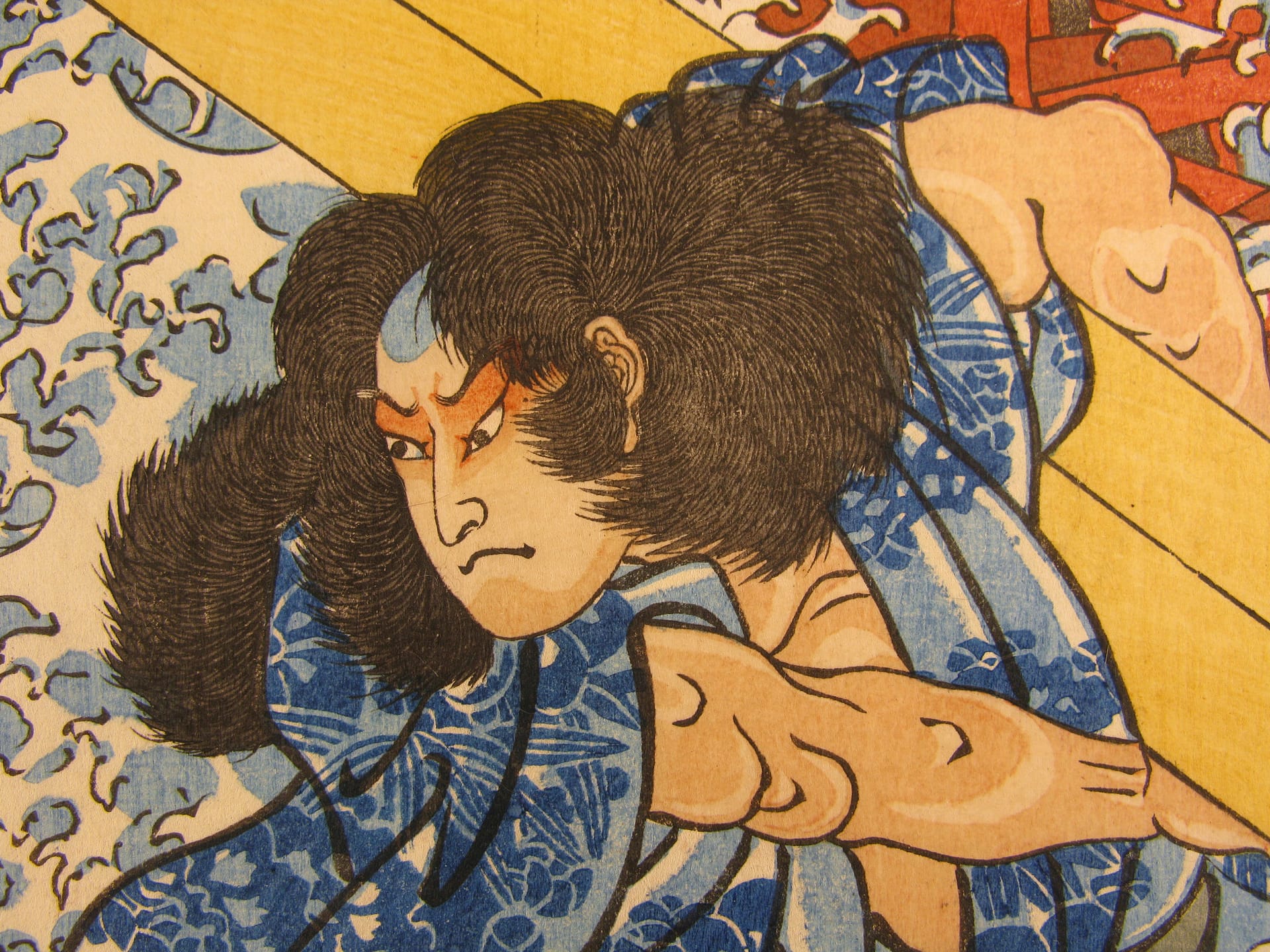
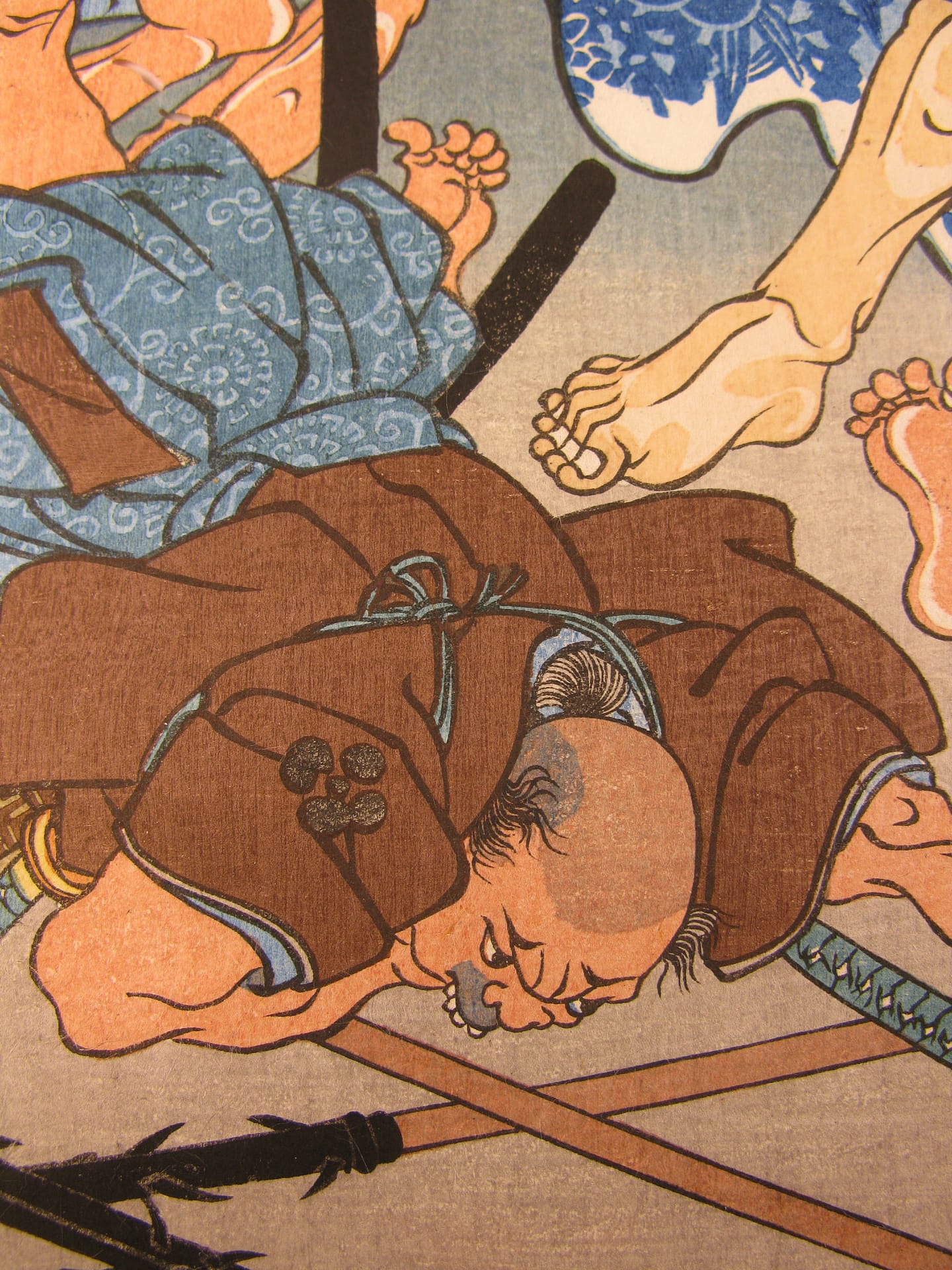
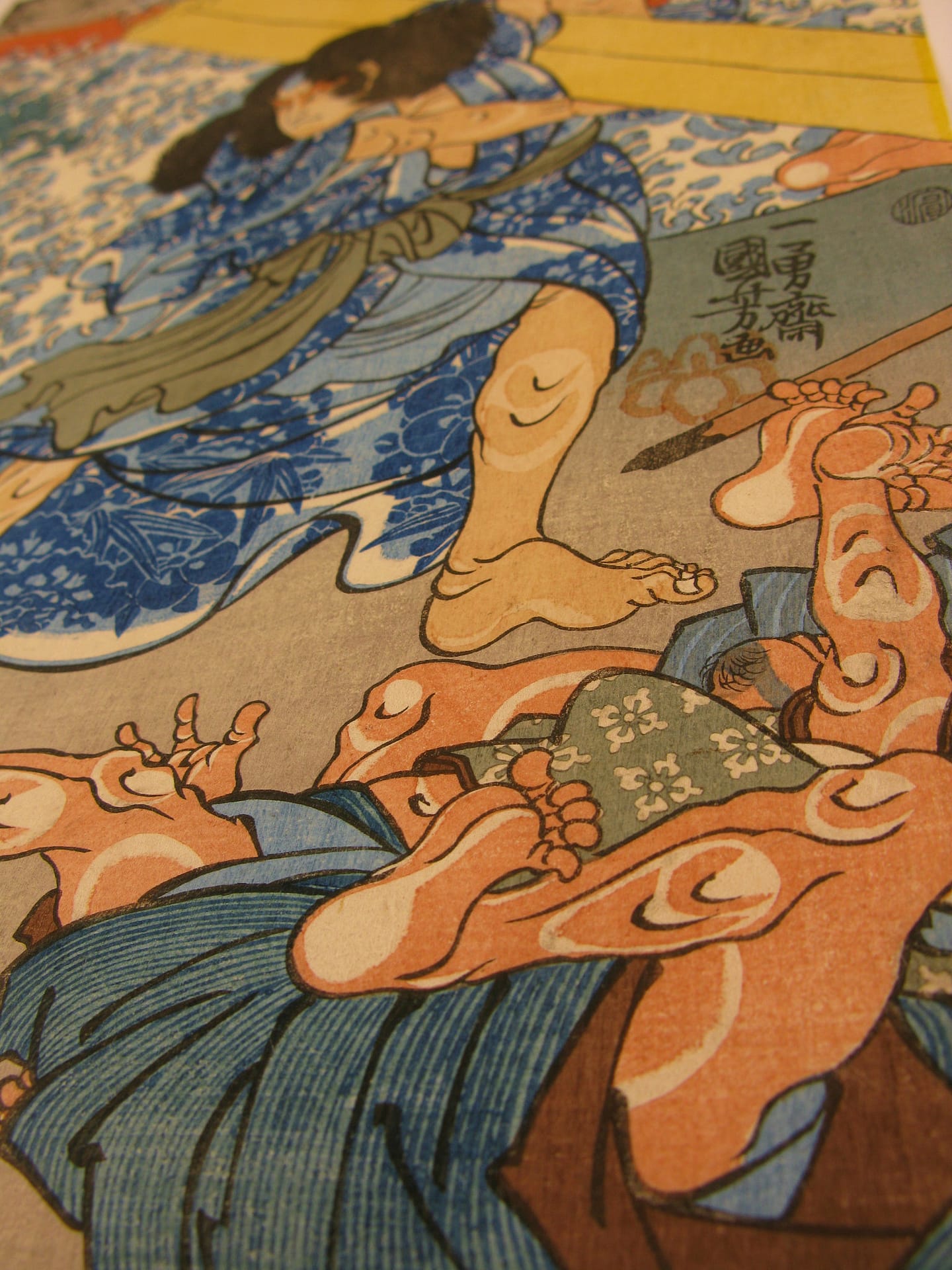
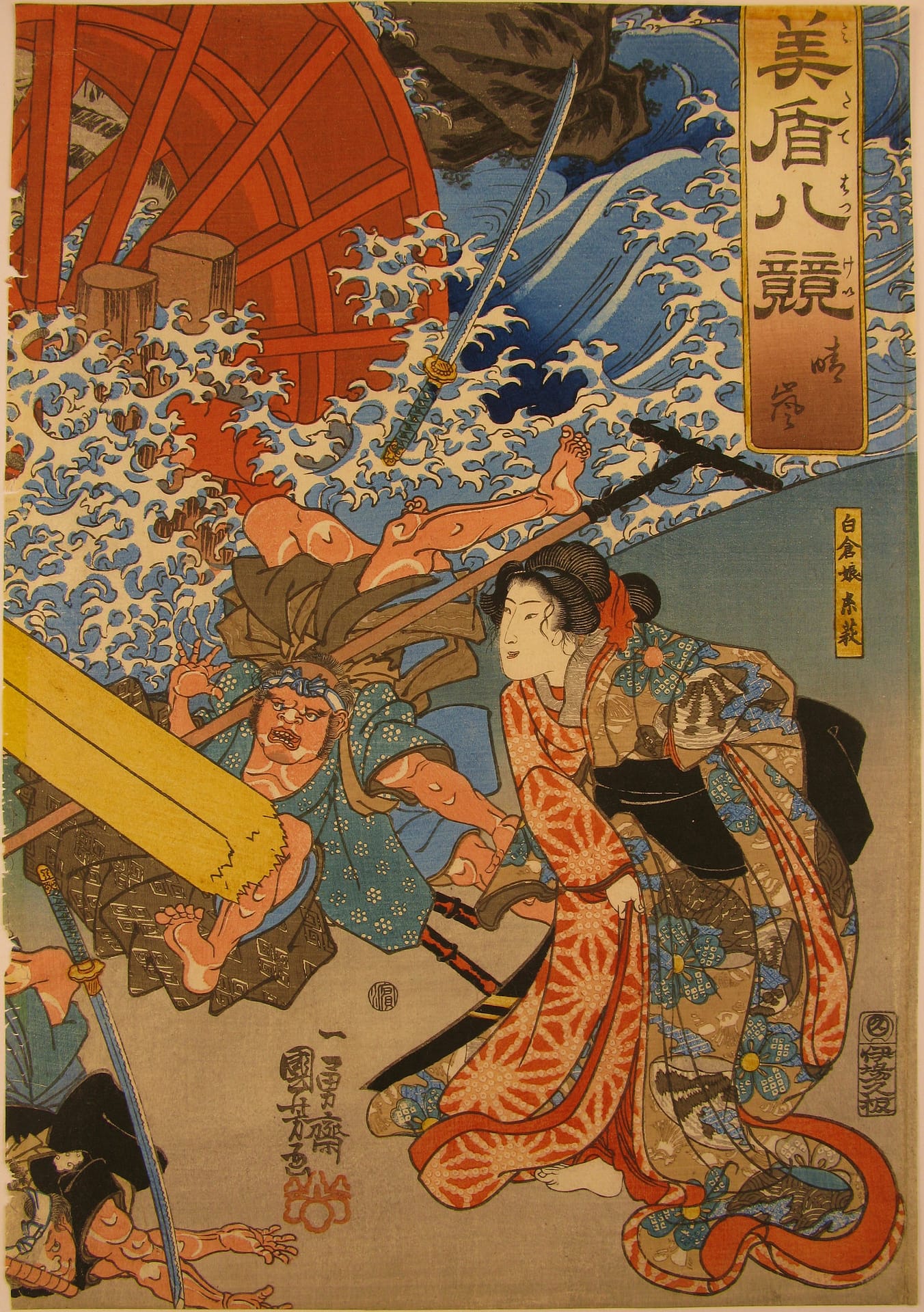
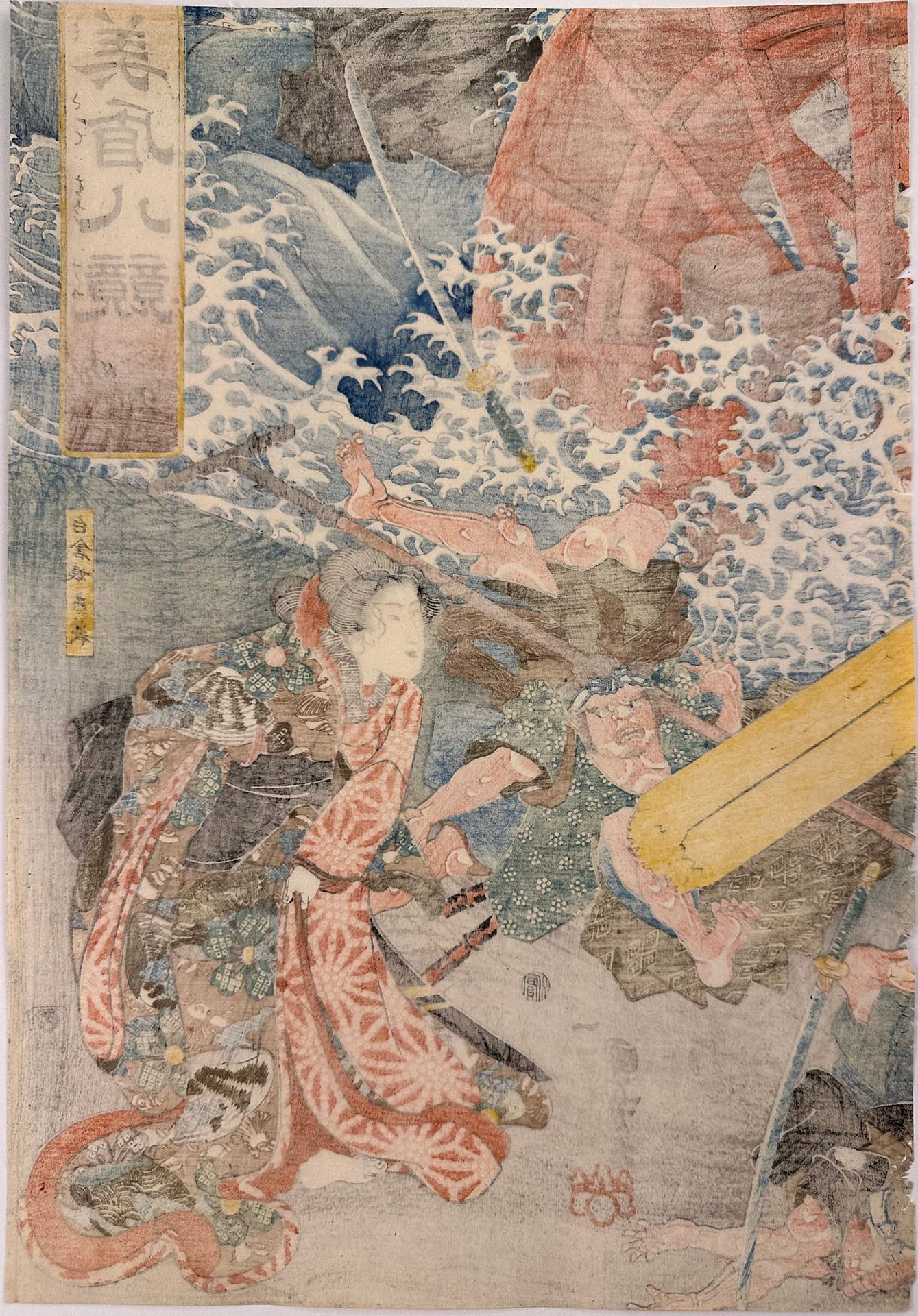
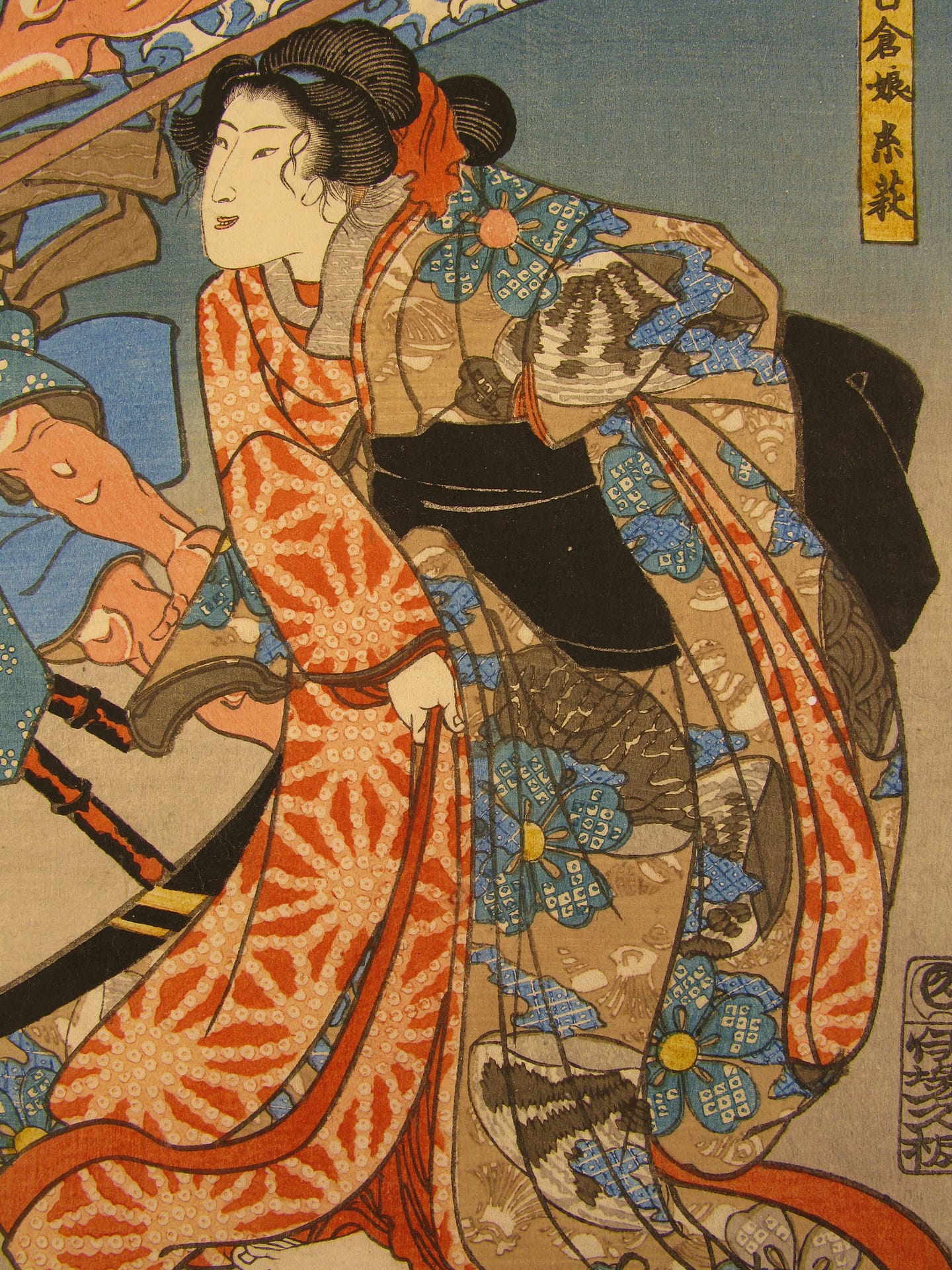
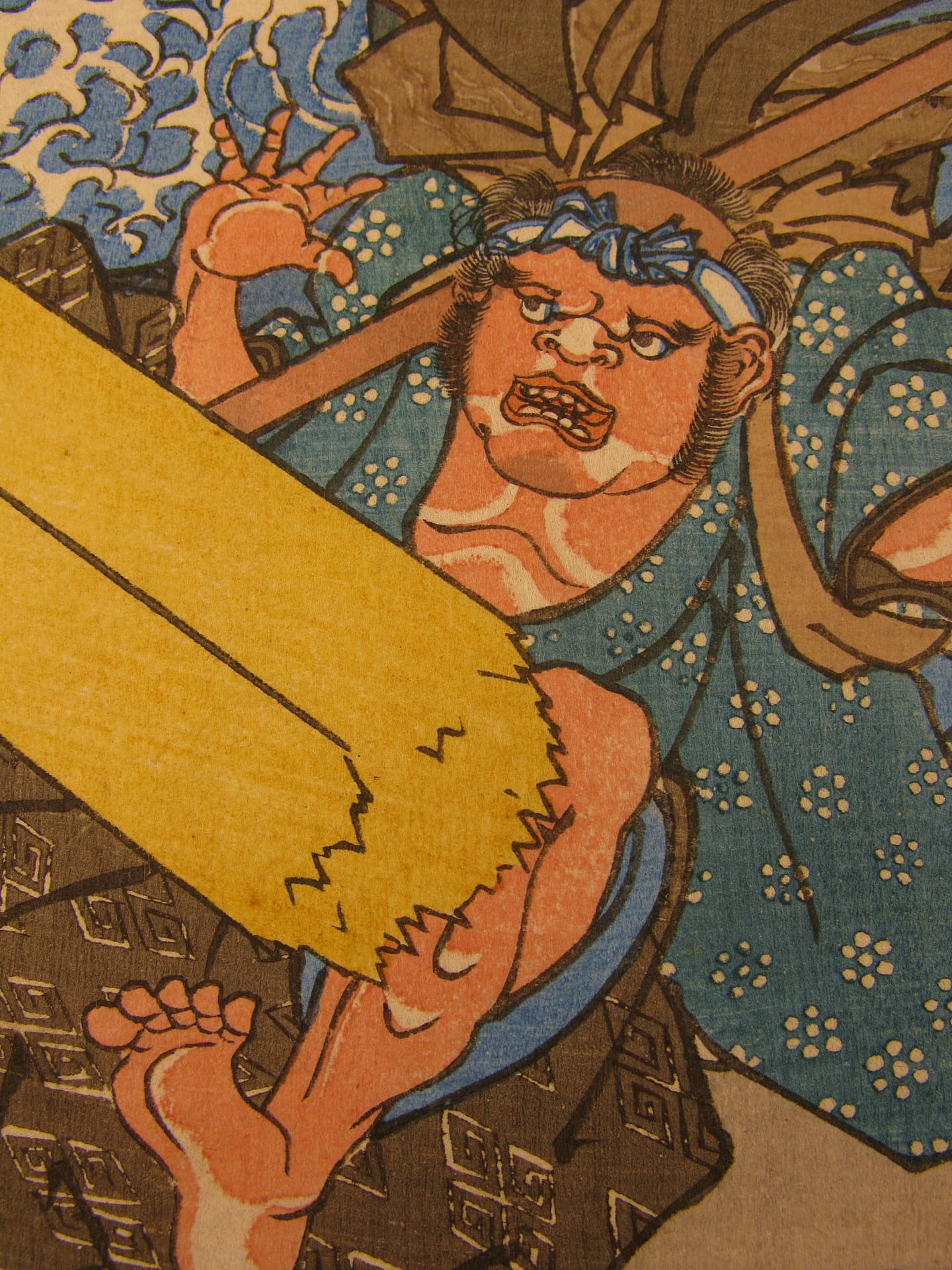
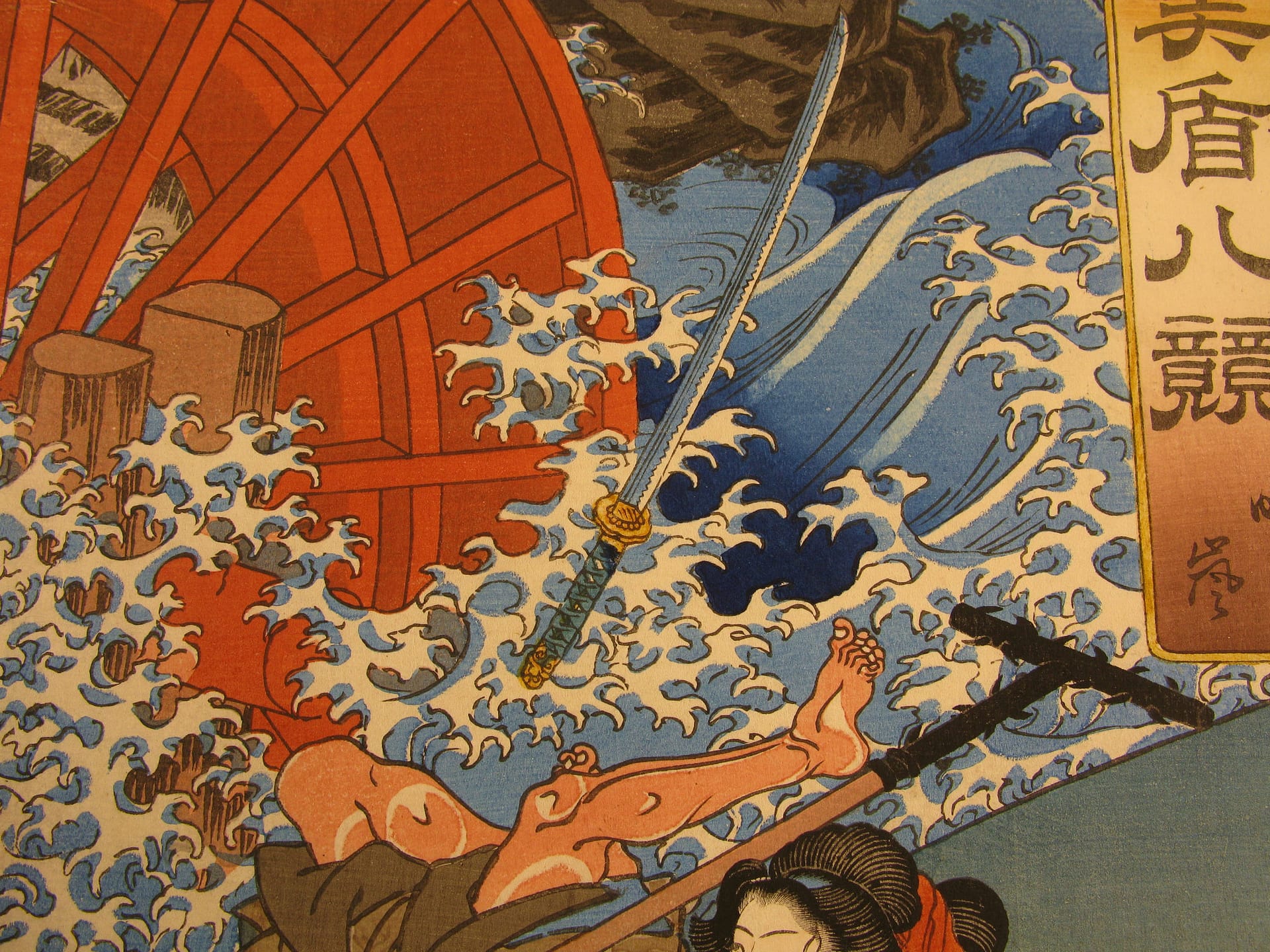
Description: The legendary swordsman Miyamoto Musashi (宮本 武蔵) battling Shirakura Dengoemon and his henchmen with a huge beam. Dengoemon’s daughter Itohagi aids Musashi, with whom she has fallen in love.
Artist: Utagawa Kuniyoshi (1797 – 1861)
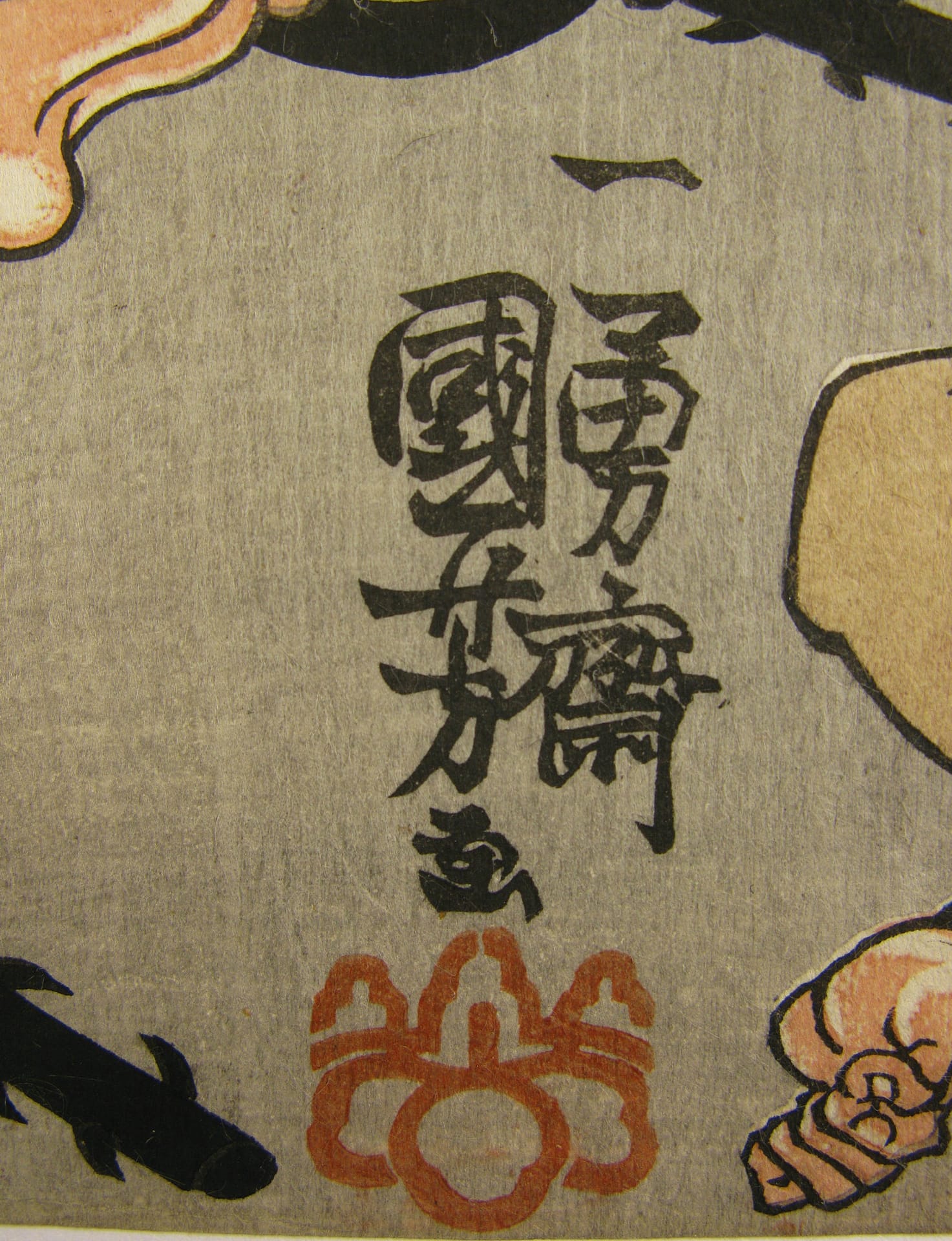
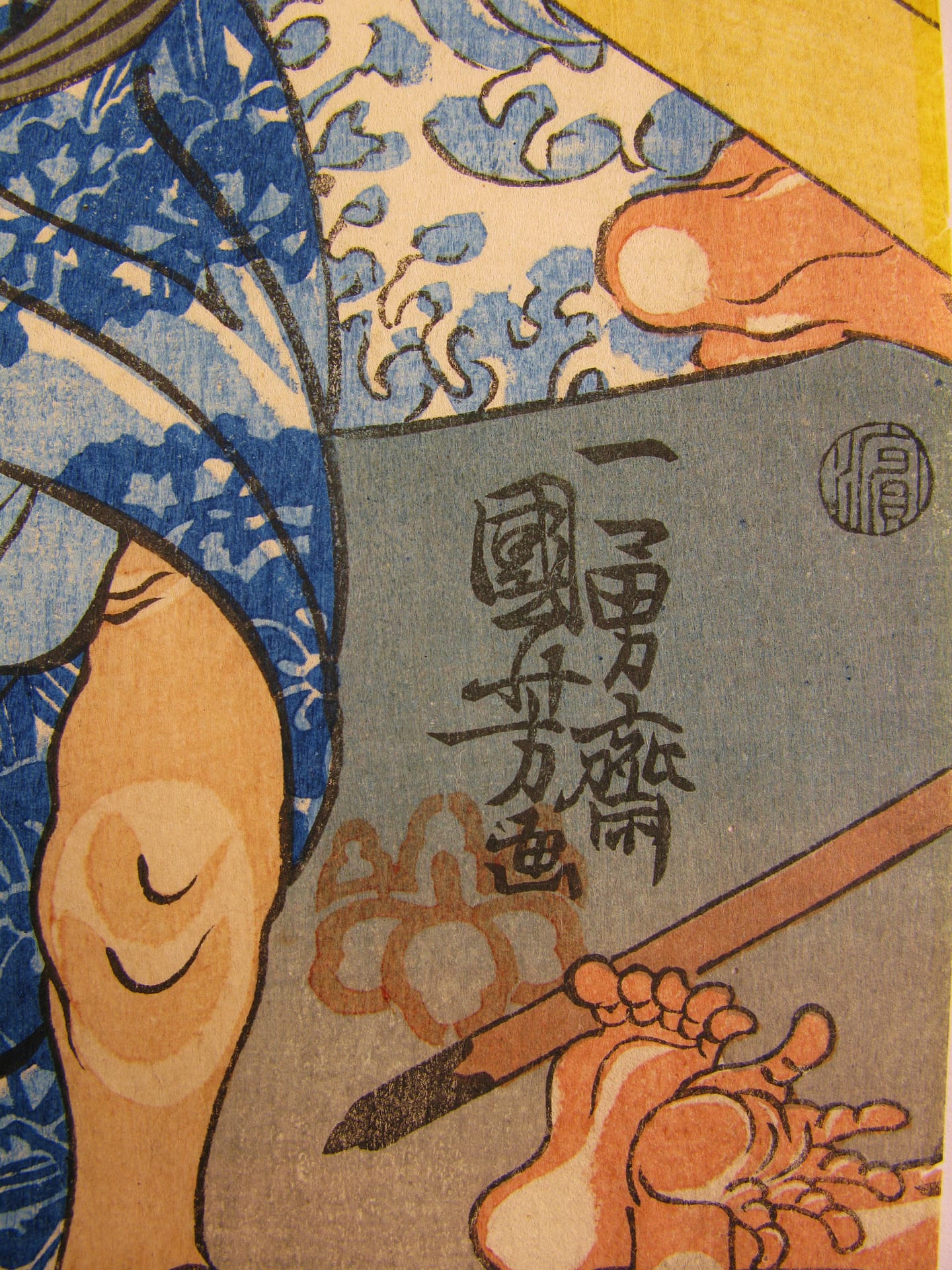
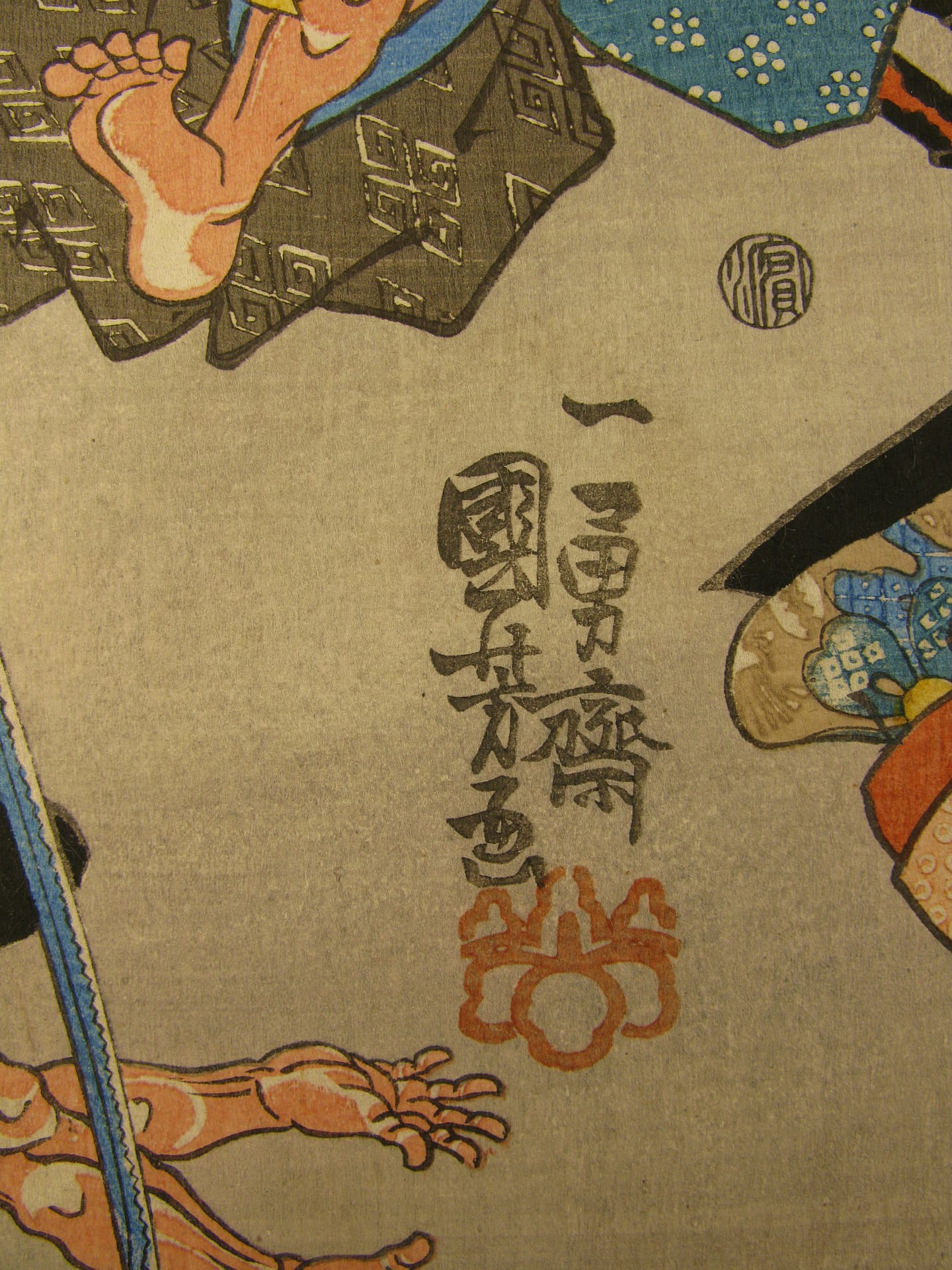
Signature: Signed on all three sheets Ichiyusai Kuniyoshi ga (一勇斎 國芳 画)
Date: 1846
Publisher: Iba-ya Kyûbei
Robinson: T176
Condition: Very good impression with nicely applied bokshi and wood grain. Good condition, and colours – some fading. Some trimming to each sheet. A beautiful and dynamic print.
Price: TBC
Tale of the text: with a little twist
The (fictional) tale begins with Miyamoto Musashi, Japan’s most overachieving swordsman, who was supposedly on an island chasing an enemy when he decided to moonlight as a kenjutsu (剣術) instructor.
He joined a school run by Shirakura Dengoemon, a man whose ego was so fragile it could have been carved from tofu.
At first, Dengoemon pretended to admire Musashi. But deep down he was thinking: “How dare this wandering ronin be better at my job than I am.” So he devised a plan that can only be described as cartoonishly villainous.
Dengoemon invited Musashi to drink. And drink. And drink. Musashi, who could normally outfight an army, could not out-drink a determined host. Once Musashi was thoroughly marinated in sake, Dengoemon stole his swords, dragged him into a bathhouse, locked the doors (with said swords), and prepared to boil him alive.
Because nothing says “I’m threatened by your talent” like attempted slow‑cooking.
Musashi regained consciousness in a room so hot it could have steamed dumplings. Realizing he was about to become Ronin soup, he did what any legendary warrior would do: He punched through the bathhouse wall. Not with a sword. Not with a plan. With raw, unfiltered Musashi strength. He ripped a massive wooden beam from the collapsing structure and staggered out, steaming like a freshly boiled lobster.
Outside, Dengoemon and his goons waited, expecting a weakened, unarmed victim. Instead, they got: Musashi furious, and wielding a giant broken beam like a divine punishment stick.
He swung it like a battering ram, flattening henchmen left and right. Dengoemon tried to rally his men, but Musashi was in full “I woke up in a burning bathhouse and I am NOT in the mood” mode.
The fight ended with Musashi smashing Dengoemon into the afterlife.
In the extended kabuki‑style versions, Dengoemon’s daughter Itohagi takes one look at Musashi — drenched, steaming, holding a beam like a heroic lumberjack — and immediately falls in love. She helps him escape, proving that even in a story full of betrayal, arson, and improvised weaponry, there’s always room for romance.