47 ronin prints research
Anatomy of the woodblock print
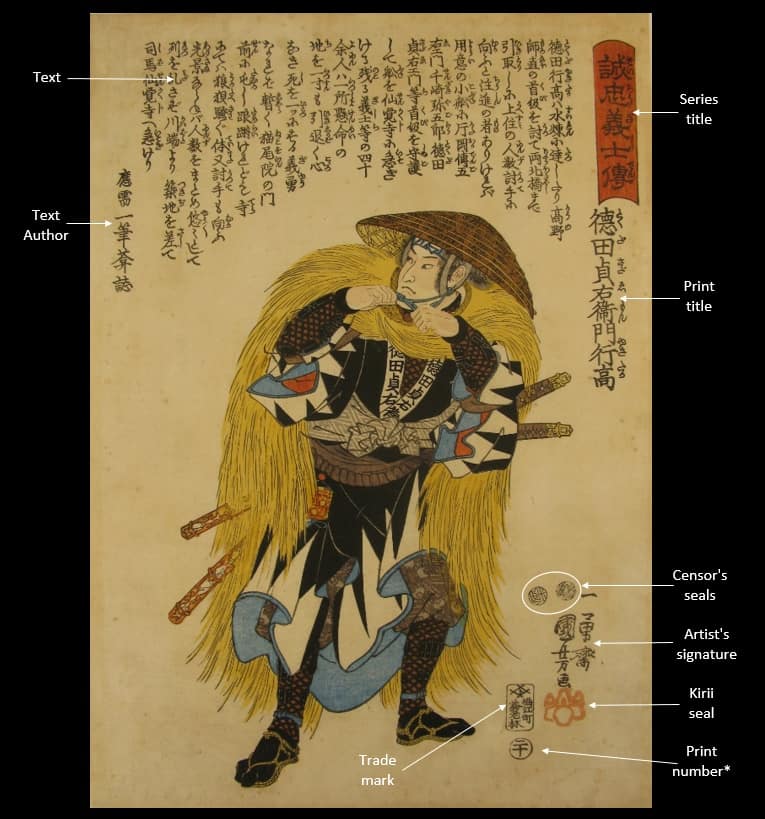
Text: In about 1843 -44, Kuniyoshi established a set form for his historical biographies which served him well for the next 10 years or so. A full length figure in action on a plain background, with the upper part of the print occupied by a biographical or descriptive text.
Series title: On each print the series title Seichu gishi den appears in an oblong red cartouche. Print no 1.38 has no okori ‘origin of’ added to the title (Seichu gishi den no okori ). Print 1.39 can come with or without ‘no okori ‘ added.
Print title: Appears below or beside the caratouche with the name of the figure illustrated.
Text author: The name of the text author ‘by brush of Ippitsu – an’ appears to the left of the text in most prints.
Artist’s signature: Ichiyusai Kuniyoshi ga (ga means artist) appears on the mid to lower half of each print on either the right or left.
Artist’s seal: Kuniyoshi used a Kiri seal, a variation of the leaf of the Paulowina imperialis (kiri) tree appearing on the Japanese imperial crest, as his personal badge and that of his school for a while. These changed throughout his career.
Censors’ seals: During the period of this series, two censors seals were required to approve the image. These usually display above or beside the artist’s signature.
Publisher’s seal: The trade mark and name of the publisher Ebiya Rinnosuke (1832-1895) appears in a small rectangular cartouche. Some prints only display the trade mark lozenge.
Print number: Usually displays below the publishers seal. Some prints within this series appear in numbered and un-numbered states, there are conflicting views as to which is the earliest. You can read more on numbered vs un-numbered – and what I believe came first here.
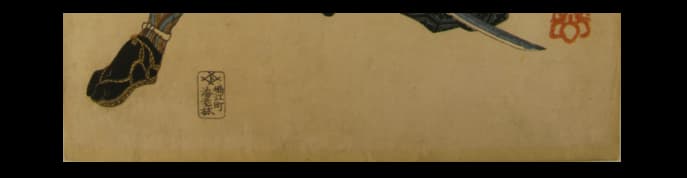
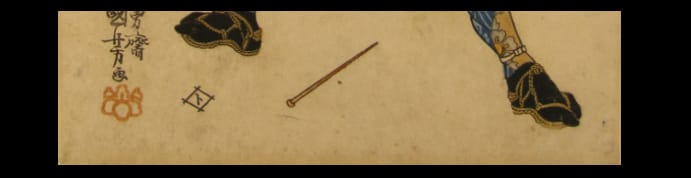
I have seen prints from 1832 through to 1854 using just the publishers lozenge, so this doesn’t help date the numbered vs un-numbers versions.
Censor seals
During the period 1842 – 1853 individual censors called Nanushi marked prints with their individual seals. During the period 1842 – 1846 these were found singly. From 1847 – 1853, the Nanushi marked prints in pairs.
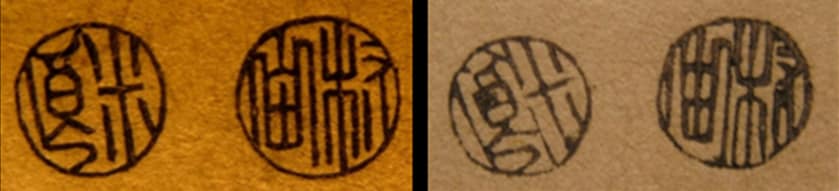
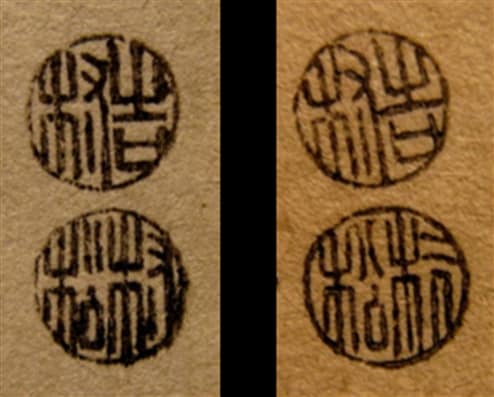
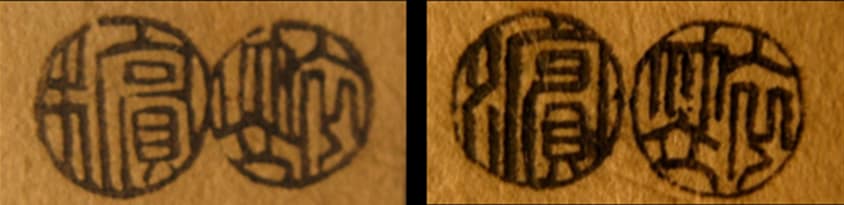
As censors worked together during different periods the combinations of censors can be dated. This series was produced during the months August 1847 – January 1848, as such the following censors’ seals will be found in combination:
* Mera – Murata
* Yoshimura – Muramatsu
* Hama – Kinugasa
Below are close ups (two versions of each) of the seals: