Collection of fine woodblock prints
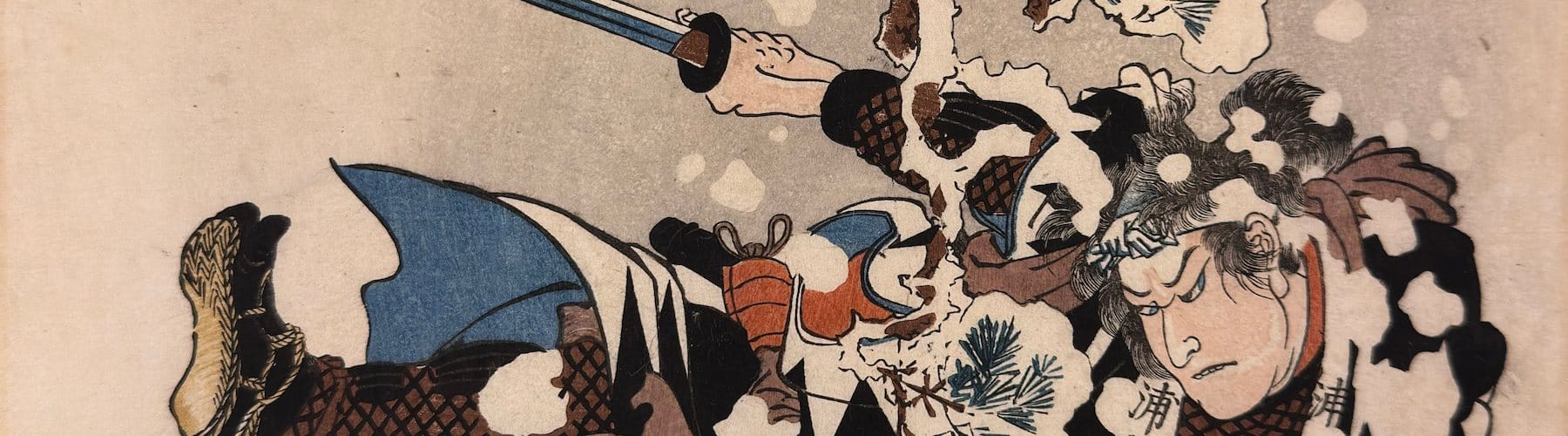
The prints on this site have been collected over the last 26 years or so. My first print was a print from the Seichu gishi den series by Kuniyoshi and I have been in love with Kuniyoshi prints from that point on. I find his style a level above other masters or pupils when it comes to Musha-e and slowly, very slowly, I started pulling together a wish list. To this day many on my ‘list’ have not come onto the market, the condition has not been good enough, or I haven’t been quick enough.
Images: A note on the pictures on this site. I have used a camera to photograph the prints and not a scanner. This creates a slight curvature in the edge lines, (entirely my lack of skills no doubt). Please ignore this artifact, if a print has been trimmed to create this sort of curvature, I will tell you : )
Light box: When you are on a print landing page and click on a print image, a ‘light box’ display will open. This will automatically scroll through the images on that page, this can be paused in the top right hand corner so you can scroll left or right at your leisure.
Explore the collection
- View all prints currently for sale
- View all single sheets
- View all diptychs
- View all triptychs
Explore the collection by series or story
Kuniyioshi (and pupils) prints
- The forty-seven ronin – the loyal and faithful samurai
- Series: The sixty-nine stations of the Kisokaido
- Series: Heroes of the grand pacification
- Series: Selection for 8 views
- Series: Stories of our country’s swordsmanship
- Series: A hundred heroes of high renown
- Series: Comparisons of Genji
- The tale of Togo’s ghost
- The tale of Yoshitsune
- The tale of the Soga brothers
- Goddess of Mount Fuji
- The fall of the Kusunoki
- The tale of O-sono
- The tale of Raiko
- Shoki the demon queller
- The tale of Tametomo
- The tale of Yojibei
- The tale of Yoshi-ie
- The tale of General Watonai
Reference books – link to prints books
Kunisada (and pupils) prints
- The tale of genji
- Yoshitsune Senbon Zakura
An introduction to Ukiyo-e and Musha-e
Images of the Floating World — and the Battlefield
Before photography, before cinema, before illustrated magazines, there was ukiyo-e — the “pictures of the floating world.” Emerging during the vibrant urban culture of the Edo period, ukiyo-e captured what people admired, desired, and talked about: actors, courtesans, landscapes, fashions, folklore, and fleeting beauty. They were affordable, portable, and immensely popular — the mass media of their day, carved in wood and brushed with pigment.
Yet the floating world was not composed entirely of theatres and teahouses.
Among its most dramatic expressions was musha-e, the warrior print. These images brought to life legendary battles, historical heroes, and larger-than-life samurai whose courage (and occasionally improbable anatomy) filled the frame. Armour gleams, banners whip in unseen wind, and expressions hover somewhere between stoic resolve and operatic intensity. The past, in musha-e, is never quiet.
Artists such as Utagawa Kuniyoshi reveled in the genre, blending historical narrative with bold composition and theatrical imagination. In their hands, warriors became not just records of history, but icons — embodiments of loyalty, bravery, vengeance, and spectacle.
If ukiyo-e reflects the pleasures and preoccupations of Edo society, musha-e reveals its memory of conflict and heroism. Together, they form a visual language through which Japan pictured both its present and its storied past.
These pages serves as an introduction to that world: carved wood, layered colour, and stories that refuse to sit quietly within their borders.
An introduction to the Utagawa school
Theatre, Lineage, and Mastery of the Printed Image
The Utagawa school was not merely a workshop — it was an empire of images. Founded in the late eighteenth century by Utagawa Toyoharu, it grew into the dominant force of ukiyo-e production throughout the nineteenth century. Within its studios, style was taught, names were inherited, and visual authority was carefully cultivated.
The school’s strength lay in its balance of structure and spectacle. Clear contour lines, bold compositions, and an instinct for popular subjects gave Utagawa artists an unmistakable presence. Actors, beauties, landscapes, warriors — all passed through its presses in astonishing quantity and variety.
Two of its most powerful figures worked side by side in the vibrant culture of late Edo Japan.
Among its most electrifying figures was Utagawa Kuniyoshi. Celebrated for his musha-e, Kuniyoshi brought explosive energy to the warrior print. His heroes strain against the frame, armour rendered in intricate detail, expressions charged with intensity. Myth, history, and imagination collide in his work, and the result feels almost cinematic — centuries before cinema.
His contemporary, Utagawa Kunisada — later known as Toyokuni III — was perhaps the most commercially successful designer of his age. A master of actor prints and bijin-ga, Kunisada understood the public with uncanny precision. His figures possess elegance and immediacy; his theatrical portraits shaped how kabuki stars were seen and remembered. When he assumed the prestigious Toyokuni name, he signaled both artistic inheritance and institutional authority within the school.
If Kuniyoshi supplied explosive imagination, Kunisada embodied sustained mastery.
Together they represent the Utagawa school at its height: disciplined yet inventive, popular yet sophisticated, prolific yet capable of extraordinary refinement.
The Utagawa legacy is not a single aesthetic, but a lineage — one in which bold individuality flourished within shared tradition.
An introduction to Kuniyoshi
The last great master?
Utagawa Kuniyoshi was born on the 15th day of the 11th month of the 9th year or Kansei (1797). He died on the 5th day of the 3rd month of 1861. In 1808 he became a student of Toyokuni I after the master saw a painting of Shōki the young man had created. (Noting B. W. Robinson gave Kuniyoshi’s birth date as January 1, 1798).
Kuniyoshi stands as one of the most imaginative and dynamic figures of late Ukiyo-e, a master whose work bridges heroic tradition and playful invention. Born in Edo during a time of strict social order and flourishing urban culture, Kuniyoshi rose from modest beginnings to become a leading artist of the Utagawa school, training under Utagawa Toyokuni.
Kuniyoshi’s early career was marked by struggle; for years he worked in relative obscurity before achieving a breakthrough with his powerful warrior prints, particularly his depictions of the Chinese outlaw heroes from the Suikoden. These designs, charged with movement, bold composition, and dramatic tattooed figures, captured the public imagination and established him as a leading designer of musha-e. His warriors are not static icons but vivid personalities—caught mid-battle, suspended in moments of tension, or confronting fate with theatrical intensity.
Yet Kuniyoshi was far more than a painter of heroes. His restless creativity ranged across genres: ghost stories filled with eerie atmosphere, satirical and humorous scenes, landscapes, actors, and even whimsical images of cats, a personal favourite subject. Beneath the surface spectacle often lies subtle commentary, as Kuniyoshi navigated the censorship of the late Edo period with wit and ingenuity, embedding political critique within allegory and historical disguise.
Technically, his prints are celebrated for their inventive compositions, sophisticated use of colour, and an almost cinematic sense of movement. Figures twist and surge across the picture plane, fabrics ripple, and backgrounds pulse with energy—qualities that distinguish his work from many of his contemporaries, including fellow Utagawa artists such as Utagawa Kunisada and Utagawa Hiroshige.
Today, Kuniyoshi is regarded as one of the last great masters of ukiyo-e, a figure whose work captures both the spirit of his age and a strikingly modern sensibility. His legacy endures not only in the history of Japanese art but also in global visual culture, where his bold storytelling and graphic energy continue to inspire artists, collectors, and admirers alike.