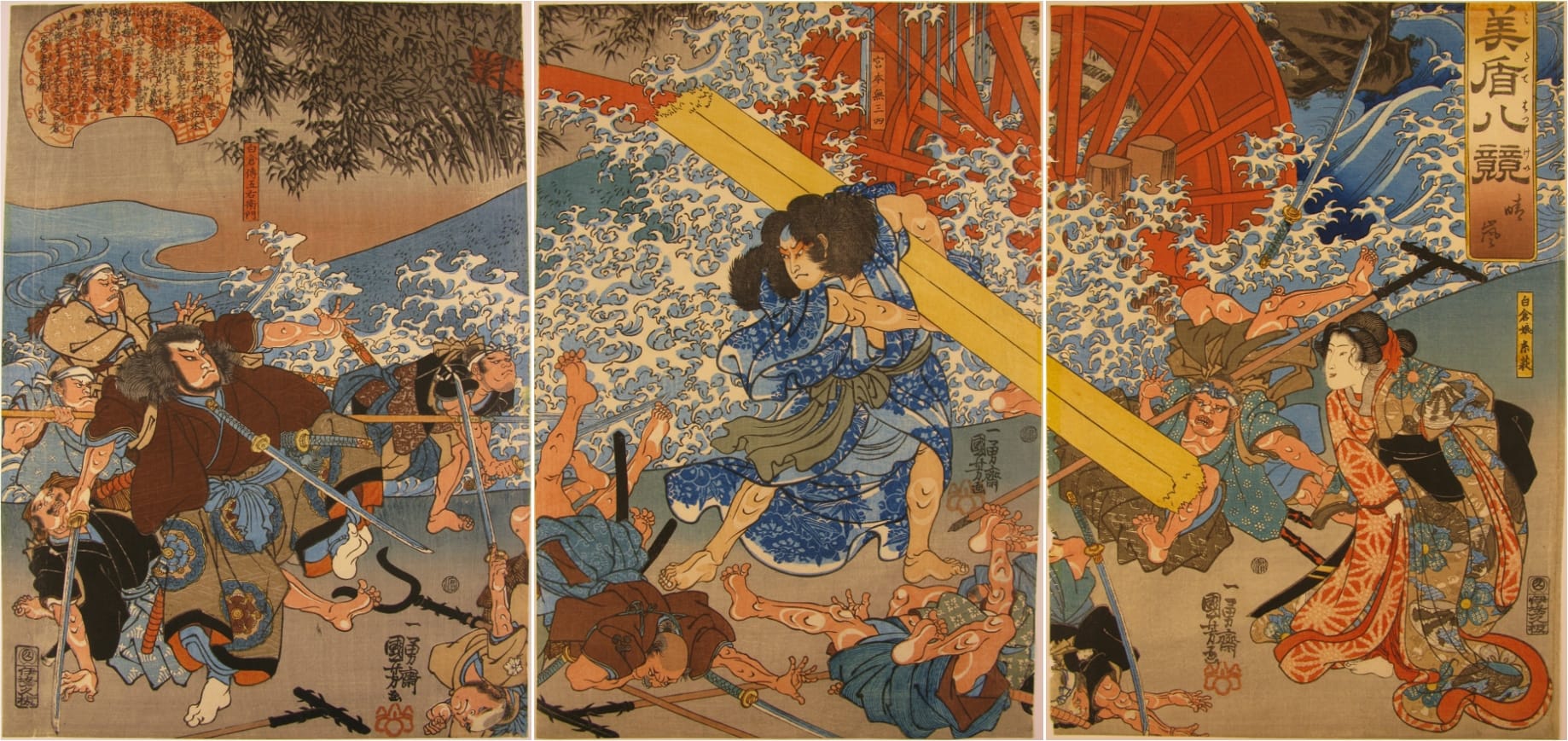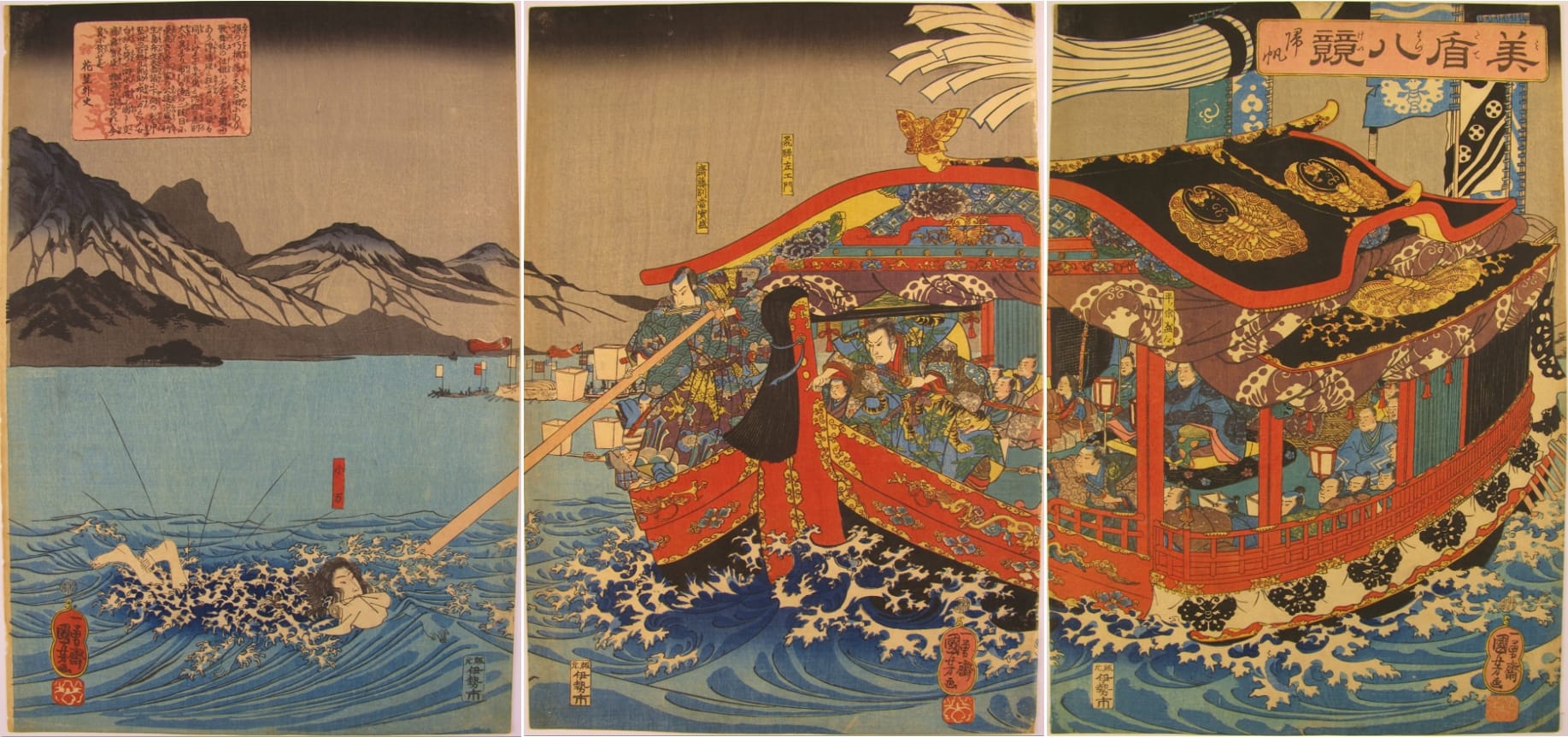
Kuniyoshi – Selection for the eight views
Mitate hakkei, 美盾八競
Utagawa Kuniyoshi’s Mitate hakkei (often translated as ‘Selection for the Eight Views’ or ‘Parody of the Eight Views’) is an imaginative series of vertical ōban triptychs published in 1846. It subverts traditional artistic tropes by transforming the classical Eight Views landscape motif into parodies of historical battles and martial tales.
The series applies the classical Chinese and Japanese theme of the Eight Views (traditionally set around Lake Dongting in China or Lake Biwa in Japan). The eight standard views are usually: Autumn Moon, Lingering Snow, Evening Glow, Vesper Bells, Returning Sails, Clearing Weather, Night Rain, and Homing Geese.
Rather than drawing serene landscapes, Kuniyoshi used the mitate (parody/analogy) technique to map these eight peaceful themes onto dramatic scenes from Japanese military history, such as the epic battles between the Minamoto and Taira clans.
During the Tenpō Reforms (1842–1847), the Tokugawa shogunate strictly banned prints depicting theatrical and certain historical subjects. By framing the triptychs with the ostensibly acceptable classical titles and utilizing the mitate parody structure, Kuniyoshi could safely publish complex, action-filled warrior scenes.
The series is highly regarded for Kuniyoshi’s clever use of visual aids to tell a story across multiple woodblock sheets (like the magnifying telescope in Yashima), which added a layer of spectacle and interaction for the Edo-period viewer.
Because producing intricate, full-colour triptychs was a large commercial undertaking, this series was a collaborative publishing effort. It was co-published by several prominent Edo merchants, including: Iba-ya Sensaburô, Ise-ya Ichibei, Enshū-ya Matabei, Iba-ya Kyūbei, and Kojimaya Jūbei.
Kuniyoshi’s engagement with the classical Eight Views (hakkei) is at once deliberate and elusive. Of the canonical themes, seven find reasonably clear expression within the group identified by B. W. Robinson (T176–T182) – albeit one print is by Horishige. The eighth, Lingering Snow (残雪), is conspicuously absent.
- Autumn Moon: Autumn moon at Kanzaki (Kanzaki no shûgwatsu, 神崎秋月) T181
- Lingering Snow:
- Evening Glow: Evening glow at Yashima (Yashima no sekishô, 屋島夕照) T179
- Vesper Bells: Evening bell at Shôshazan (Shôshazan no banshô, 書冩山 晩鐘) T178
- Returning Sails: Returning sails (kihan, 帰帆) T180
- Clearing Weather: Mountain mist (seiran, 晴嵐) T176
- Night Rain: Evening rain in the Gion woods (Gionbayashi no ya-u, 祇園林夜雨) T182 – this print is by Hiroshige
- Homing Geese: Descending geese at Takadono (Takadono no rakugan, 高殿落雁) T177
The bushidoboutique collection of Mitate hakkei prints