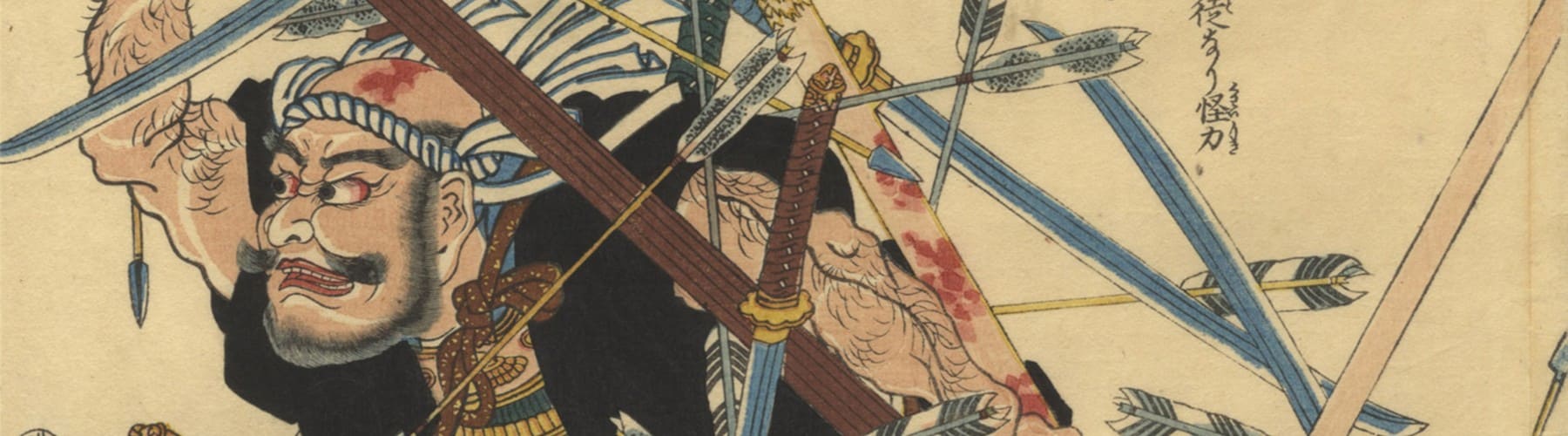
Kuniyoshi – Heros of the grand pacification
Taiheiki eiyû den (太平記英勇傳)
Utagawa Kuniyoshi produced the print series Taiheiki eiyū den (“Heroes of the Great Peace”) circa 1846-1849. It was published by Yamamoto Heikichi (publishing house name Eikyudo). It was issued during the change in censorship regulations as evidenced by only a single censor seal on print 50 – and the remaining prints issued with 2 seals as required from 1847, refer to Anatomy of the prints for further information.
The series title pretends to reference the medieval chronicle Taiheiki about Emperor Go-Daigo. In reality, it celebrates the 16th-century Sengoku warlords whose struggles eventually produced the Tokugawa peace.
The historical misdirection allowed Kuniyoshi to evade censorship while giving audiences exactly the martial drama they wanted.
The series contained 50 prints and not all prints are numbered (I am unsure if the full set exists in both the numbered and un-numbered state – it is alluded to within Elena’s book (referenced below), though I am yet to see a full un-numbered set. The text on the prints was written by Ryukatei Tanekaszu (1807-1858) an author of popular fiction at the time.
Why the sleight of hand?
The connection between the 16th-century Japanese civil wars and Taiheiki eiyū den (often translated “Heroes of the Great Peace”) by Utagawa Kuniyoshi is a fascinating example of art, politics, and censorship colliding during the Edo period.
The title is indeed a deliberate sleight of hand, and understanding it requires stepping back to the upheavals that shaped early modern Japan.
The Age of Civil War (16th Century)
From the mid-1400s to the late 1500s Japan experienced the Sengoku period, literally the “Age of Warring States.” The country fragmented after the weakening of the Ashikaga shogunate following the devastating Ōnin War (1467–1477).
Instead of a stable national government, regional warlords (daimyō) fought for territory and legitimacy. Castles proliferated, alliances shifted constantly, and military innovation—especially mass infantry tactics and firearms—transformed warfare.
Three figures eventually imposed order:
- Oda Nobunaga – the ruthless unifier who shattered old power structures
- Toyotomi Hideyoshi – the brilliant general who completed most of the unification
- Tokugawa Ieyasu – the patient strategist who secured lasting rule after the Battle of Sekigahara (1600)
Ieyasu’s victory eventually produced the long peace of the Edo period under the Tokugawa shogunate. Later generations looked back on the chaos of the Sengoku wars as the dramatic prelude to national pacification.
The Tokugawa shogunate was in the final stages of the Tenpo Reforms (1841–1847), a series of austerity measures launched to revitalize the government’s military, financial, and moral authority. Censorship was intensified to curb escalating social disorder, ensure economic stability, and uphold the feudal class structure, primarily against rising political satire and luxurious “decadent” culture.
What “Grand Pacification” Means
The phrase “Great Peace” (Taihei / Taiheiki imagery) evokes the idea that heroic warriors struggled through chaos to create a stable realm. In historical memory, the violent century of daimyo warfare became a mythic age of heroic figures, almost like a Japanese medieval epic.
This romanticized view was extremely popular in Edo popular culture—kabuki theatre, storytelling, and woodblock prints.
Kuniyoshi’s Series and the Trick in the Title
At first glance, the title suggests the famous medieval chronicle Taiheiki, which recounts the 14th-century wars surrounding Emperor Go-Daigo and the fall of the Kamakura period.
But the prints do not depict those events. Instead, Kuniyoshi illustrates heroes of the Sengoku wars, figures associated with the rise of the Tokugawa order.
How Edo Audiences Understood the Game
This kind of cultural “wink” was common in Edo visual culture. Educated viewers could easily identify:
- distinctive armour styles
- family crests (mon)
- famous battle episodes
So the title functioned almost like a protective mask. Everyone knew what the prints were really about, but officially they were harmless references to a classic text.
Why Sengoku Heroes Were So Popular
For Edo audiences living under strict social order, the Sengoku period represented a thrilling era when:
- personal courage could change history
- ambitious warriors could rise from obscurity
- battles and strategy shaped the nation
Kuniyoshi’s dynamic style—muscular warriors, dramatic poses, and explosive compositions—perfectly suited this heroic mythology.
Chronological Path to the “Grand Pacification”
1467–1477: Collapse of Central Authority. The crisis begins with the Ōnin War in Kyoto.
- Rival samurai factions fight over succession within the Ashikaga shogunate.
- Kyoto is devastated.
- Central authority collapses and provincial warlords become effectively independent.
This marks the beginning of the Sengoku (“Warring States”) era.
Late 1400s–mid 1500s: Regional military houses consolidate power. Important warlords include:
- Takeda Shingen
- Uesugi Kenshin
- Imagawa Yoshimoto
- Mōri Motonari
These figures dominate the mid-Sengoku world. The long rivalry between Takeda Shingen and Uesugi Kenshin produces the famous series of clashes known as the Battles of Kawanakajima (1553–1564).
1560: A minor lord named Oda Nobunaga defeats the powerful Imagawa Yoshimoto at the Battle of Okehazama. (Print No.2)
- Nobunaga attacks during a thunderstorm.
- Yoshimoto’s army is caught off guard.
- One of the most dramatic upsets in samurai history.
This battle launches Nobunaga as the first serious contender to unify Japan.
1560s–1582: Nobunaga wages relentless campaigns. Key events include:
- 1567: Victory over Saito Tatsuoki, lord of Mino province, and seizes Inabayama castle. (Prints 4, 5, 6, 23)
- 1568: Capture of Kyoto (mentioned in Prints 8 and 19)
- 1570: Victory over Asai Nagamasa and Asakura Yoshikage in the battle of Anegawa.
- 1571: Destruction of the militant Buddhist monastery of Enryaku-ji on Mt Hiei. (Alluded to in prints 8 and 11)
- 1573: Asakura Yoshikage and Asai Nagamasa’s downfall and suicides. (Prints 7, 8, 10, 11, 12, 13)
- 1575: Crushing of the Takeda cavalry at the Battle of Nagashino.
At Nagashino, Nobunaga uses ‘organized arquebus fire’, changing Japanese warfare.
1582: Betrayal at Honnō-ji. Nobunaga’s general Akechi Mitsuhide suddenly rebels, instead of marching to Chugoku he turns and launches a surprise attack on Nobunaga. (Prints 19, 49)
Nobunaga is surrounded at the temple of Honnō-ji and dies during the Incident at Honnō-ji. (Prins 1, 9, 17)
This shocking event becomes one of the most dramatic episodes in samurai lore.
1582: Hideyoshi’s Revenge and Rise. Nobunaga’s brilliant subordinate Toyotomi Hideyoshi moves quickly.
Battles at Yamazaki and Uchidenohama see the defeat of Akechi Mitsuhide and followers, and the downfall of Akechi Mitsuhide’s castle at Sakamoto. (Prints 29, 31, 34, 35, 36, 38 depict Akechi followers. Print 50 is Hideyoshi just before battle, and some of his companions in 21, 25)
1583-84: Hideyoshi foils conspiracies against him led by Shibata Katsuie allies included Sakuma Morimasa, Takigawa Kazumasu and Oda Nobunaga’s third son, Nobutaka. (Prints 3, 14, 20, 39 Katsuie and allies)
The battle at the Omi province stronghold of Shizugatake proved disastrous for Katsuie, the relative weakness disclosed to Katsuie by Hideyoshi retainer Yamaji Shogen Masakuni (print 33). Katsuie eventually commits suicide in his castle at Kitanosho. (Prints 16, 33, 42, 43 Katsuie followers and 15, 24, 37, 41, the Hideyoshi followers)
1590s: Hideyoshi’s Ambition and Death, After unification, Hideyoshi launches foreign wars:
- 1592-93 and 1597–98: Japanese invasions of Korea. The campaigns are costly and inconclusive. (Prints 32, 44, 47, 48, 22)
Hideyoshi dies in 1598, leaving power contested among major daimyo.
1600: The Final Struggle — The decisive battle is the Battle of Sekigahara. Two factions clash:
- Eastern Army led by Tokugawa Ieyasu
- Western Army loyal to Toyotomi heirs
Ieyasu wins after several daimyo switch sides. which leads to Tokugawa dominance over Japan.
The idea behind the title “Heroes of the Great Peace” is that their violent struggles ultimately produced the peaceful Tokugawa order. But the official title Of Kuniyoshi’s Taiheiki eiyu den references the medieval chronicle ‘The Taiheiki’ about Emperor Go-Daigo—a convenient disguise to avoid censorship during the Tenpō Reforms.
Recommended books … n stuff
- Heros of the grand pacification Kuniyoshi’s Taiheiki eiyu den by Elena Varshavskaya
- Kuniyoshi project by William Pearl
- Netflix series: Age of Samurai ; Battle for japan