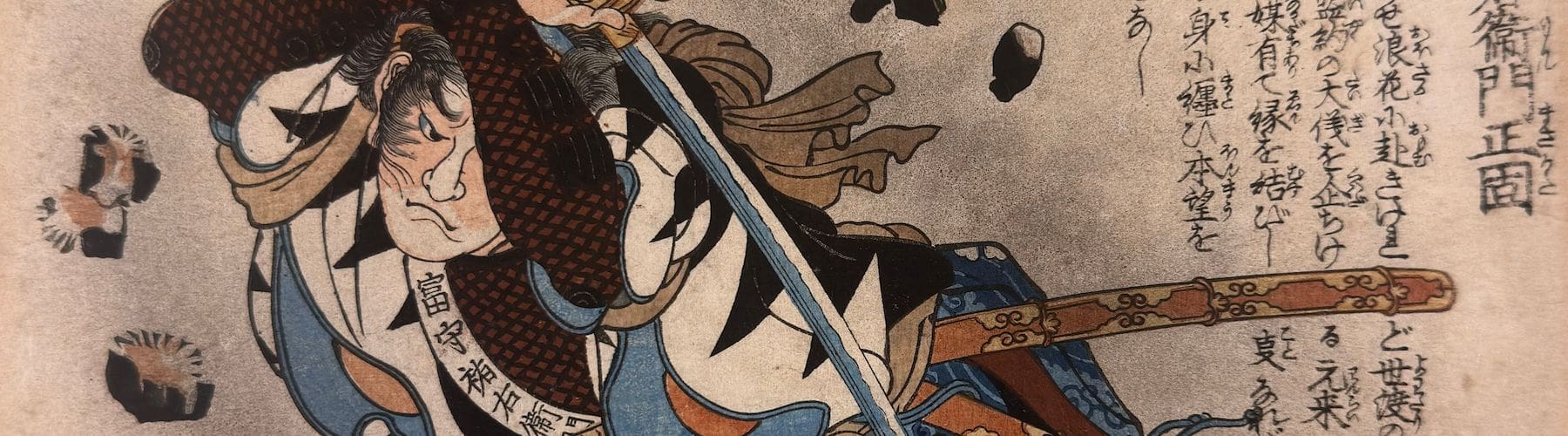
The tale of the forty-seven ronin
History vs Kanadehon Chûshingura
One of the most famous stories of revenge in Japanese history comprises the exploits of the 47 Ronin (masterless samurai) who avenged the death of their lord in the early 18th century.
Their story illustrates and defines the Japanese concept of loyalty, providing a supreme example of the samurai ideals of cool courage and fidelity. This event struck a deep emotional chord in the very heart of Japanese society, and the result was a steady stream of theatrical performances, books, and woodblock prints.
The story of the 47 Ronin was initially dramatized by the famous playwright Chikamatsu Monzayemon, and later in 1748 by Takeda Idzumo II (thought to be the principal author with support from Miyoshi Shōraku and Namiki Senryū, however there is some challenge to this – refer to wikipedia for more). Idzumo’s 11 Act play Kanadehon Chûshingura (The Treasury of Loyal Retainers) is most commonly referenced in images and woodblock prints of the edo period. It was originally a puppet play (bunraku), but quickly adapted for Kabuki theatre.
An important point to note regarding the Kanadehon Chûshingura : to avoid censorship laws, the playwrights changed the date from the eighteenth century to the fourteenth century, the location was moved from Edo to Kamakura, and the names of the characters were disguised:
Lord Asano Takumi-no-kami became Lord En’ya Hangan
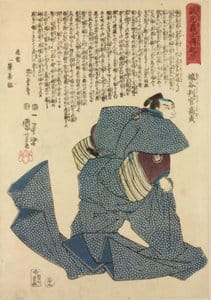
Kira Kozuke-no-suke (his enemy) became Kono Moronao
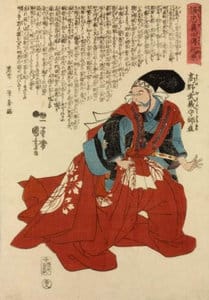
Oishi Kuranosuke, leader of the vendetta, became Oboshi Yuranosuke
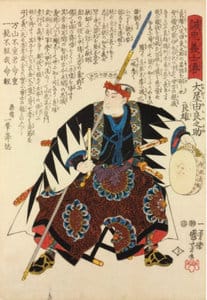
Its core plot tracks the fall of Lord En’ya Hangan, the tyranny of Ko no Moronao, and the eventual revenge led by retainer Oboshi Yuranosuke.
The Kanadehon Chûshingura (a brief summary)
Acts I to III: Insult and Provocation
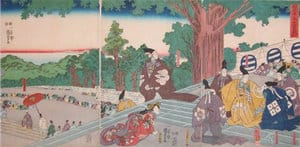
Act I (Helmet Inspection): The Chushingara actually first act starts in the 14th century with the identification of the priceless enemy helmet of Nitta Yoshisada at Tsurugaoka Shrine, and introduces the villain Kô no Musashi no Kami Moronao (T248) who lusts after Lord Enya Hangan’s wife, Lady Kaoyo.
Act II (Pine-cutting): Lord Momonoi Wakasanosuke is publicly insulted by Moronao and prepares to kill him, but retainer Kakogawa Honzo intervenes with bribes to save his master’s house.
Act III (The Shogun’s Palace): Moronao transfers his spite onto Hangan for failing to show proper compliance. Driven past his limit by constant goading, Hangan draws his short sword and wounds Moronao inside the palace corridors.
Acts IV to VI: Tragedy and Disgrace

Act IV (Hangan’s Suicide): Drawing a weapon inside the palace is a capital crime. Hangan is condemned to commit ritual seppuku (disembowelment), leaving his lands seized and his men masterless (ronin). Before dying, he tasks his chief retainer, Oboshi Yuranosuke, with avenging his death, and the loyal retainers scatter as masterless rōnin.
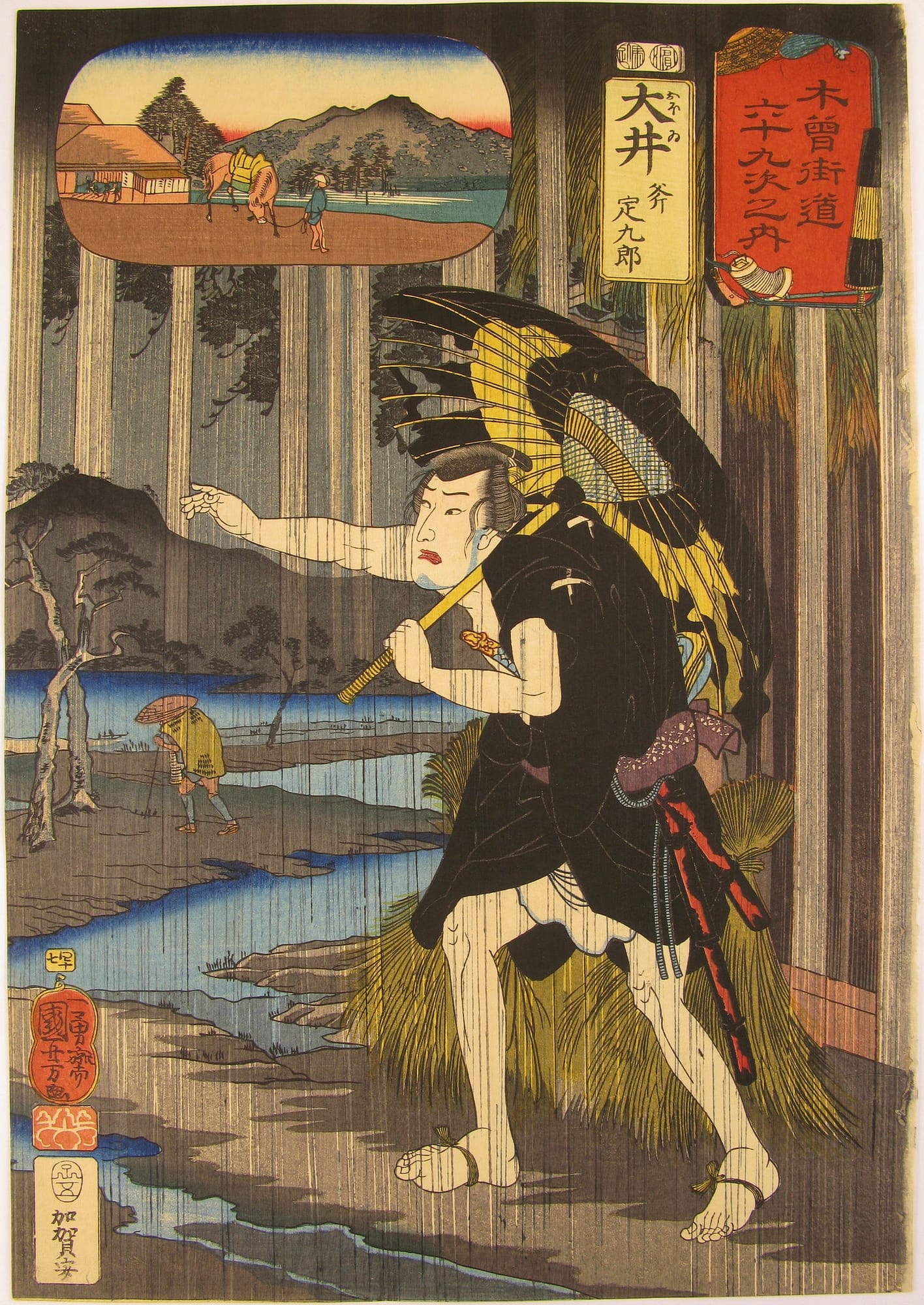
Act V (Yamazaki Highway): Former retainer Hayano Kampei, despondent over missing the attack, wanders a dark road on a stormy night as a hunter. A thief named Sadakuro attacks an old man for money and is killed by Kampei, who unknowingly takes the stolen purse without realizing it belonged to his own father-in-law (the old man). (S74.48)
Act VI (Kampei’s Suicide): Believing he accidentally murdered his wife Okaru’s father, Kampei commits ritual suicide, only to be cleared of the crime and accepted into the loyal vendetta with his dying breath.
Acts VII to XI: Loyalty, Marriage and Revenge
Act 7 (Ichiriki Teahouse in Gion) Yuranosuke pretends to live a life of drunken debauchery to fool spies, handling various secret messages and rejecting compromised allies.
Act 8 (Bride’s Journey) A poetic travel-dance act following Konami and her mother traveling to Yuranosuke’s home to pursue a marriage alliance.
Act 9 (Yuranosuke’s Country Retreat) Yuranosuke’s wife tests Konami’s family loyalty, leading to a dramatic self-sacrifice by Honzō to secure the marriage and clear the path for the vendetta.
Act 10 (Amakawaya Shop) Merchant Gihei demonstrates absolute loyalty and self-sacrifice by turning away his own wife and family to safeguard weapons and supplies for the impending raid.
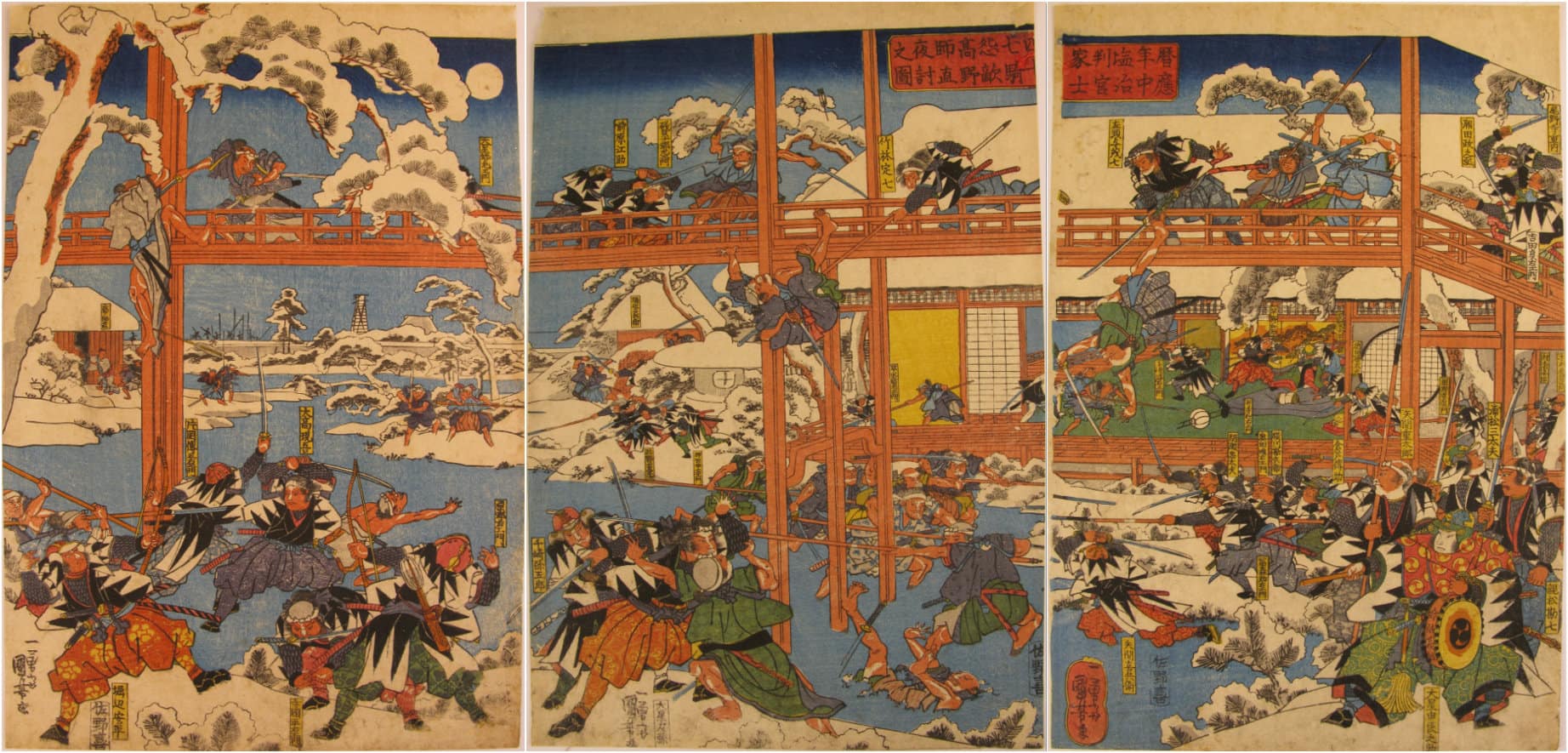
Act 11: (Storming of Morono’s Mansion) The 47 loyal samurai execute a successful midnight winter raid, capture Moronao, and successfully achieve their revenge before facing their own mandated deaths.
The historical story of the 47 ronin
The fateful incident
At the beginning of the eighteenth century (1701) there lived a daimyō named Asano Takumi no Kami Naganori, Lord of the castle of Akō in the province of Harima. It happened that an Imperial envoy, sent from the Court of the Mikado to the Shōgun at Yedo, was due to be received with all the elaborate ceremony appropriate to so august an occasion. Takumi no Kami and another noble, Kamei Sama, were appointed to entertain the envoy, while a senior official named Kira Kōtsuké no Suké Yoshinaka was charged with instructing them in the proper etiquette.
The two daimyō were therefore obliged to attend the castle daily to receive Kira’s instruction. Unfortunately, Kira was a man with a keen appreciation of money and a somewhat less developed appreciation of generosity. The customary presents brought to him by the two noblemen were, in his opinion, altogether too modest. He consequently took little trouble to teach them and instead delighted in making them the objects of his ridicule. Takumi no Kami, restrained by a stern sense of duty, endured these insults patiently. Kamei Sama, however, possessed rather less of this particular virtue and rather more of a temper.
One evening, after returning to his palace, Kamei summoned his councillors and declared: “Kōtsuké no Suké has insulted Takumi no Kami and myself during our service in attendance upon the Imperial envoy. This is against all decency. I was minded to kill him upon the spot; but I bethought me that if I did such a deed within the precincts of the castle, not only would my own life be forfeit, but my family and vassals would be ruined. So I stayed my hand. Still, the life of such a wretch is a sorrow to the people, and to-morrow, when I go to Court, I will slay him. My mind is made up, and I will listen to no remonstrance.”
His face, we are told, became livid with rage. One councillor, a man of considerable judgment, immediately understood that arguing with his lord in such a mood would be about as useful as attempting to reason with a drawn sword. He therefore replied: “Your lordship’s words are law. Your servant will make all preparations accordingly; and to-morrow, should Kōtsuké no Suké again be insolent, let him die the death.”
Kamei was delighted by this apparent agreement. But the councillor, once safely home, was deeply troubled. Reflecting upon Kira’s reputation as a miser, he reasoned that a man so fond of money might perhaps be persuaded to become considerably more agreeable when properly encouraged.
He gathered together all the money he could command and rode through the night to Kira’s palace. There he presented himself with suitable humility. “My master, who is now in attendance upon the Imperial envoy, owes much thanks to my Lord Kōtsuké no Suké, who has taken such pains to teach him the proper ceremonies. This is but a shabby present which he has sent, but he hopes that his lordship will condescend to accept it.” The “shabby present” consisted of a thousand ounces of silver for Kira himself, together with a further hundred ounces for distribution among his retainers.
The effect was immediate.
Kira’s retainers, upon seeing the money, became models of gratitude. Their master, even more delighted, received the councillor privately and promised that on the following day he would instruct Kamei Sama with the greatest care in every point of etiquette.
The councillor returned home in high spirits. Kamei, meanwhile, knew nothing of this financial diplomacy and spent the night preparing himself for murder. The next morning, however, Kira’s manner had undergone a remarkable transformation. “You have come early to Court this morning, my Lord Kamei,” he declared. “I cannot sufficiently admire your zeal. I shall have the honour of calling your attention to several points of etiquette today. And I beg your lordship to excuse my previous conduct, which must have seemed rude. I am naturally of a cross-grained disposition, so I pray you to forgive me.”
As Kira continued with his apologies and fair speeches, Kamei’s anger gradually subsided. He abandoned his intention of killing him, and thus, through the cleverness of one councillor—and the persuasive qualities of a substantial quantity of silver—Kamei Sama and his entire house were saved from ruin.
Shortly afterwards, Takumi no Kami (S54.39) arrived at the castle. He, however, had sent Kira no such present.
The unfortunate result was that Kira resumed his former behaviour, and indeed treated Takumi with even greater contempt than before. Takumi bore the insults patiently, submitting himself to Kira’s orders because he believed himself bound to do so while on official duty.
But patience, like everything else, has its limits. At last Kira pointed to his own clothing and said haughtily: “Here, my Lord of Takumi, the ribbon of my sock has come untied; be so good as to tie it up for me.” Burning with rage, Takumi nevertheless obeyed. When he had finished, Kira looked down at the result and sneered: “Why, how clumsy you are! You cannot so much as tie the ribbon of a sock properly! Any one can see that you are a boor from the country and know nothing of the manners of Yedo.” He turned away laughing. Takumi’s patience was exhausted. “Stop a moment, my lord.”
As Kira turned, Takumi drew his dirk and struck at his head. Kira’s Court cap protected him, and the wound was only a scratch (S54.38). He fled, with Takumi pursuing and striking a second time. The blow missed and the blade lodged in a pillar. At that moment an officer named Kajikawa Yosobei rushed forward and restrained the enraged nobleman, allowing Kira to escape.
The consequences were immediate and severe. Takumi no Kami was arrested and confined. A council was convened, and the law was clear: to attack another man within the precincts of the palace was an intolerable offence. Takumi was sentenced to perform hara-kiri. His goods were confiscated, his castle of Akō was taken from him, and his retainers were left without a lord.
Thus they became rōnin, masterless samurai. Some entered the service of other daimyō; others became merchants. Among them was Takumi’s principal councillor, Oishi Kuranosuké. (S54.1)
Oishi had been absent at Akō when the quarrel occurred. Had he been present, it was believed, he would have found some way of managing the situation—perhaps, like Kamei’s councillor, by the judicious application of silver. Instead, Takumi was dead, his house ruined, and Kira still alive.
Let the planning begin
Oishi and forty-six other faithful retainers therefore formed a secret league. Their purpose was simple: they would avenge their master’s death by killing Kira Kōtsuké no Suké. (T273)
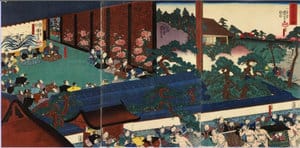
Kira, however, was well protected. His father-in-law, Uyésugi Sama, had provided him with a considerable guard. The rōnin therefore understood that they could not simply march upon his house and announce their intentions. They must first convince Kira that they had abandoned all thought of revenge.
So the forty-seven men separated and assumed disguises. Some became craftsmen, others merchants and pedlars.
Oishi himself went to Kyoto, where he established a house in Yamashina and deliberately began to live a life of drunkenness and debauchery. It was an extraordinary performance.
Kira, naturally suspicious of the former retainers of Takumi, sent spies to watch Oishi. But Oishi was determined to give them a convincing spectacle. He frequented houses of ill repute, drank heavily and behaved as though the only thing he intended to avenge was the shortage of wine.
One day, returning drunk from some low establishment, he fell down in the street and went to sleep. A Satsuma man passing by recognised him. “Is not this Oishi Kuranosuké, who was a councilor of Asano Takumi no Kami, and who, not having the heart to avenge his lord, gives himself up to women and wine? See how he lies drunk in the public street! Faithless beast! Fool and craven! Unworthy the name of a Samurai!” The Satsuma man went so far as to tread upon Oishi’s face and spit upon him.
Kira’s spies reported the incident faithfully, and Kira was greatly relieved. It seemed that the once-feared retainers of Takumi were not plotting revenge after all. They were merely disgraced men, apparently more interested in wine than honour.
Oishi’s own wife was less easily deceived. Deeply distressed by her husband’s conduct, she confronted him. “My lord, you told me at first that your debauchery was but a trick to make your enemy relax in watchfulness. But indeed, indeed, this has gone too far. I pray and beseech you to put some restraint upon yourself.”
Oishi replied with calculated cruelty. “Trouble me not. Since my way of life is displeasing to you, I will divorce you, and you may go about your business. I will buy some pretty young girl from one of the public-houses and marry her for my pleasure. I am sick of the sight of an old woman like you about the house, so get you gone—the sooner the better.”
His wife pleaded with him, reminding him that she had been his faithful companion for twenty years and had borne him three children. But Oishi remained unmoved. She was sent away with the two younger children. Their eldest son, Oishi Chikara, remained with his father. The spies duly reported this as well.
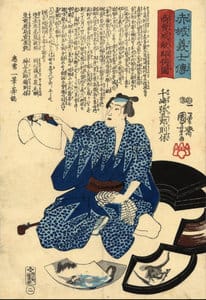
When Kira heard that Oishi had divorced his wife, sent away his children and apparently taken a concubine, he concluded that he had nothing further to fear. The retainers of Takumi must, he thought, be cowards incapable of avenging their lord. His guard was gradually reduced. And so the trap began to close.
While Oishi continued his shameless masquerade, his companions travelled to Yedo disguised as workmen and pedlars. By various means they gained access to Kira’s residence. They studied the building, (S58.2) its entrances and rooms, and learned the habits and character of those who lived within it. Their reports were sent secretly to Oishi. At last the message arrived: Kira was thoroughly off his guard.
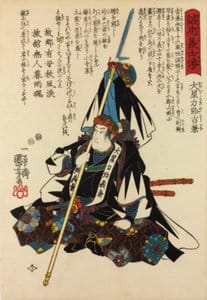
The time for revenge had come.
Oishi secretly left Kyoto and joined his companions. The forty-seven men gathered together and patiently awaited their opportunity. It was now the twelfth month, and winter had descended upon the land. The cold was bitter. Then came a night of heavy snow, when the world lay silent and peaceful beneath the darkness.
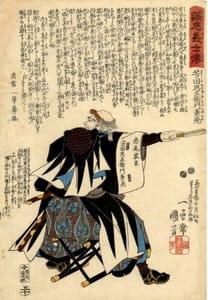
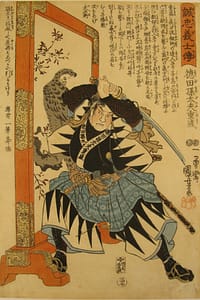
The rōnin decided that no better moment could be found. They divided themselves into two parties. Oishi would attack the main gate, while his sixteen-year-old son, Chikara (S54.2 and 2A), would lead the attack upon the postern gate, under the guardianship of Yoshida Chiuzayémon (S54.50).
A drumbeat would signal the attack
If Kira were found, the man who killed him was to blow a shrill whistle. His comrades would then gather, identify the head and carry it to Sengakuji, where it would be offered at the tomb of their dead master. Afterwards they would surrender themselves to the Government, fully expecting to be sentenced to death. Before setting out, the forty-seven men shared a final farewell feast. Oishi then addressed them: “To-night we shall attack our enemy in his palace. His retainers will certainly resist us, and we shall be obliged to kill them. But to slay old men and women and children is a pitiful thing; therefore, I pray you each one to take great heed lest you kill a single helpless person.” The men applauded.
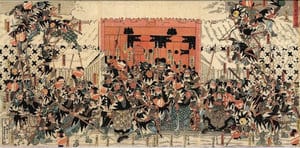
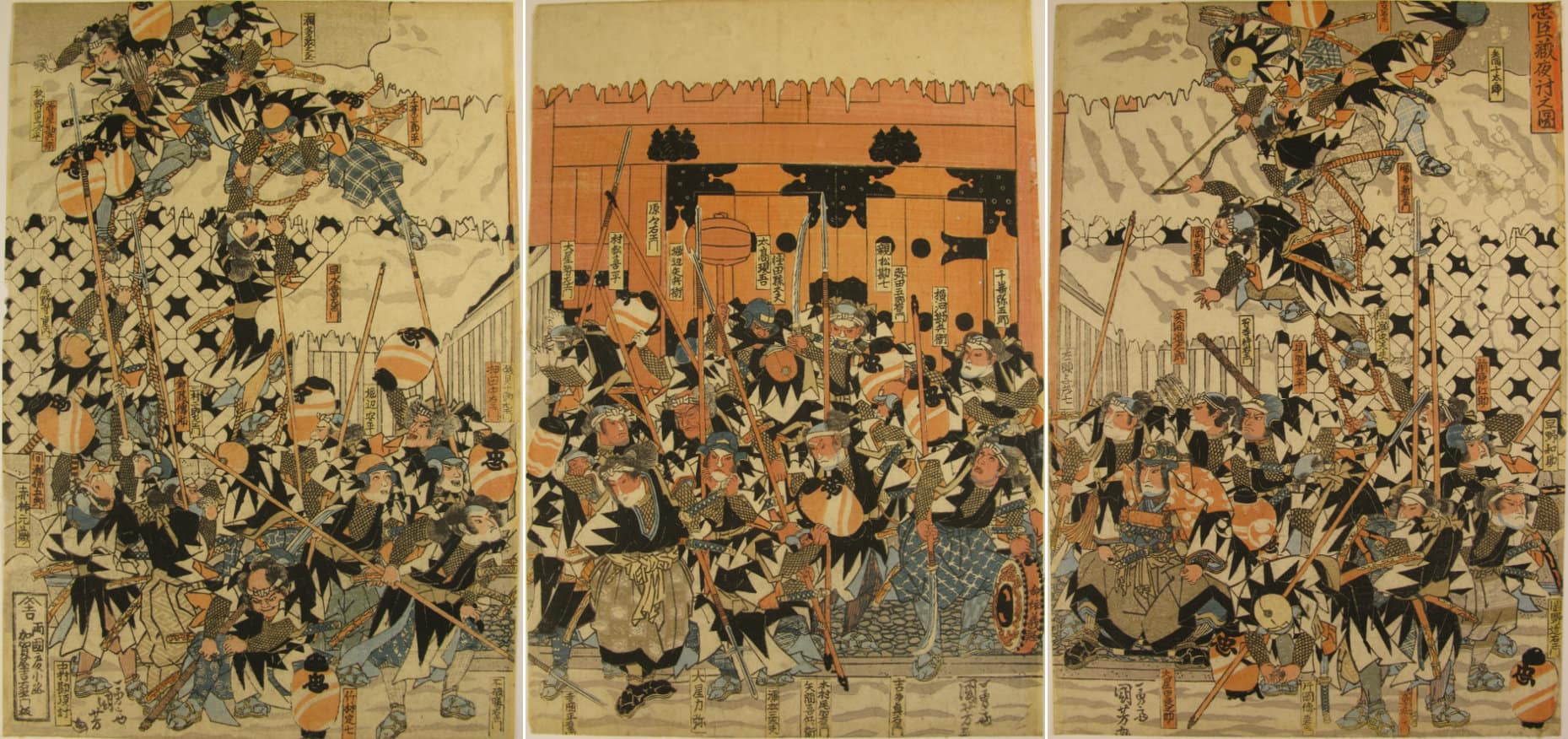
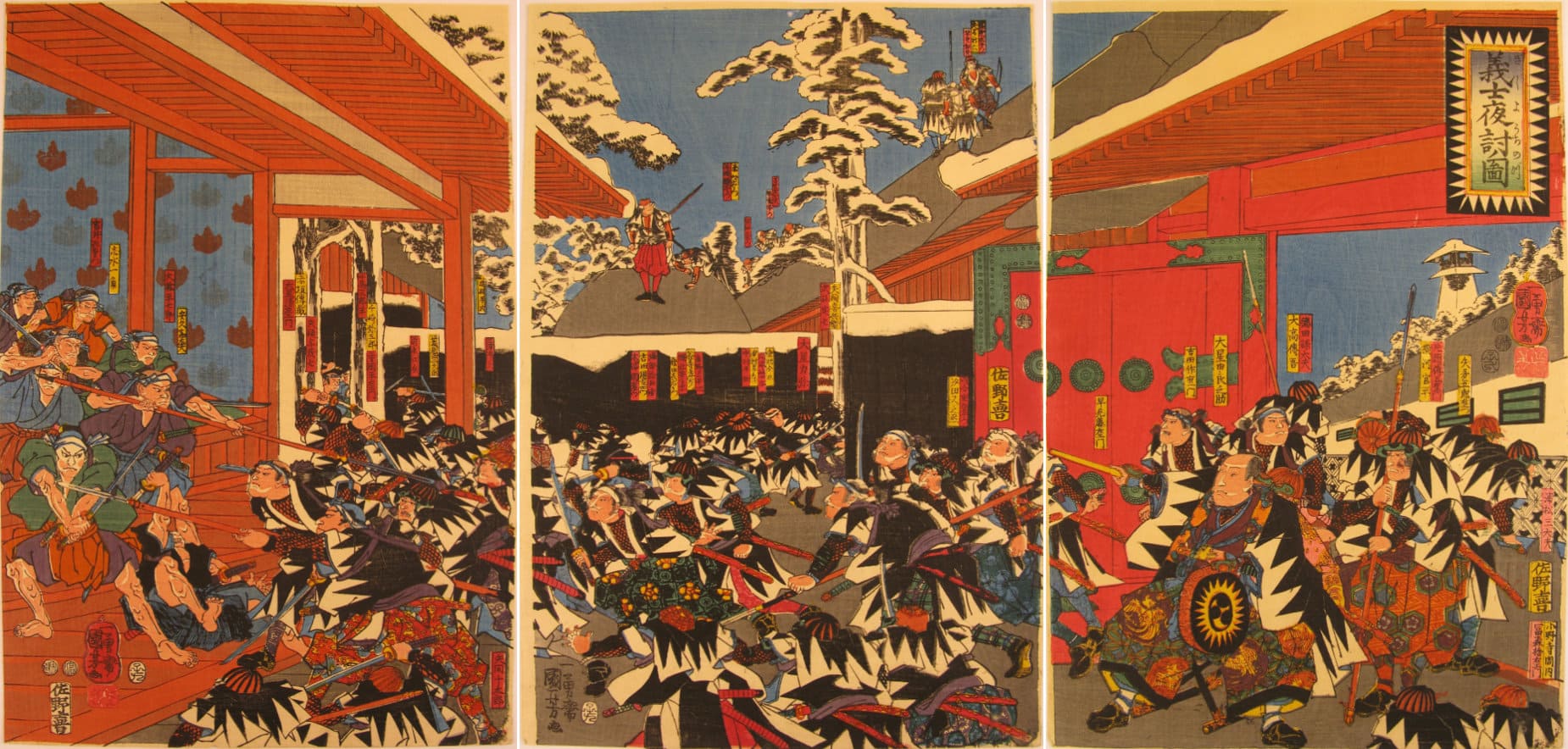
Midnight arrived on the night of 14 December 1702 (Western calendar: 30 January 1703). The rōnin set out through the driving snow. At Kira’s residence they divided into their two parties. Four men climbed into the courtyard by means of a rope ladder. (T13, T276)
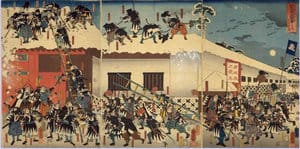
They entered the porter’s lodge, where the guards were sleeping, and bound them before they could recover from their astonishment. The guards begged for mercy. The rōnin agreed to spare their lives if they surrendered the keys. Unfortunately, the keys were kept elsewhere, and no one could produce them. The rōnin therefore resorted to a more direct form of architectural negotiation: they smashed the great wooden bolt with a hammer. The gates flew open. At the same moment Chikara and his men broke in through the rear. (T287A)
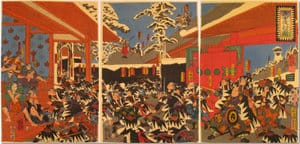
Oishi sent a messenger to the neighbouring houses: “We, the Rōnin who were formerly in the service of Asano Takumi no Kami, are this night about to break into the palace of Kōtsuké no Suké, to avenge our lord. As we are neither night robbers nor ruffians, no hurt will be done to the neighbouring houses. We pray you to set your minds at rest.”
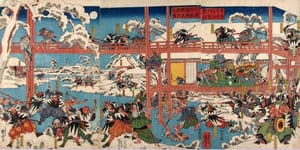
Kira was apparently so unpopular with his neighbours that none came to his assistance. Oishi also placed archers around the roof, instructed to prevent anyone escaping to summon help. Then, with his own hand, he beat the drum. The attack began. (T12, T80)
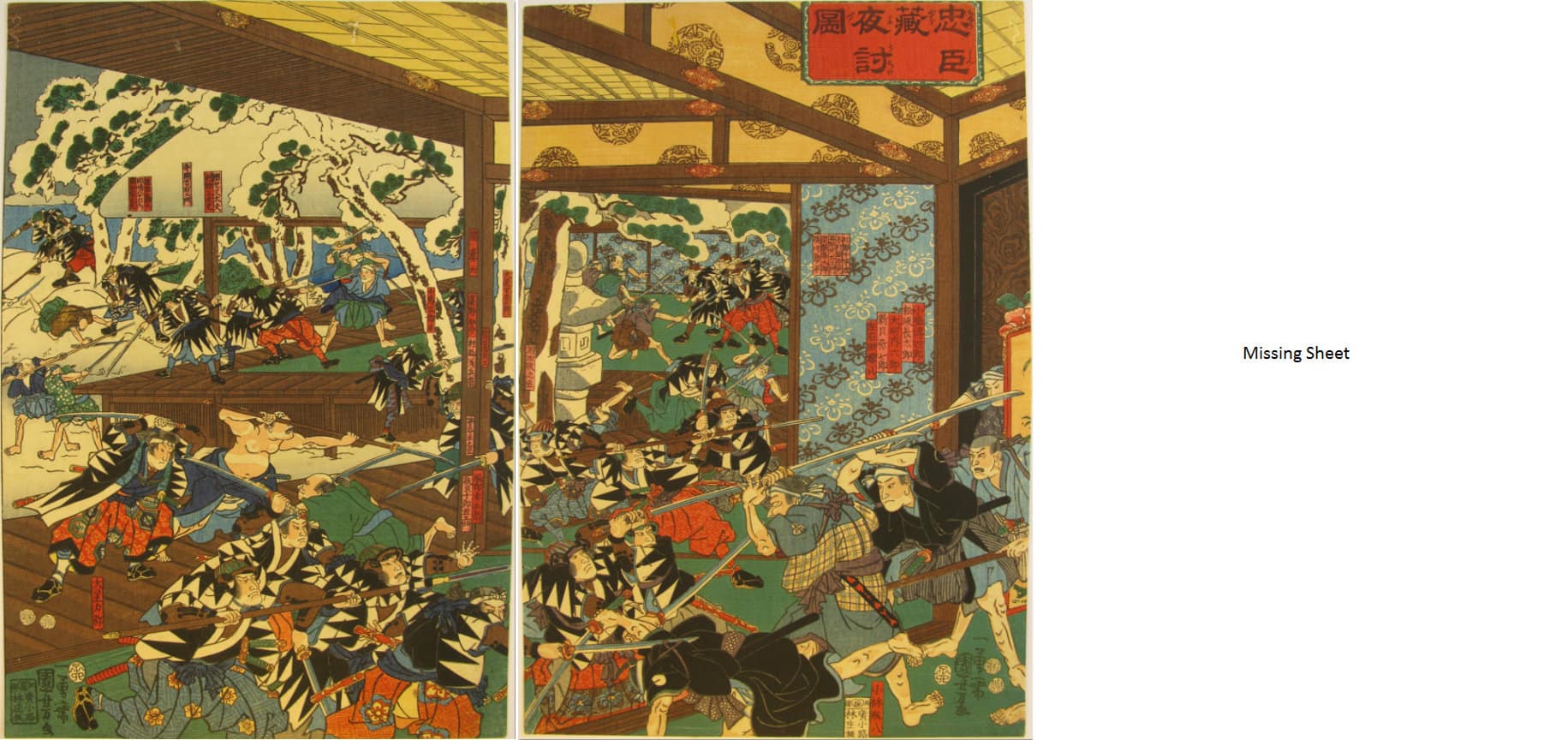
Kira’s retainers awoke and rushed to defend their master. A fierce battle followed. Chikara’s men entered from the rear, while Oishi’s party fought through the front rooms. Kira himself, terrified for his life, hid in a closet with his wife and female servants. (T249, T285)
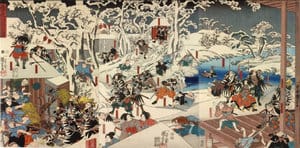
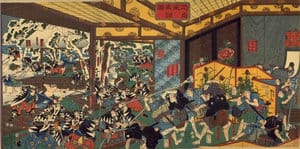
His retainers fought bravely, but the rōnin gradually overwhelmed them. Attempts to send messengers for help were thwarted by Oishi’s archers. At last Oishi cried: “Kōtsuké no Suké alone is our enemy; let someone go inside and bring him forth, dead or alive!”
Three of Kira’s finest retainers defended the entrance to his private room – Kobayashi Héhachi, Waku Handaiyu, and Shimidzu Ikkaku all good men and true, and expert swordsmen.
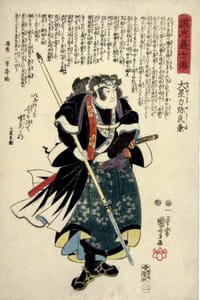
They fought so fiercely that for a time they drove the rōnin back. Oishi was furious. “What! Did not every man of you swear to lay down his life in avenging his lord, and now are you driven back by three men? Cowards! To die fighting in a master’s cause should be the noblest ambition of a retainer!”
Then he turned to his son. “Here, boy! Engage those men, and if they are too strong for you, die!” Chikara (S54.2A/2) seized a spear and attacked Waku Handaiyu. Driven backwards, he slipped and fell into a pond. His opponent, believing him helpless, leaned forward to finish him. Chikara struck his leg, brought him down and killed him.
The remaining defenders were soon overcome. Kira’s son, Kira Sahioyé, made a brief attempt to resist but was wounded and fled.
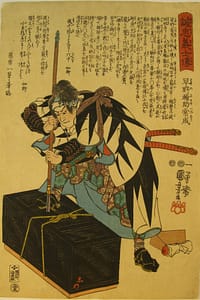
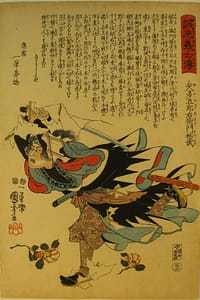
For a bit of fun, associating the historical account to the fictional ‘print text ‘ in seichu gishi den series of prints – within the text of the prints, Kobayashi Héhachi was fought by the ronin Tadao (S54.14), Shimidzu Ikkaku was fought by Takanori (S54.28) and Kira’s son, Kira Sahioyé, by Shigemori (S54.37).
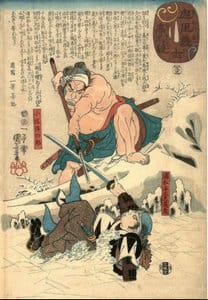
Waku Handaiyu, is not mentioned in the print text of seichu gishi den series, however a pond incident is referenced in the print of Masatatsu (S54.41) but fighting with one of Kira’s retainers named ‘Torii Riemon’ not Waku Handaiyu. There is another Kuniyoshi print featuring this pond incident also in (S57.43) perhpas he found this interaction just slightly amusing! – anyway continuing on:
Yet Kira himself could not be found.
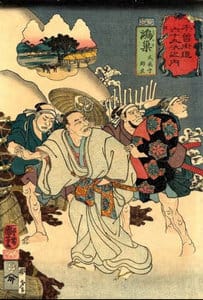
The rōnin searched the entire residence. They found only terrified women and children. For a moment despair seized them. After all their planning and sacrifice, had their enemy escaped? (S74.9) They even considered dying together on the spot. Then Oishi entered Kira’s sleeping room. He touched the bedding. “The bed-clothes are yet warm. Our enemy is not far off. He must certainly be hidden somewhere in the house.”
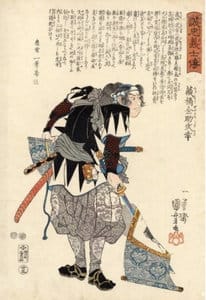
The search began again. At the rear of the room was a concealed opening behind a hanging picture. (54.25) A spear thrust through the wall revealed a hidden space beyond. One of the rōnin entered and discovered a small courtyard with an outhouse for charcoal and firewood.
There he saw something white. He struck at it with his spear. Two armed men sprang out. A fierce struggle followed. One was killed, while the other engaged the rōnin. Searching inside the outhouse, Jiutarō again saw something white and thrust at it. A cry of pain answered him. The figure was a man. The rōnin rushed forward and dragged him out.
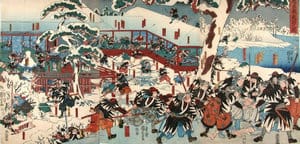
He was an elderly nobleman of about sixty years of age, dressed in a white satin sleeping robe stained with blood from a wound in his thigh. They asked his name. He refused to answer. The whistle sounded. The forty-seven men gathered. (S54.13, T260)
Oishi approached with a lantern and examined the old man’s face. It was Kira Kōtsuké no Suké. And upon his forehead was still the scar left by Takumi no Kami during their original quarrel. There could be no mistake.
Oishi knelt before him. “My lord, we are the retainers of Asano Takumi no Kami. Last year your lordship and our master quarrelled in the palace, and our master was sentenced to hara-kiri, and his family was ruined. We have come to-night to avenge him, as is the duty of faithful and loyal men. I pray your lordship to acknowledge the justice of our purpose. And now, my lord, we beseech you to perform hara-kiri. I myself shall have the honour to act as your second, and when, with all humility, I shall have received your lordship’s head, it is my intention to lay it as an offering upon the grave of Asano Takumi no Kami.”
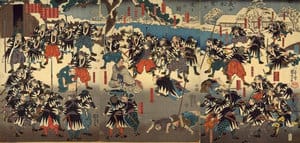
Kira was given every opportunity to die as a nobleman should. He did nothing. He crouched trembling and speechless. At last Oishi understood that Kira had no intention of accepting the honourable death being offered to him. The rōnin therefore forced him down and cut off his head with the same dirk with which Takumi no Kami had taken his own life. (T272)
The revenge was complete
The forty-seven men placed Kira’s head in a bucket and prepared to depart. Before leaving, however, they carefully extinguished the fires and lights in the house, lest a fire should break out and harm their neighbours.
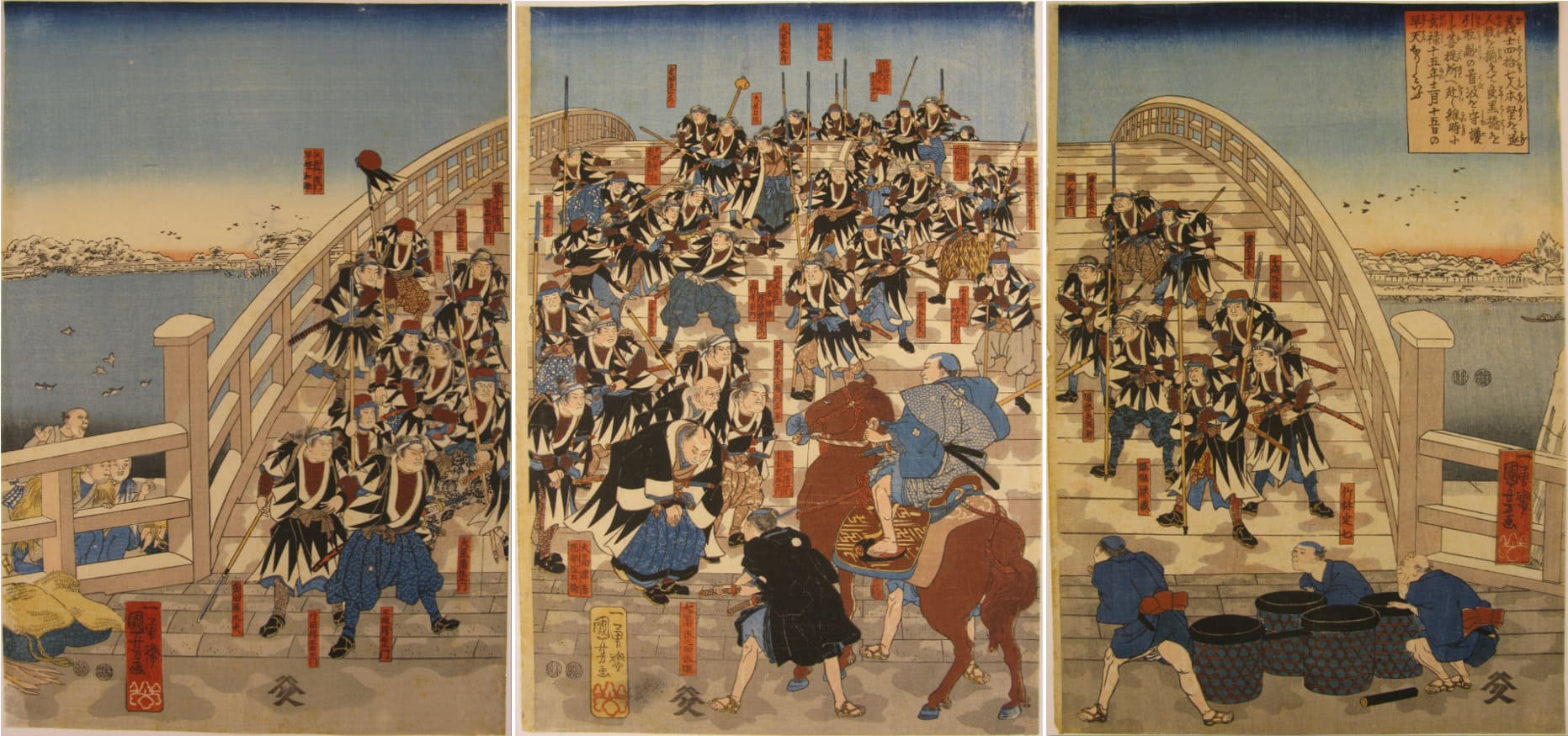
At dawn they reached the road toward Sengakuji.
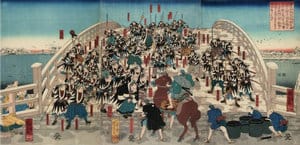
The people came out to see them, their clothes and weapons stained with blood. Everyone marvelled at their courage and devotion. The rōnin expected that Kira’s father-in-law might pursue them, and prepared themselves to die fighting. But assistance was ready should they need it, and no attack came.
At about seven in the morning they passed the palace of the Prince of Sendai. Hearing of their exploit, the prince ordered that they be invited inside. His councillor approached Oishi. “My master bids me beg you, as you must be worn out after all you have undergone, to come in and partake of such poor refreshment as we can offer you.” (T209)
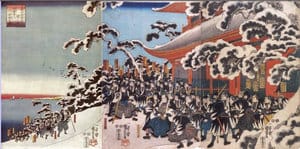
Oishi gratefully accepted. The forty-seven rōnin were brought inside and given gruel and wine. The retainers of the Prince of Sendai gathered to admire them. But the men could not linger.
They thanked their hosts and continued to Sengakuji. There they were met by the abbot. (T210)
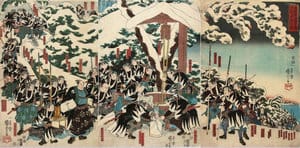
The head of Kira Kōtsuké no Suké was washed clean in a nearby well (T211) and placed before the grave of Asano Takumi no Kami. The priests read prayers and incense was burned. (T186)
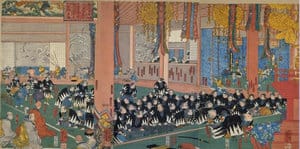
The abbot led them to the tomb of their dead master and there they laid the head. (T81) Oishi went first, followed by his son Chikara, and then the other forty-five men. Finally Oishi addressed the abbot: “When we forty-seven men shall have performed hara-kiri, I beg you to bury us decently. I rely upon your kindness. This is but a trifle that I have to offer; such as it is, let it be spent in masses for our souls!”
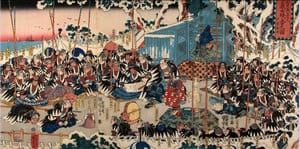
He gave the abbot all the money he possessed. The priest, deeply moved, promised to fulfil their wishes. The forty-seven men had accomplished the purpose for which they had sacrificed everything. They now waited calmly for the Government’s sentence.
It soon came.
The rōnin were summoned before the Supreme Court, where the governors of Yedo and the public censors assembled. The judgment was uncompromising: “Whereas, neither respecting the dignity of the city nor fearing the Government, having leagued yourselves together to slay your enemy, you violently broke into the house of Kira Kōtsuké no Suké by night and murdered him, the sentence of the Court is, that, for this audacious conduct, you perform hara-kiri.”
The forty-six* men were divided among four daimyō and ordered to perform hara-kiri. They had expected nothing else In Genroku 16, on the 4th day of the 2nd month 元禄十六年二月四日 (Western calendar: 20 March 1703) they carried out their punishment. Their bodies were carried to Sengakuji and buried before the tomb of their master, Asano Takumi no Kami.
In time, their fame spread throughout Japan, and people travelled to Sengakuji to pray at the graves of the faithful men. Among those visitors was the Satsuma man who had once encountered Oishi drunk in the streets of Kyoto.
Standing before Oishi’s grave, he confessed: “When I saw you lying drunk by the roadside at Yamashina, in Kyoto, I knew not that you were plotting to avenge your lord; and, thinking you to be a faithless man, I trampled on you and spat in your face as I passed. And now I have come to ask pardon and offer atonement for the insult of last year.”
Having spoken, he prostrated himself before the grave. Then he drew his dirk and took his own life. The chief priest, taking pity upon him, buried him beside the forty-seven rōnin.
Thus, even in death, the story of the forty-seven men acquired one final companion: the stranger who had mistaken patience and disguise for cowardice, and who, upon learning the truth, sought to make amends in the only manner that his own understanding of honour allowed.
The graves of the forty-seven* rōnin remain at Sengakuji, where generations have remembered their story—not merely as one of revenge, but as an enduring tale of loyalty, sacrifice, deception, courage and the sometimes extraordinarily complicated business of being a samurai.
Notes and appendices
* Each of the 46 rōnin killed himself (exception also is 1.47 who killed himself prior) in Genroku 16, on the 4th day of the 2nd month (元禄十六年二月四日; 20 March 1703). This has caused a considerable amount of confusion ever since, with some people referring to the “forty-six rōnin”; this refers to the group put to death by the shōgun, while the actual attack party numbered forty-seven. The forty-seventh rōnin, identified as Terasaka Kichiemon, eventually returned from his mission and was pardoned by the shōgun (some say on account of his youth). He lived until the age of 87, dying around 1747, and was then buried with his comrades. The assailants who died by seppuku were subsequently interred on the grounds of Sengaku-ji, in front of the tomb of their master.
Manuscript which the Forty-seven Rônins laid upon the tomb of their master
“The 15th year of Genroku, the 12th month, and 15th day. We have come this day to do homage here, forty-seven men in all, from Oishi Kuranosuké down to the foot-soldier, Terasaka Kichiyémon, all cheerfully about to lay down our lives on your behalf. We reverently announce this to the honoured spirit of our dead master. On the 14th day of the third month of last year our honoured master was pleased to attack Kira Kôtsuké no Suké, for what reason we know not. Our honoured master put an end to his own life, but Kira Kôtsuké no Suké lived. Although we fear that after the decree issued by the Government this plot of ours will be displeasing to our honoured master, still we, who have eaten of your food, could not without blushing repeat the verse, ‘Thou shalt not live under the same heaven nor tread the same earth with the enemy of thy father or lord,’ nor could we have dared to leave hell and present ourselves before you in paradise, unless we had carried out the vengeance which you began. Every day that we waited seemed as three autumns to us. Verily, we have trodden the snow for one day, nay, for two days, and have tasted food but once. The old and decrepit, the sick and ailing, have come forth gladly to lay down their lives. Men might laugh at us, as at grasshoppers trusting in the strength of their arms, and thus shame our honoured lord; but we could not halt in our deed of vengeance. Having taken counsel together last night, we have escorted my Lord Kôtsuké no Suké hither to your tomb. This dirk, by which our honoured lord set great store last year, and entrusted to our care, we now bring back. If your noble spirit be now present before this tomb, we pray you, as a sign, to take the dirk, and, striking the head of your enemy with it a second time, to dispel your hatred for ever. This is the respectful statement of forty-seven men.”
Recommended books … n stuff
- Kuniyoshi -The faithful samurai by David R Weinberg
- Kuniyoshi The Warrior-Prints by B. W. Robinson
- Kuniyoshi from the Arthur R Miller collection by Timothy Clark
- Kuniyoshi project by William Pearl
Whilst I link to Amazon books – for god sake don’t buy from there unless you shop around first!
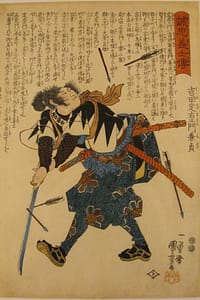
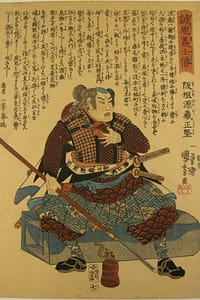
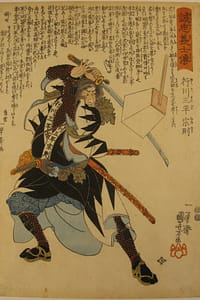
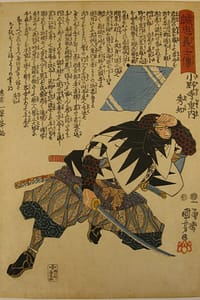
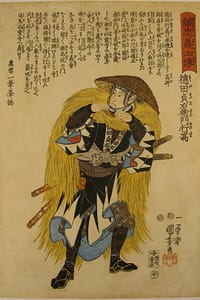
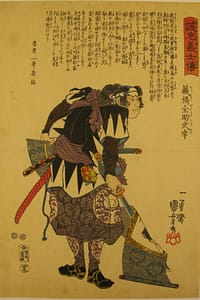
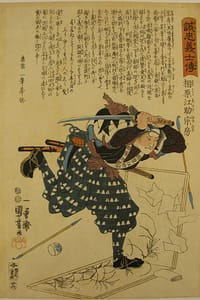
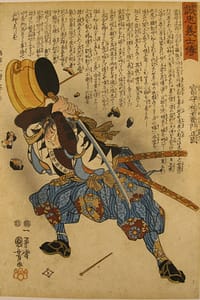
The bushidoboutique collection of 47 Ronin/Chushingura related prints
Single sheets


USD TBC
USD TBC
USD TBC
USD TBC








Triptychs
USD TBC
USD TBC
USD TBC
USD TBC
USD TBC