Stations of the Kisokaido prints – research
Anatomy of the woodblock print
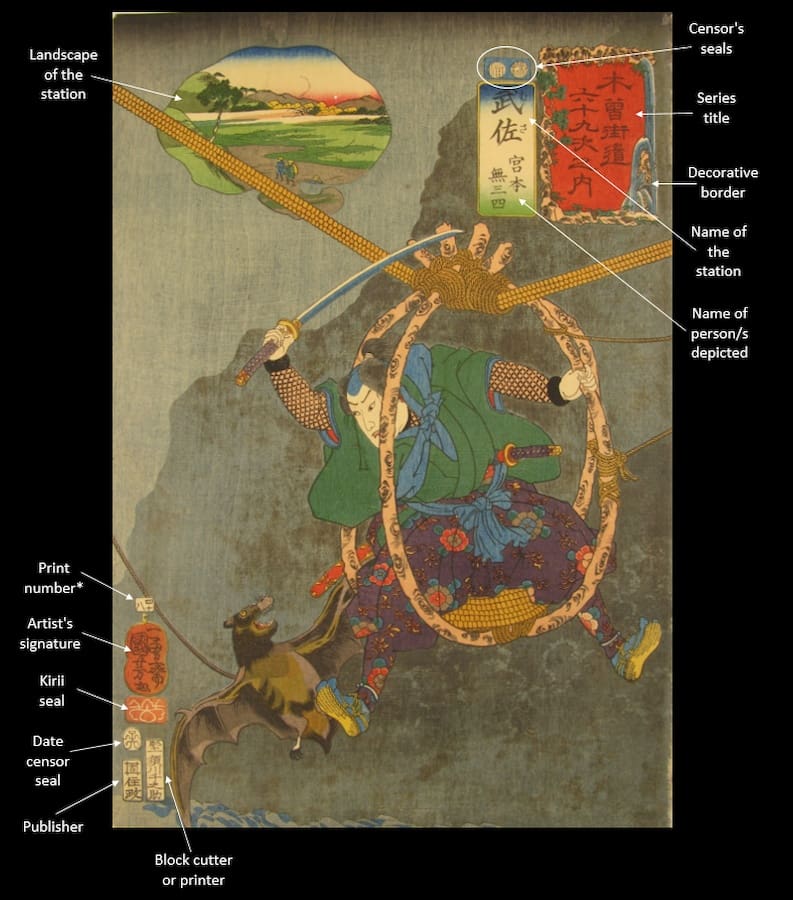
Each print consists of three pictorial elements; the main picture, the inset landscape and the decorative border that frames the series title in the upper right hand corner.
Series title: This red panel in the upper right corner contains the name of the series, and is the same on every print.
Decorative border: The border that surrounds the series tile will always cleverly associate in someway to the main story.
Name of station and character/s: The cartouche to the left of the series title contains, in large characters, the name of the station, and in smaller characters, the name/s of the persons depicted.
Censor’s seals: Above the name cartouche are the two censor’s seals. Refer below for more details regarding the censor seals found in this series.
Landscape panel: In the upper left corner is a panel depicting the landscape of the station, the shape of the panel or it’s border – or both, somehow relate to the story.
Artist signature and seal: The bottom left corner has additional information such as Kuniyoshi’s signature and Kiri seal.
Print number: Above the artists signature is the print number, with the exception of prints 8 and 71 which appear unnumbered. Noting also, that print 67 (example below) has been incorrectly numbered as 48. I have seen 1 example that appears to be have been corrected to 67 in a later print state, but I’m unsure if it’s a genuine example, or an overzealous collectors ‘adjustment’.
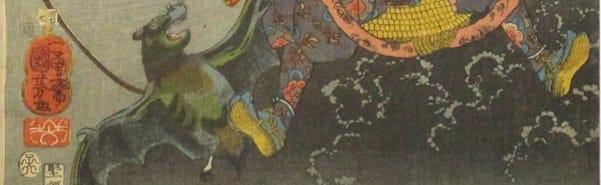
Censor’s date seal: A third censorship seal providing the date of the publication (with some mistakes on some prints apparently as it was a relatively new system at this time), nuances within the seal will differentiate 1852 and ‘month’ and 1853 and ‘month’.
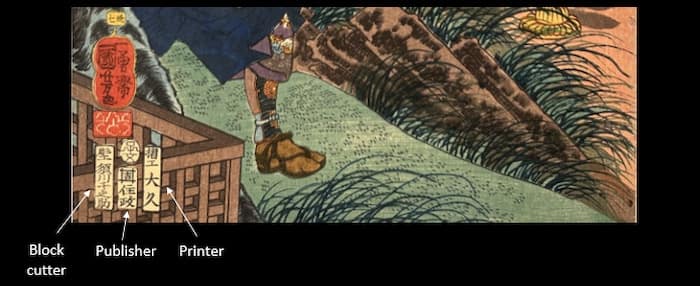
Publisher’s seal: Displays as either a trade mark or a rectangular cartouche, usually underneath the Kiri seal or Censor’s date seal.
Block cutter and/or Printer name: These can be found on some prints either alone or in combination. Generally display in a cartouche alongside the Publisher’s seal.
Censor seals
During the period 1842 – 1853 individual censors called Nanushi marked prints with their individual seals. During the period 1842 – 1846 these were found singly. From 1847 – 1853, the Nanushi marked prints in pairs.
As censors worked together during different periods the combinations of censors can be dated. This series was produced during the months May 1852 – February 1853, as such the following censors’ seals will be found in combination:
- Fukushima-Muramatsu
- Hama-Magome
- Kinugasa-Murata
- Mera-Watanabe



