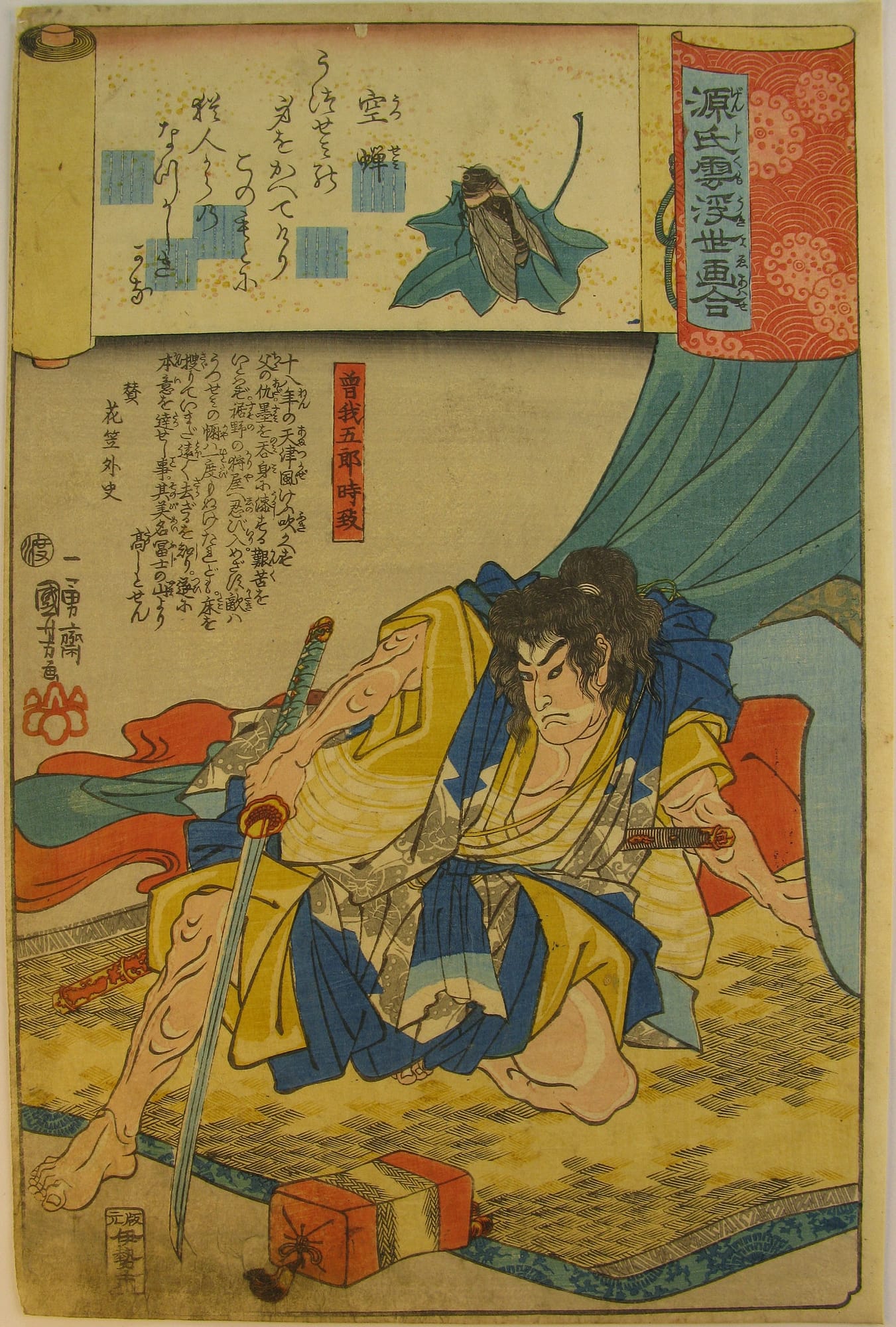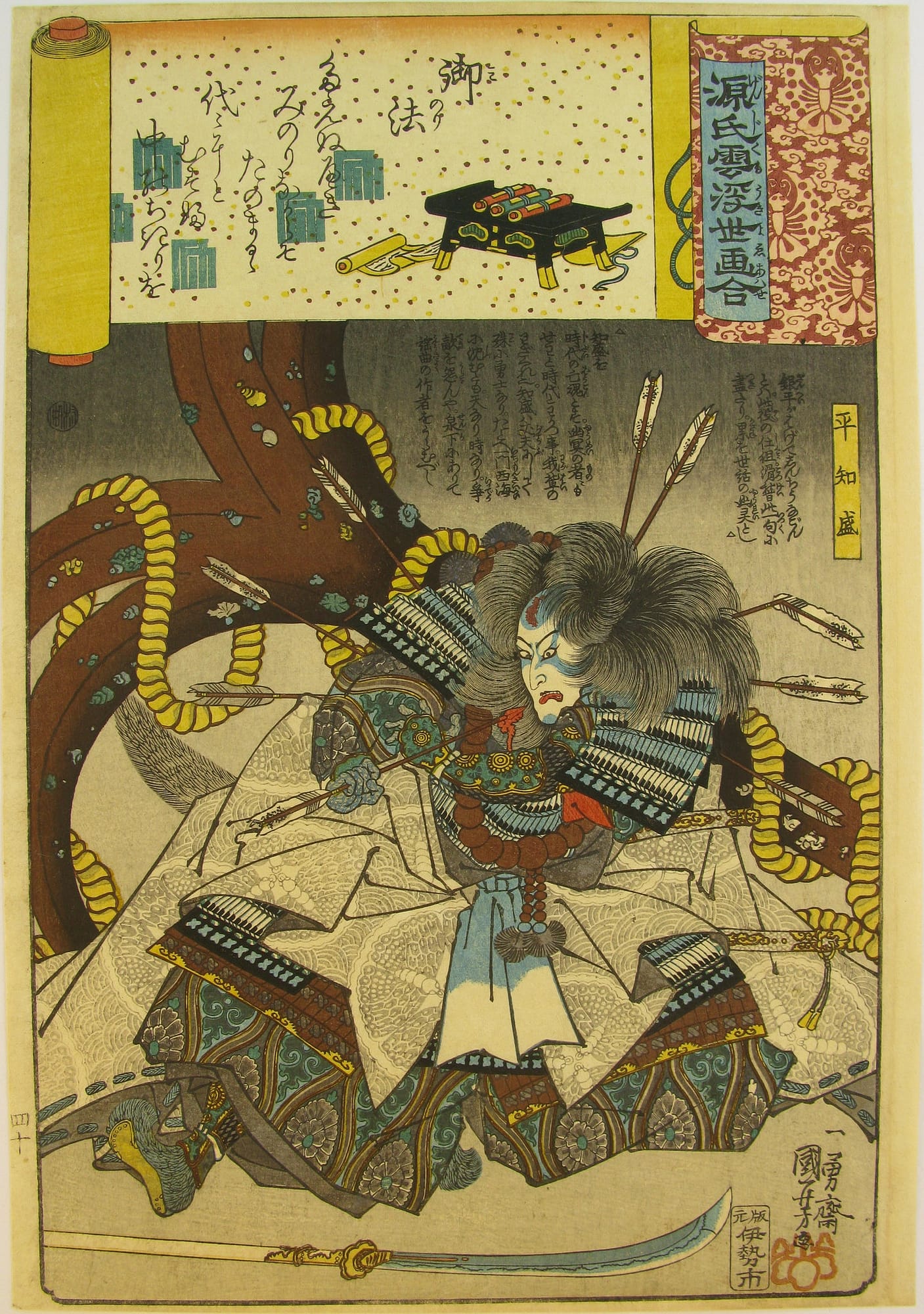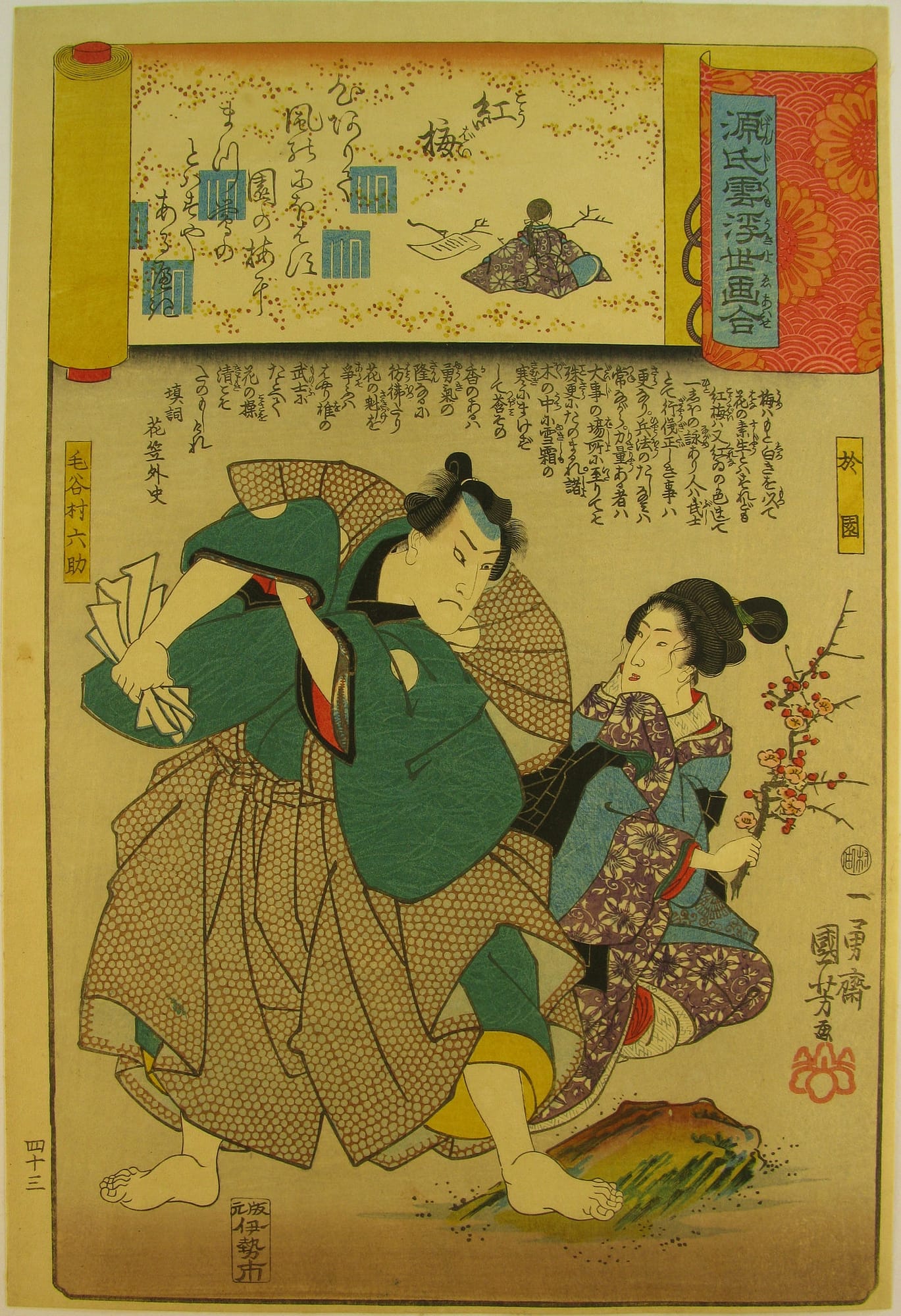
Kuniyoshi – Comparisons of the cloudy chapters of Genji
Genji kumo ukiyo-e awase, 源氏雲浮世画合
The Tales of Genji (Genji monogatari) is the greatest novel in classical Japanese literature and often considered the world’s first novel—was written by Lady Murasaki in the early 11th century and follows the romantic exploits of Prince Genji. Each of its 54 chapters has its own name and crest (Genji‑mon).
Kuniyoshi’s print series doesn’t illustrate the novel directly. Instead, each print is linked to a chapter through its crest and accompanying poem, but the imagery draws from warrior tales, folklore, and kabuki theatre rather than Genji’s courtly world. Many characters are even recognizable kabuki actors. The result is a playful hybrid of parody and musha‑e (warrior prints).
This series consists of one design for each of the fifty-four chapters, on which the title cartouche in the right upper corner reads Genji kumo ukiyoe awase (源氏雲浮世画合); and six additional prints titled Genji kumo shu-i (源氏雲拾遺).
Print size: ôban
Publisher: Ise-ya Ichibei
Published: 1845-1846
Print no: usually found in the left hand margin.
Censor seal: Due to the time period (1843 -46) these were produced there was only a single censor seal (nanushi) required. Various censors were involved including, Watari, Kinugasa, Mura and Murata. They approved the following prints:
- Watari: 1-7, 16, 18, 20, 23, 24
- Kinugasa: 8, 9, 10
- Mura: 11-15, 17, 19, 21, 22, 25-31, 36, 41
- Murata: 32-35, 37-40, 42, 43, 44, 46-60
Censorship Context
During the Tenpō Reforms (1841–43) introduced by Mizuno Tadakuni (chief adviser to the shogun Tokugawa Ieyoshi), depictions of kabuki actors (yakusha-e), courtesans (bijin-ga), and overtly erotic (shunga) subjects were restricted. Artists like Kuniyoshi turned to allegory, embedding actor likenesses into historical or mythical figures. Genji kumo ukiyo-e awase exemplifies this strategy: actors’ recognizable faces appear disguised as warriors or legendary heroes. This series is not conservative—it is a coded continuation of prohibited imagery.
Kuniyoshi’s use of grotesque and playful imagery, part of the broader asobi-e (“play pictures”) tradition. The series belongs to the broader Edo practice of mitate-e (見立絵). Mitate means comparison, parody, or playful analogy. These prints assume an active, knowledgeable viewer; to “read” a print properly, the Edo viewer would ideally:
- recognize the Genji chapter via the crest (genji-mon)
- understand the poetic inscription
- identify the kabuki role or actor likeness (even without names)
- grasp the analogy between the two layers.
This creates what can be described as a multi-layered semiotic system. These are not just images, they are intellectual puzzles, rewarding connoisseurship. The series is studied as a cultural negotiation, balancing popular demand for actor prints with shogunate restrictions, while embedding literary prestige through Genji references.