The ghost of Asakura Togo haunting Masatomo
Play: Higashiyama Sakura sôshi (東山桜荘子), The Higashiyama Storybook
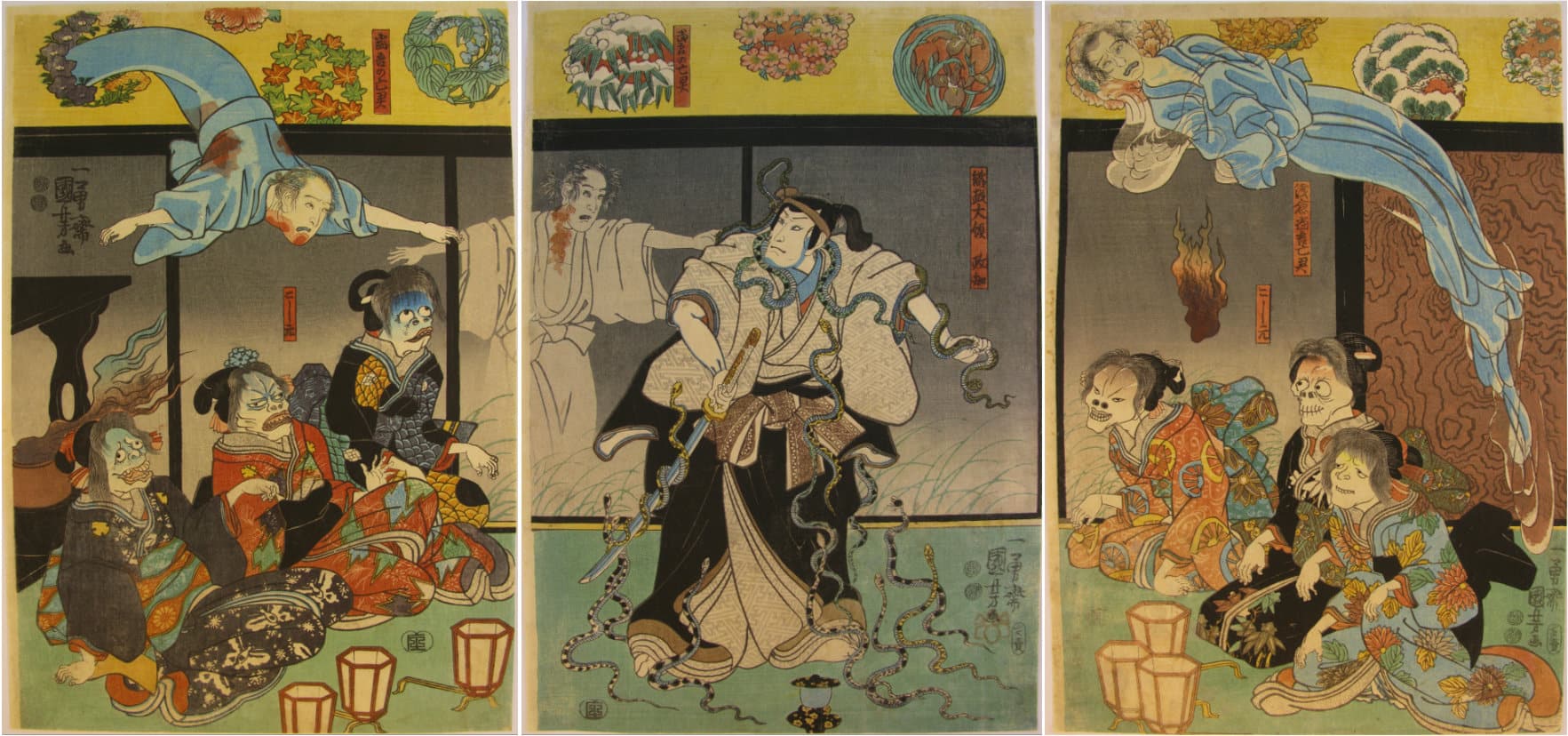
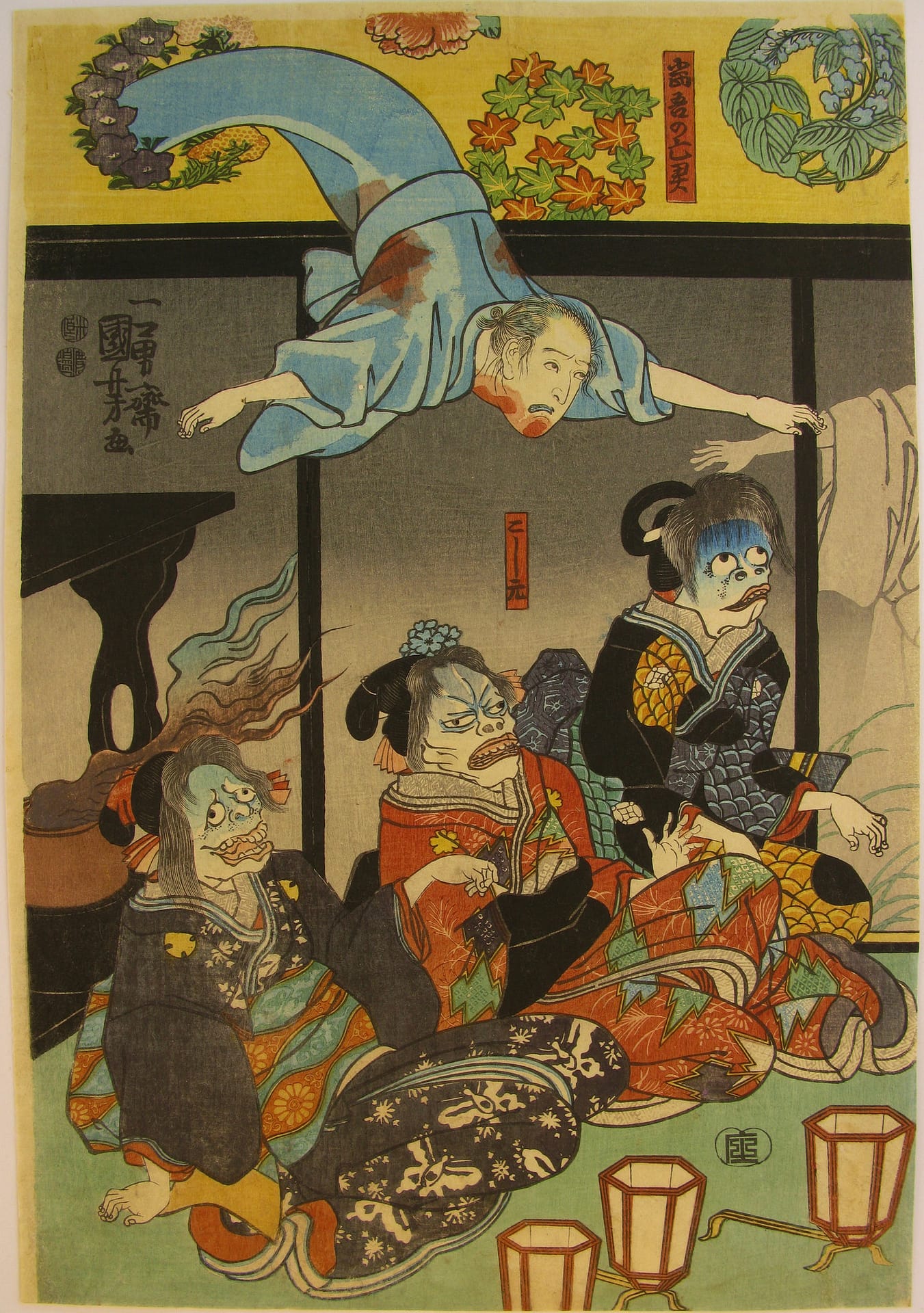
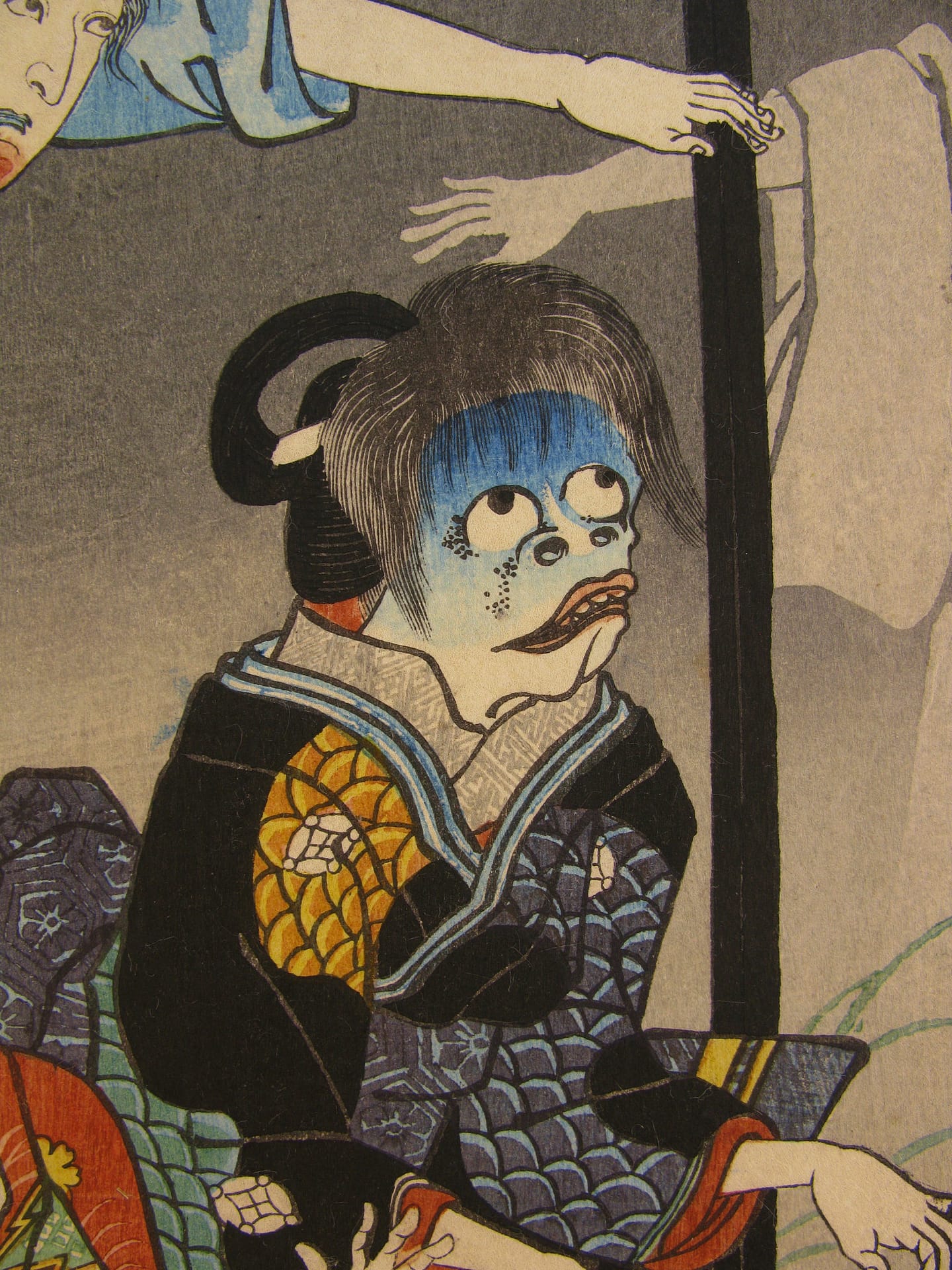
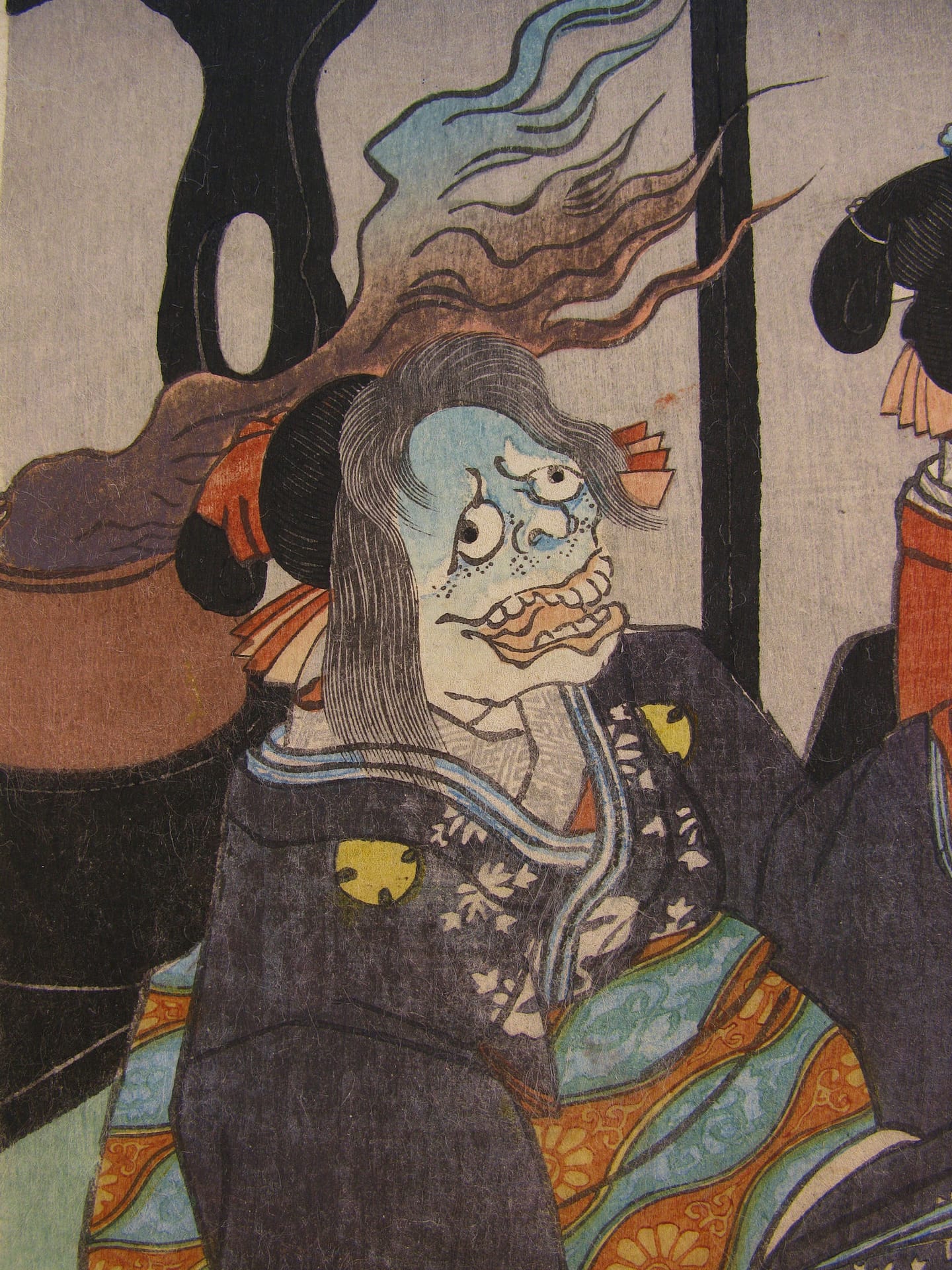
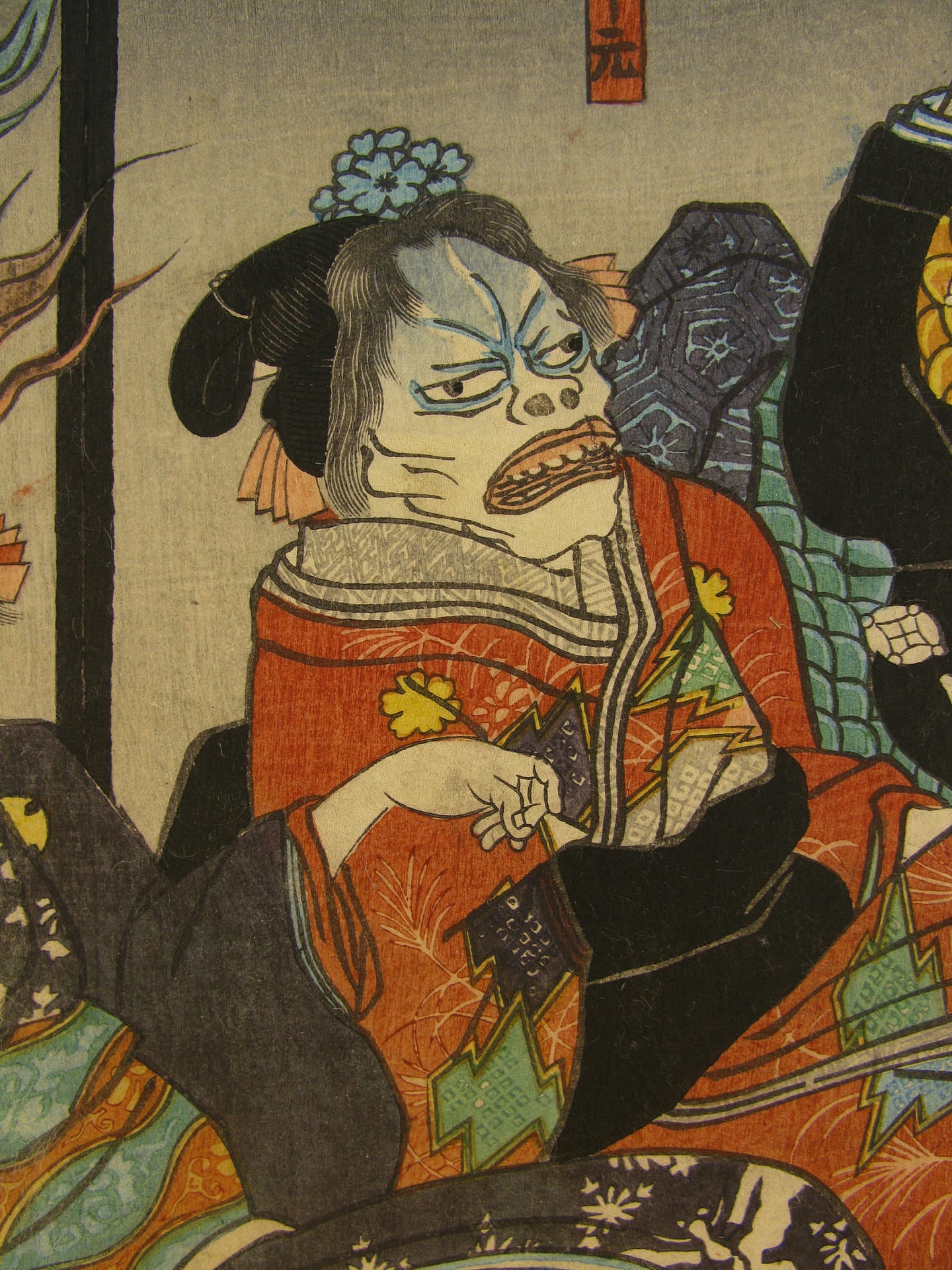
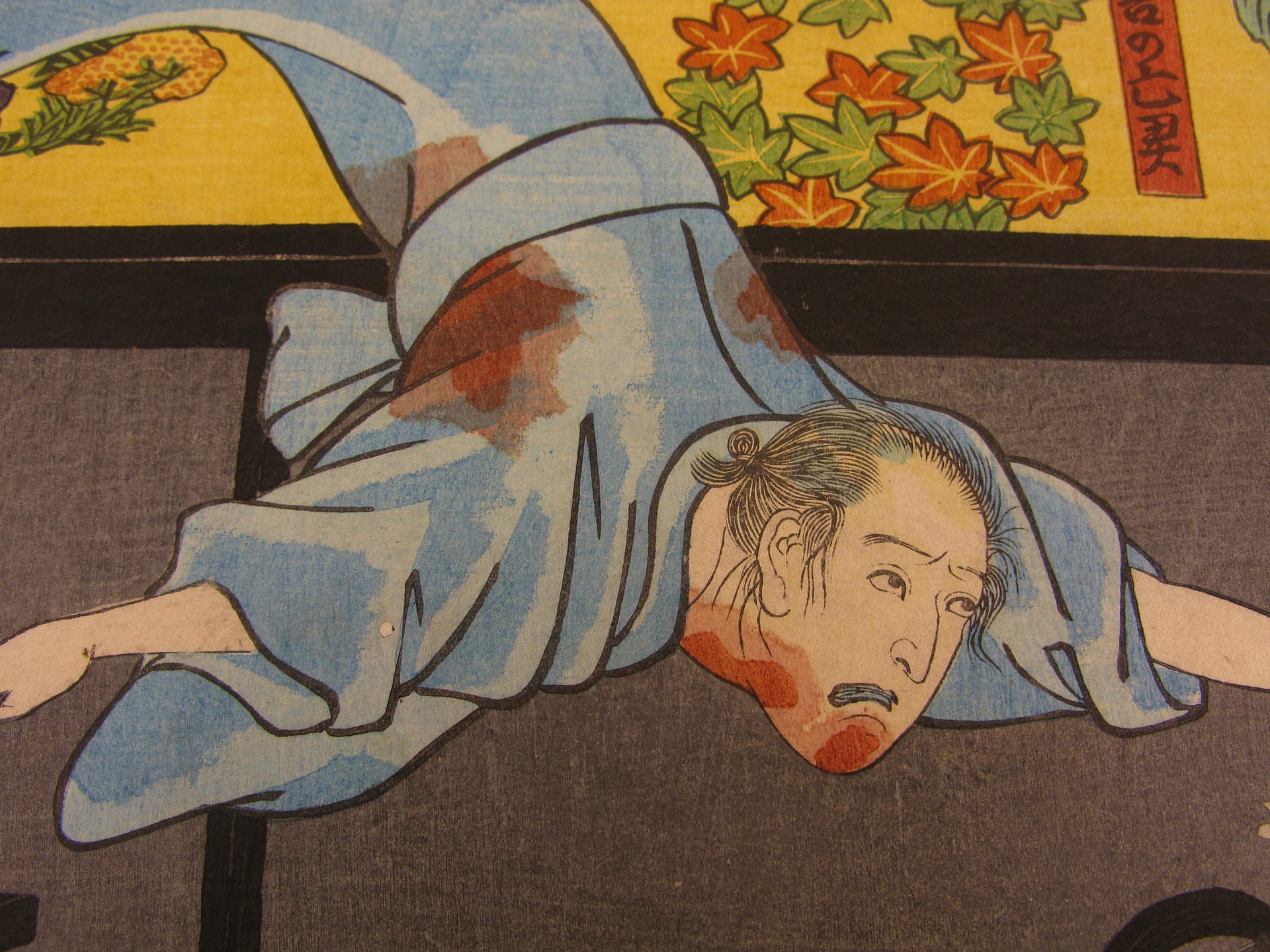
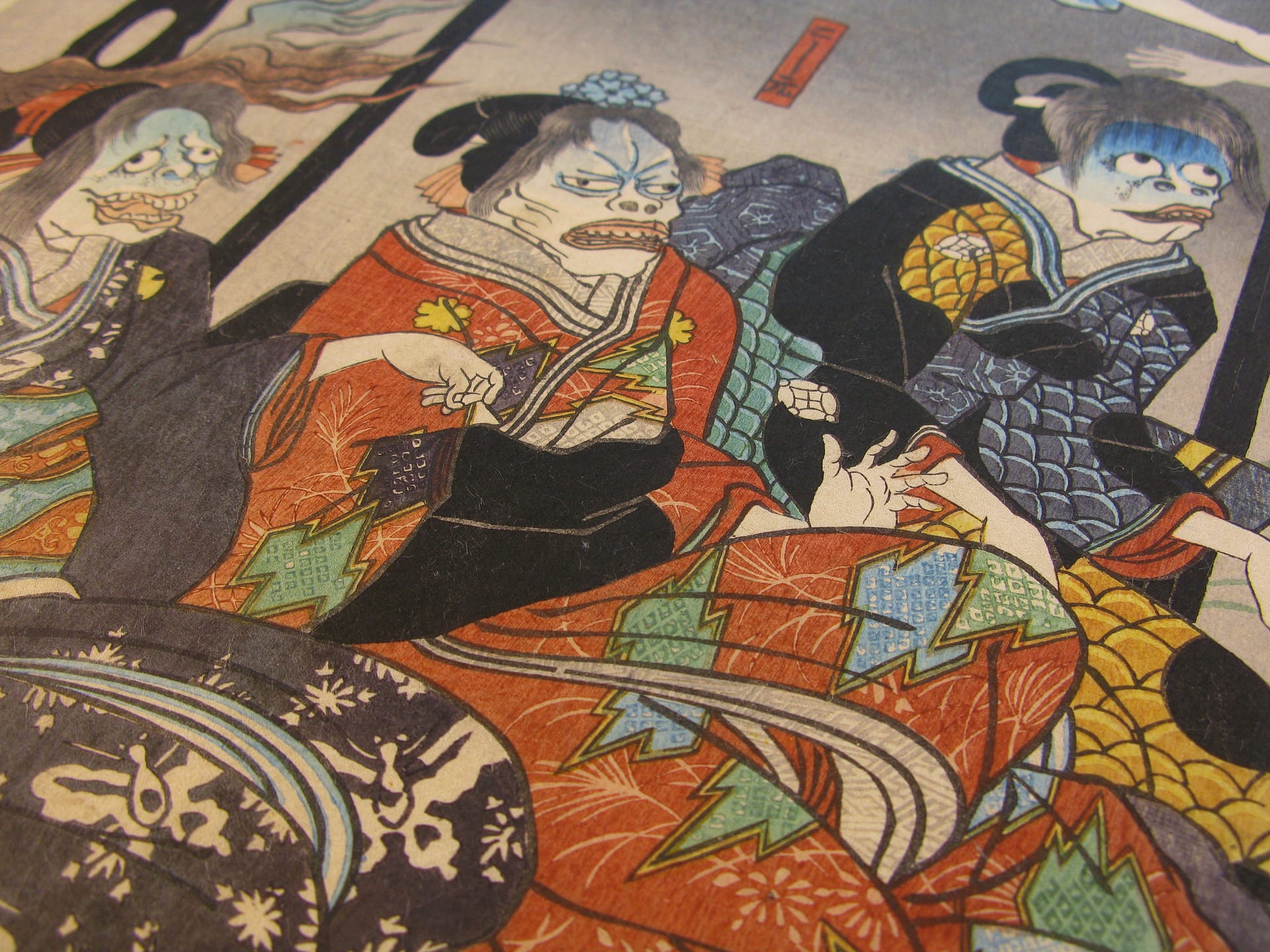
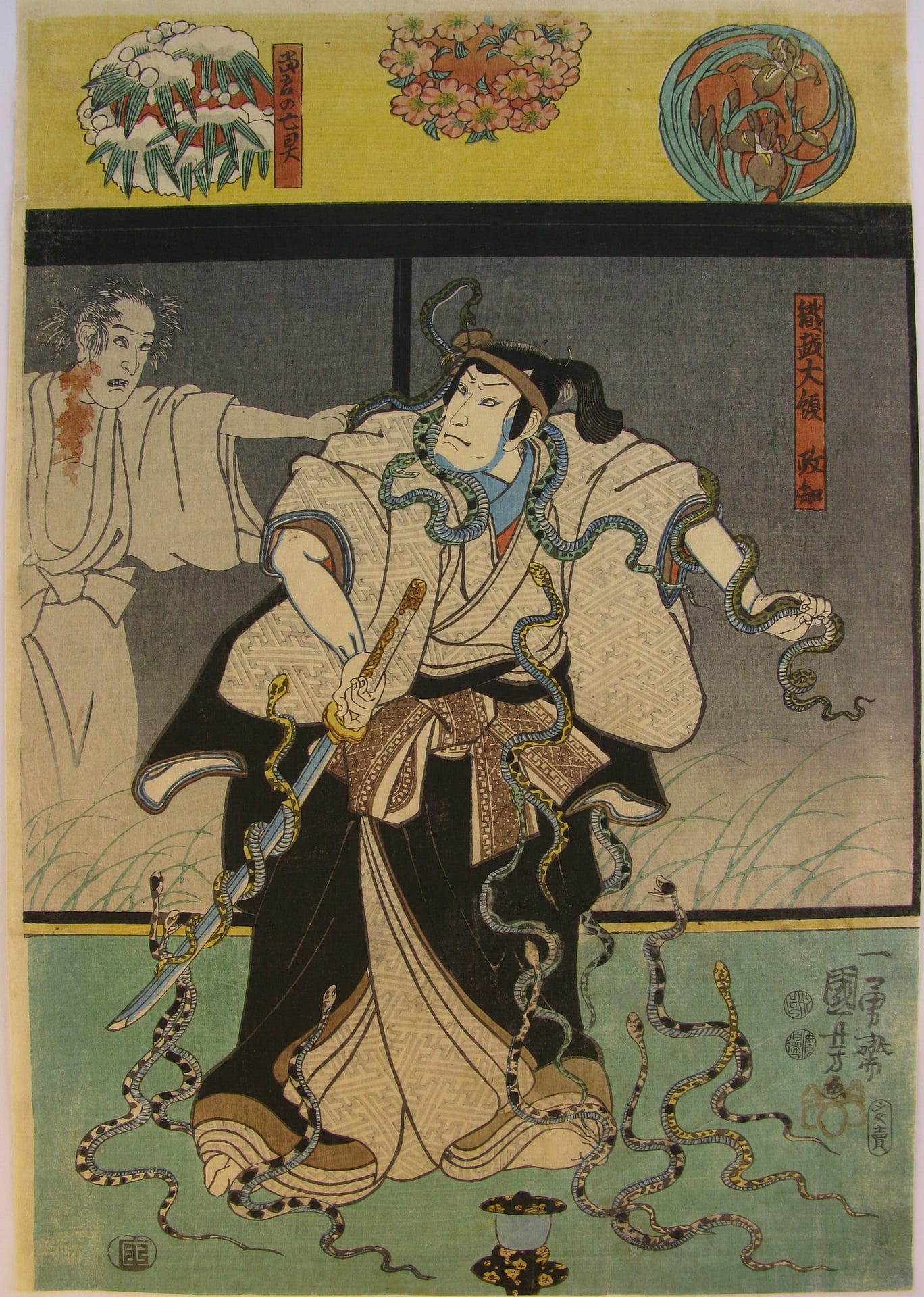
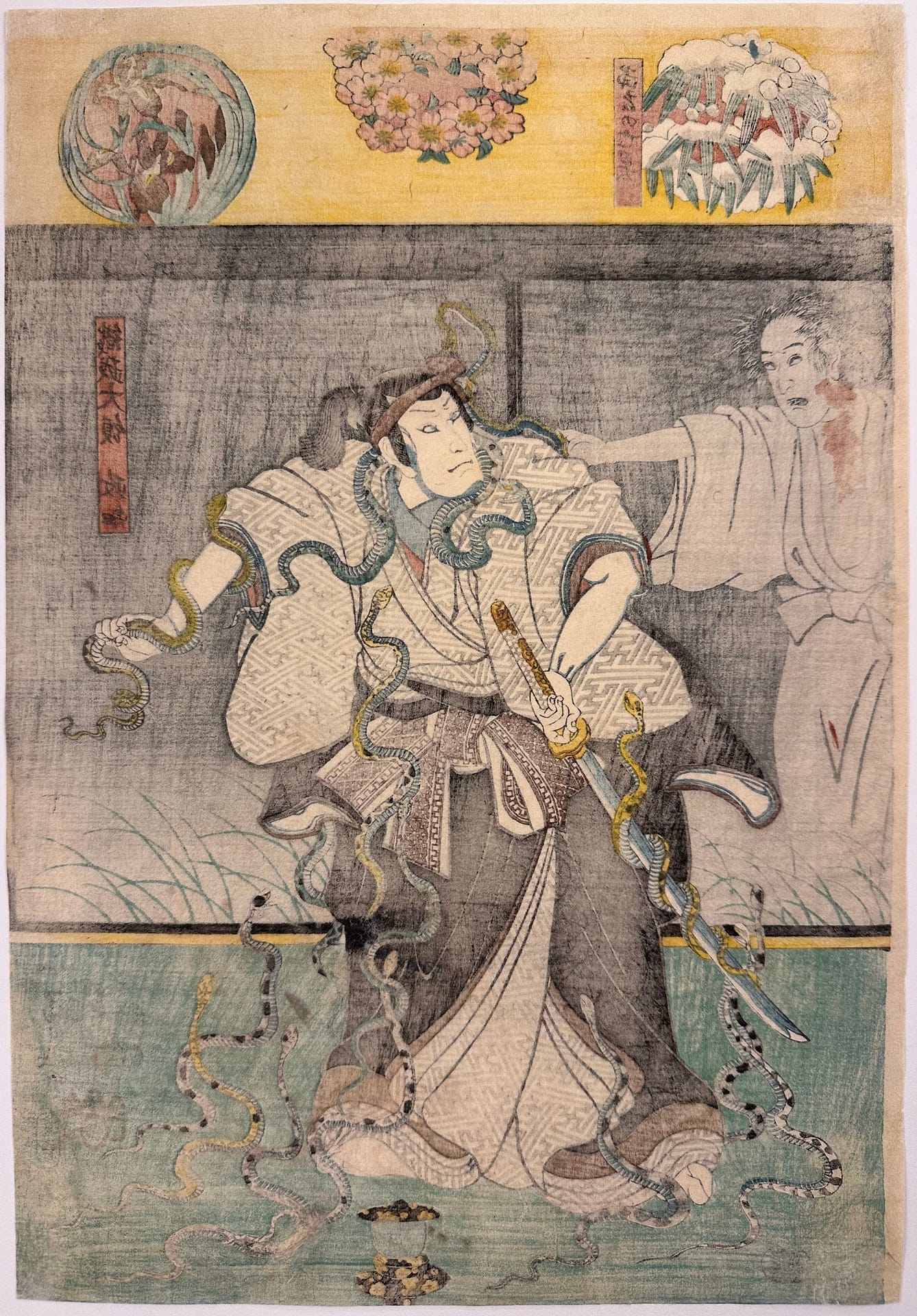
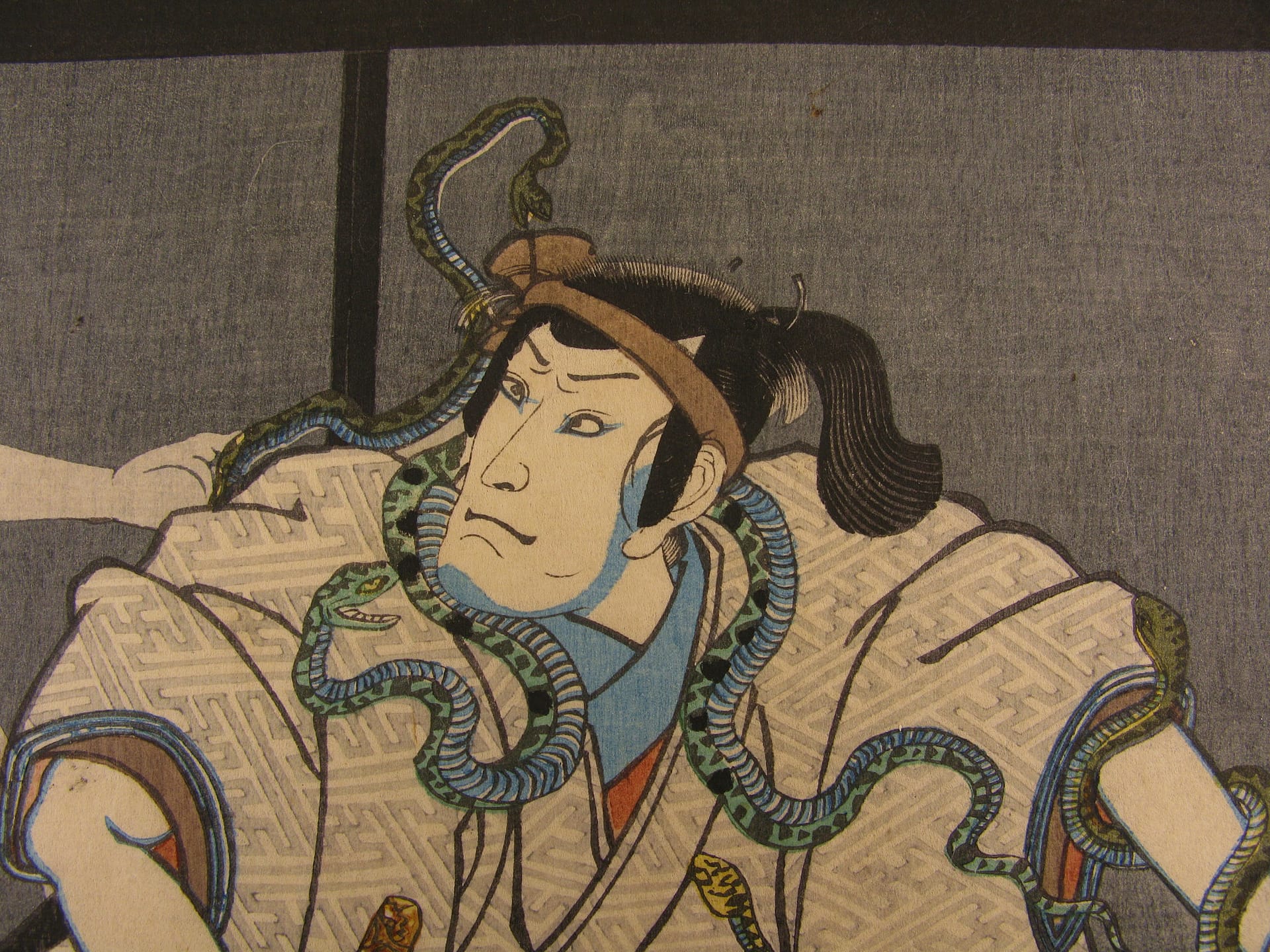
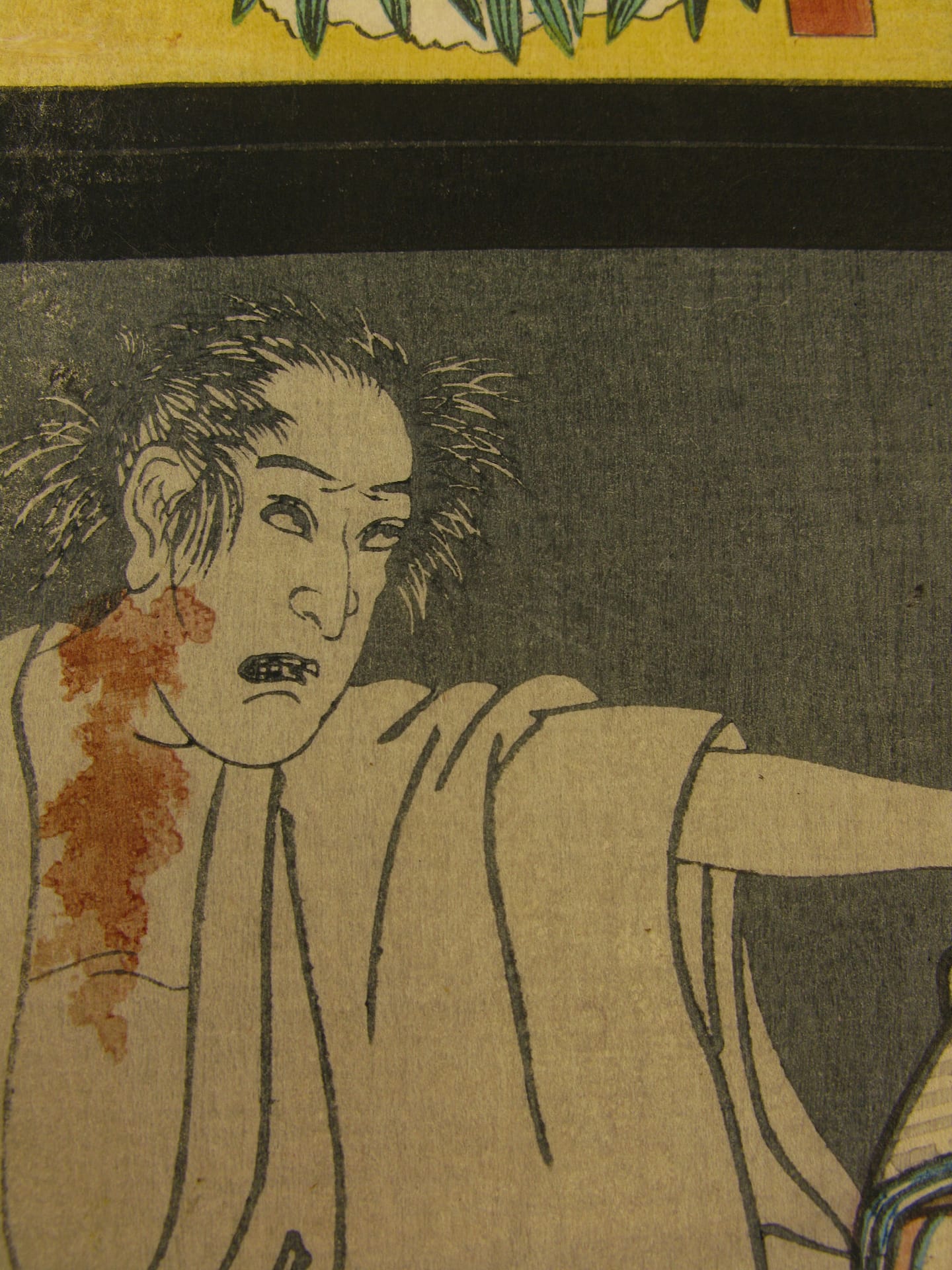
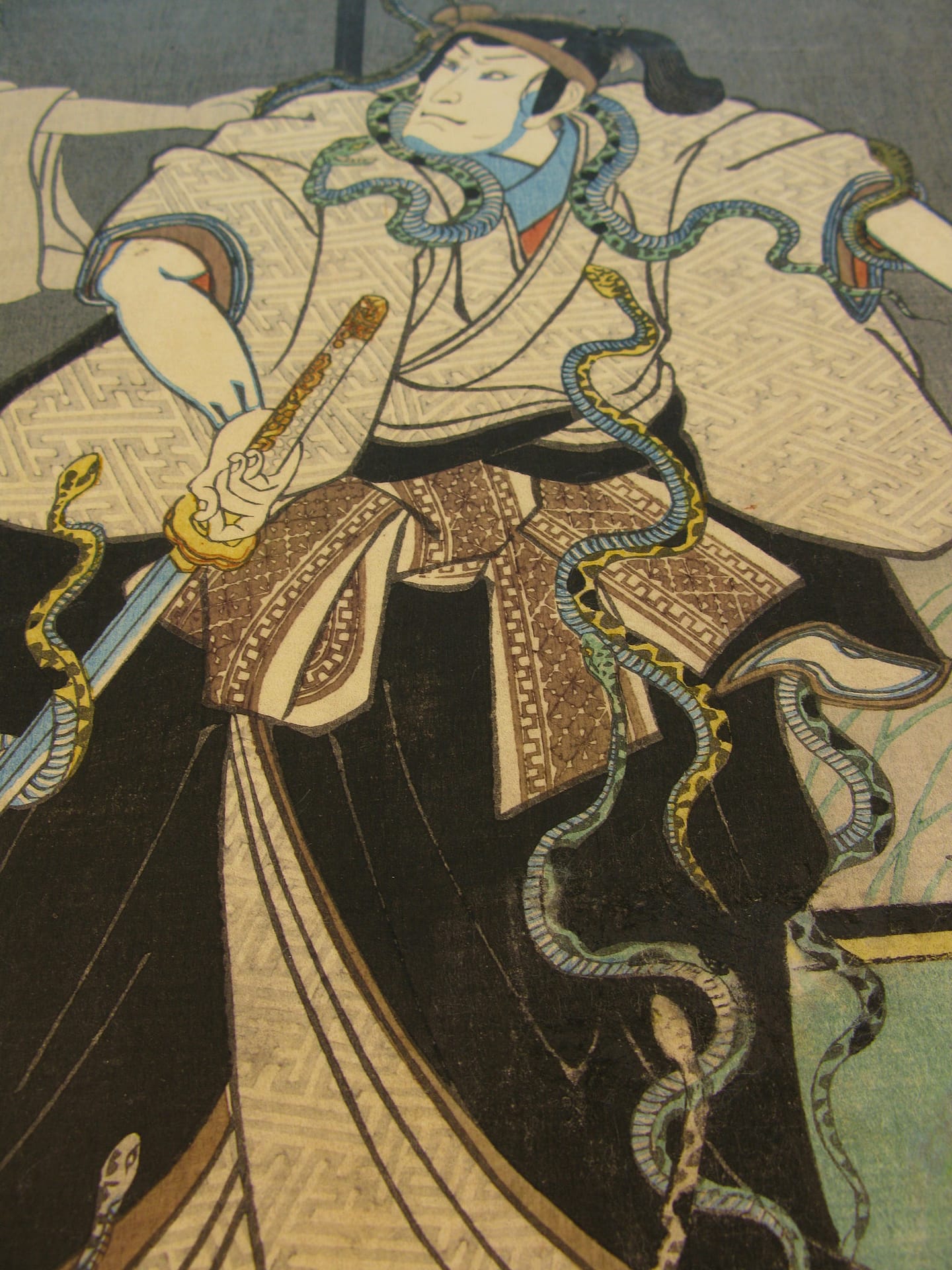
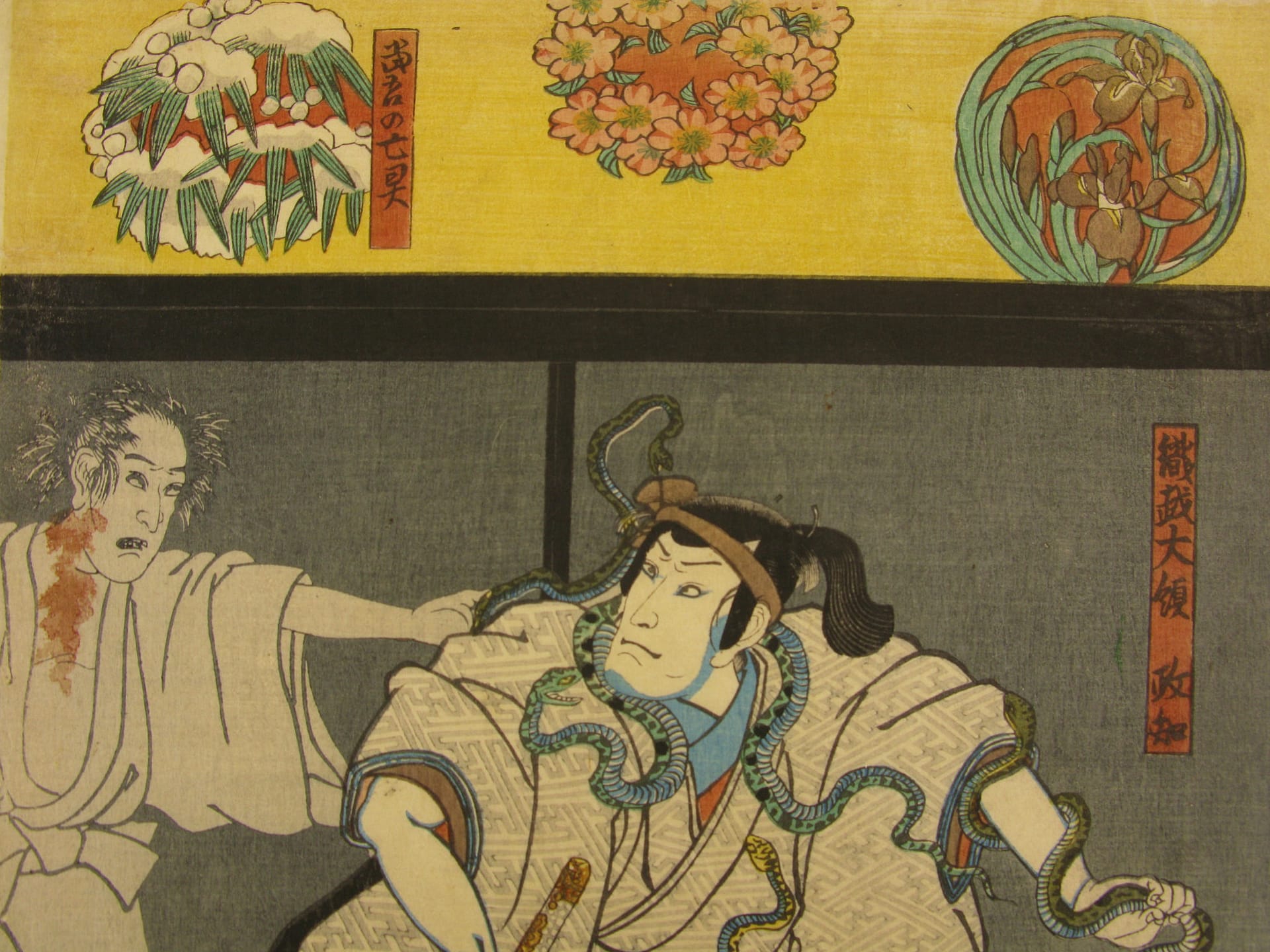
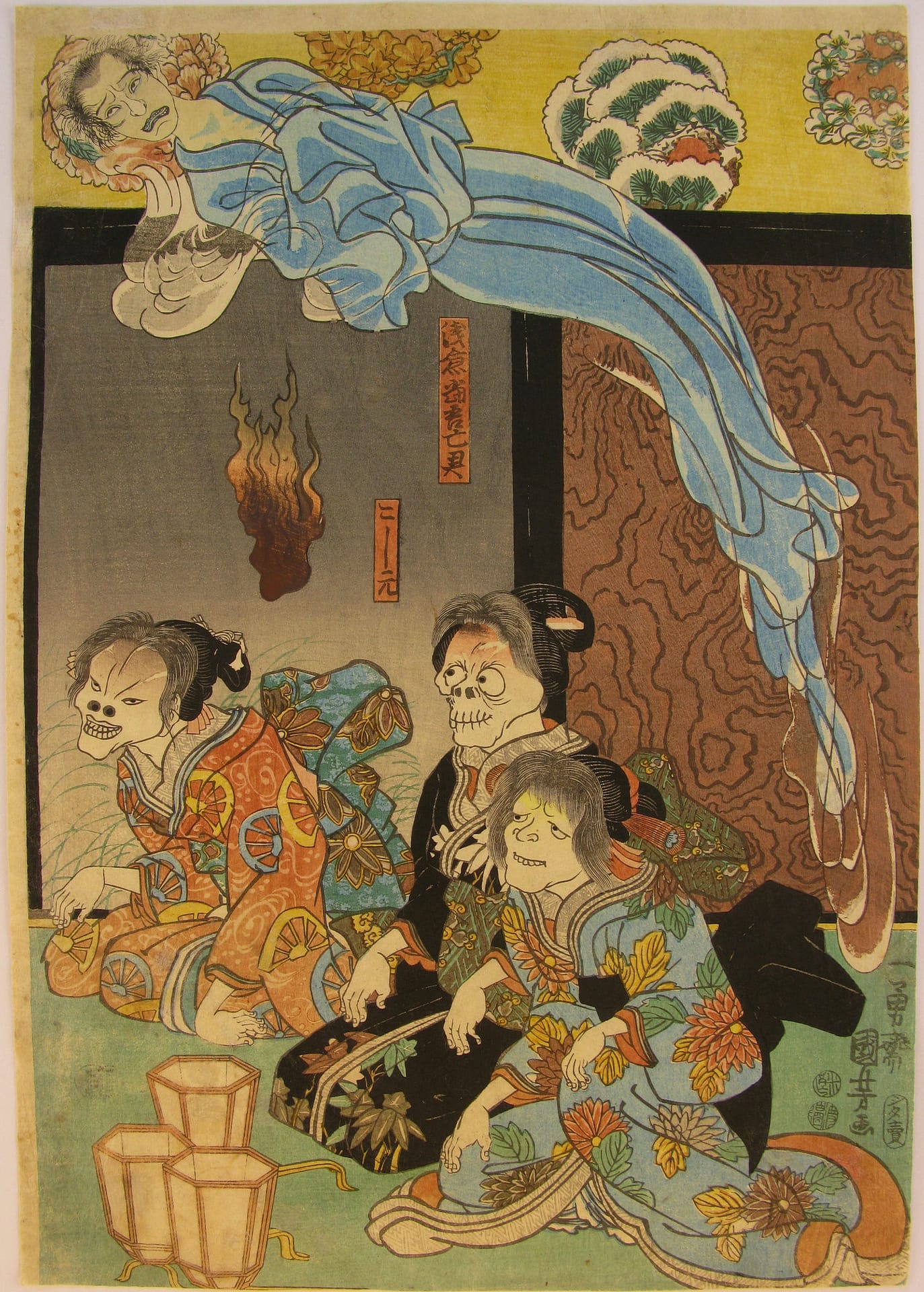
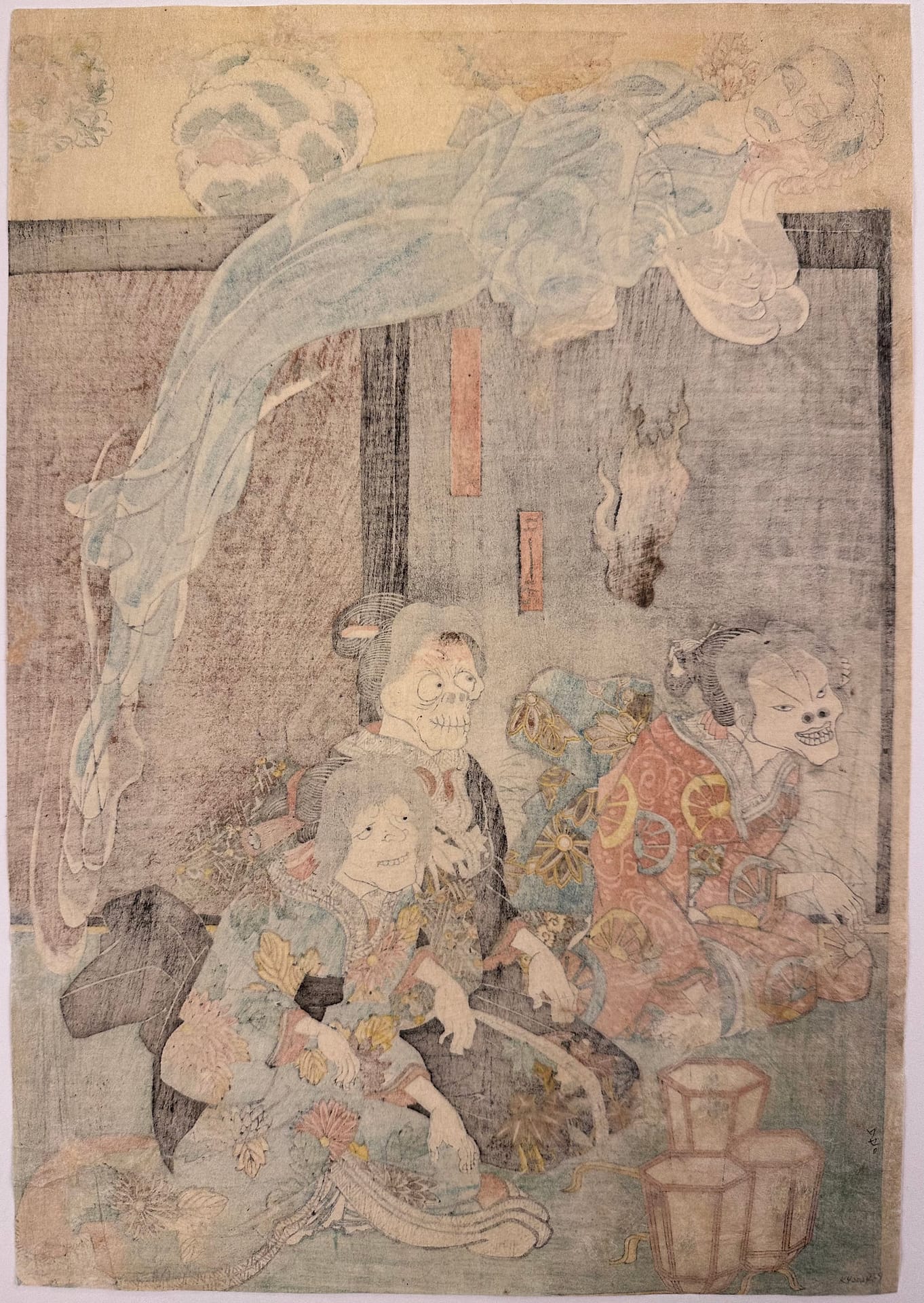
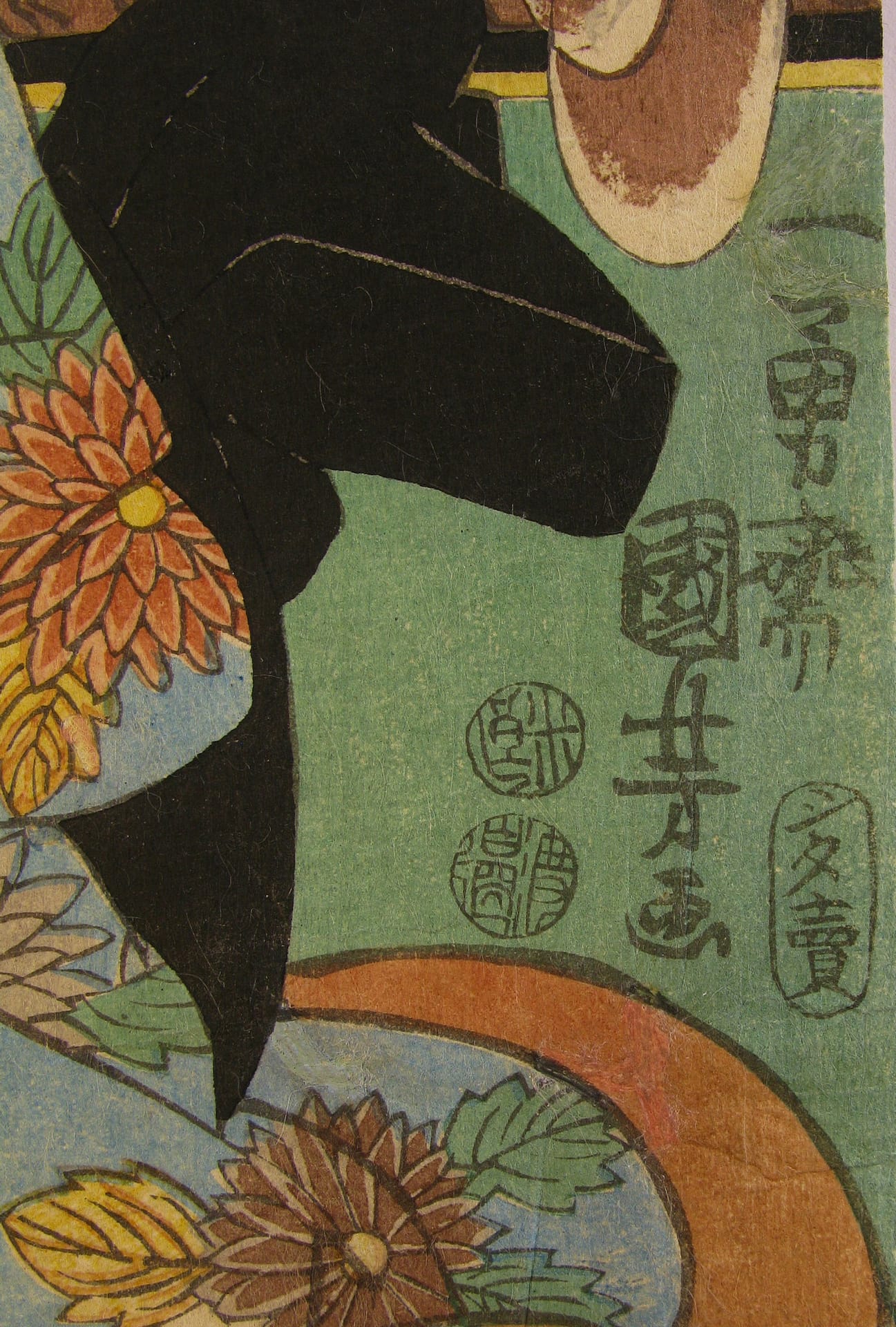
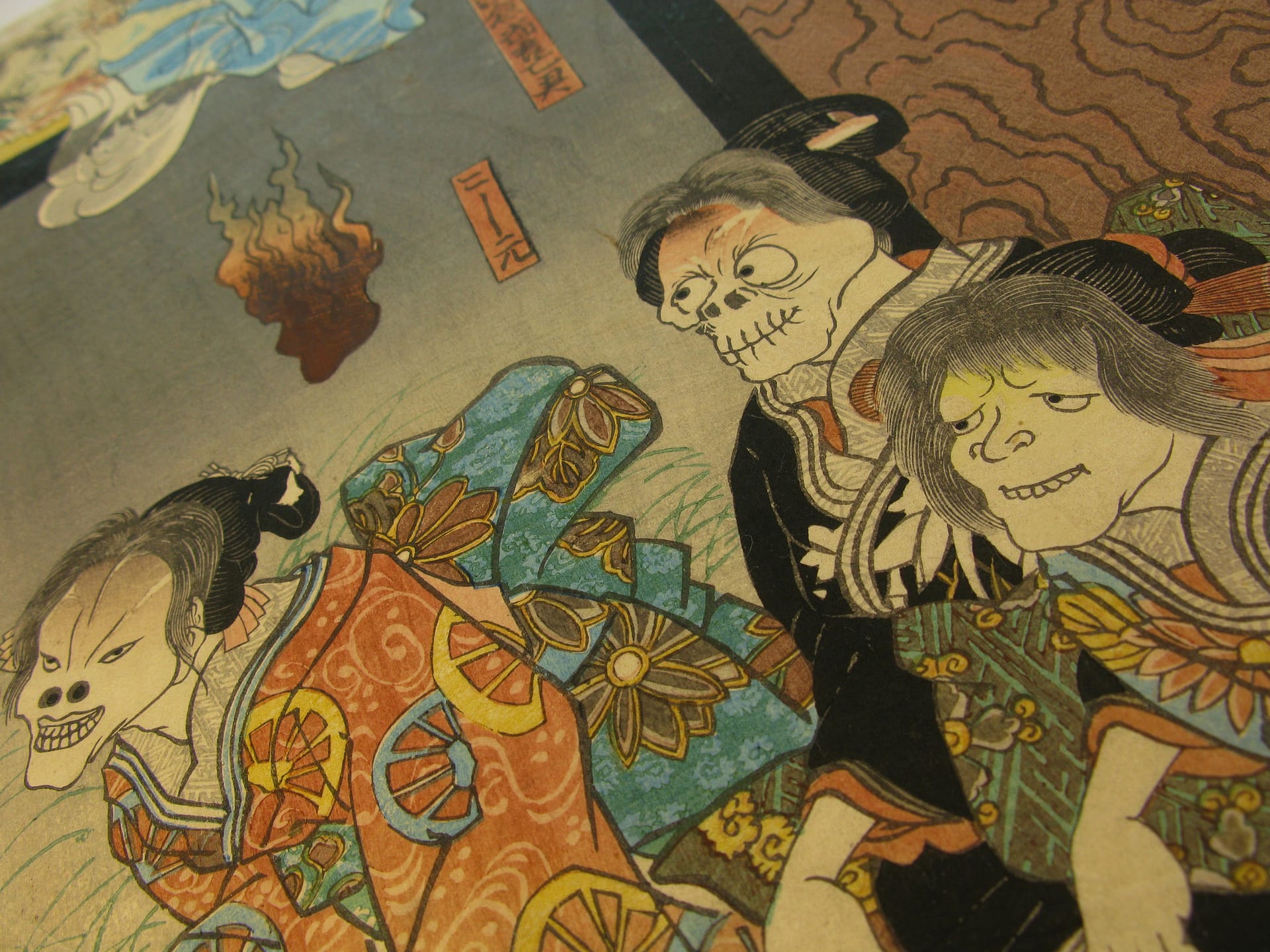
Actors: Bandô Hikosaburô IV as Lord Orikoshi Masatomo (織越大領), center sheet; and Ichikawa Kodanji IV as the ghost of Asakura Tôgo (浅倉当吾), on all three sheets
Artist: Utagawa Kuniyoshi (1797 – 1861)
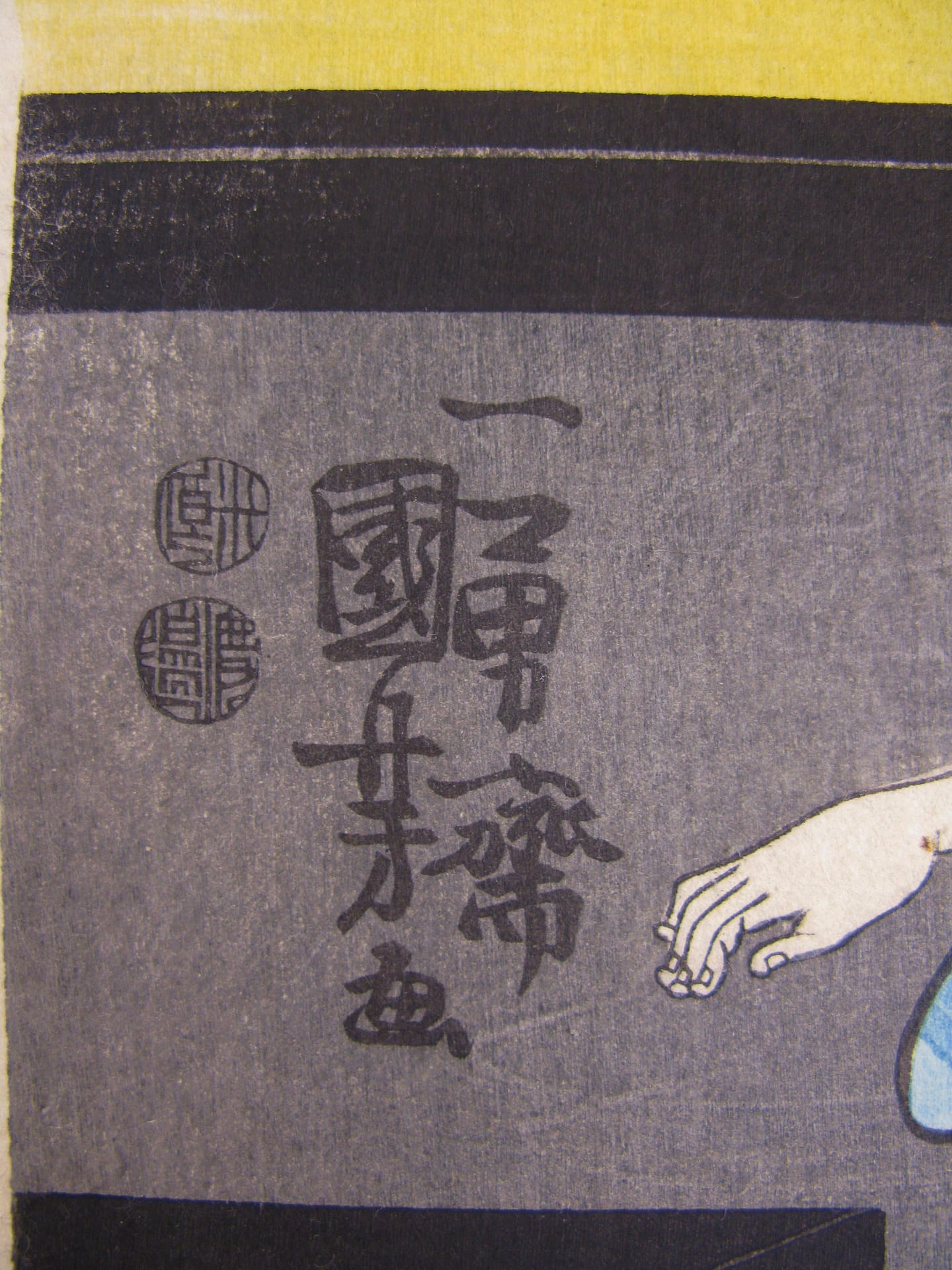
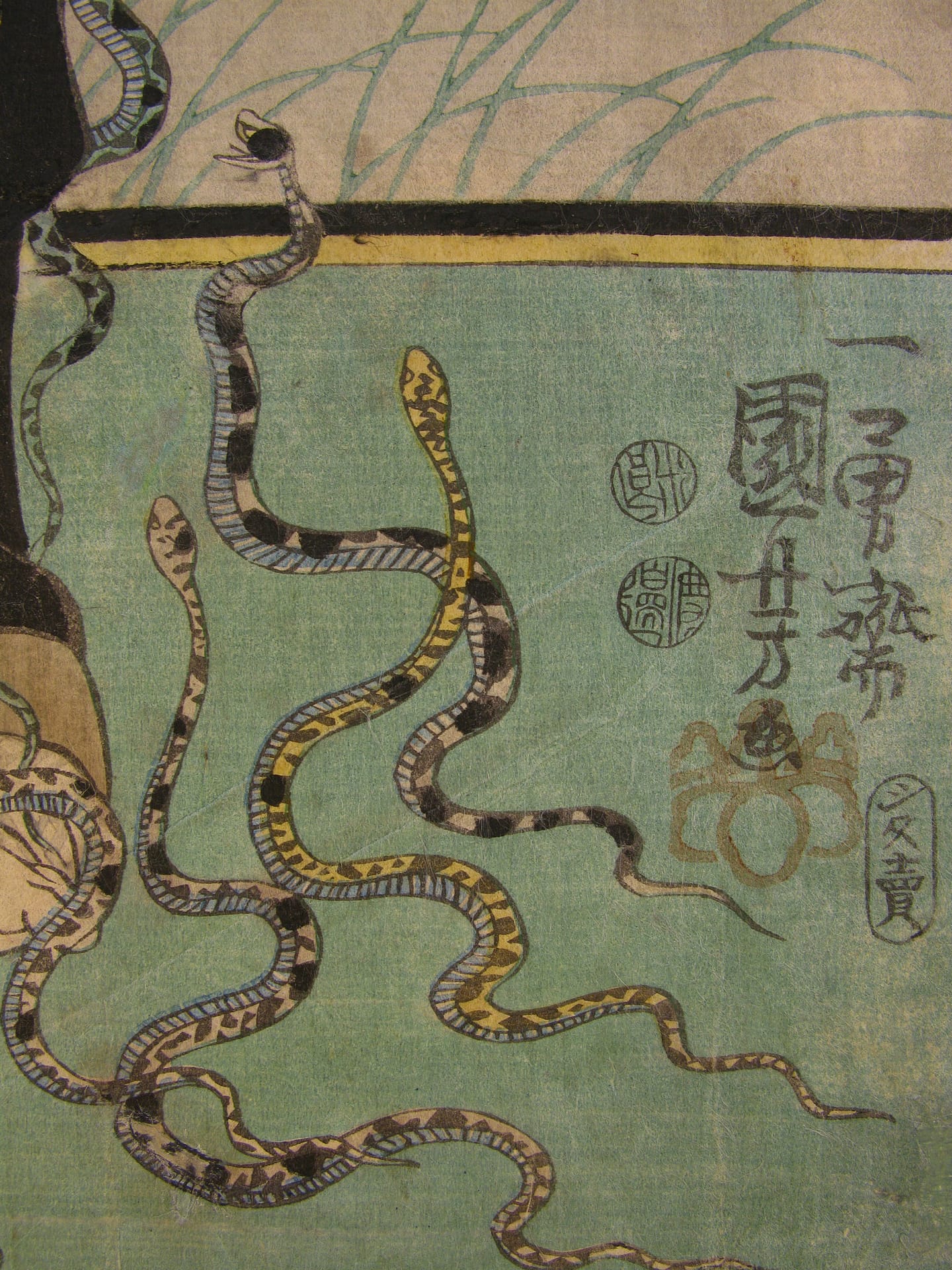
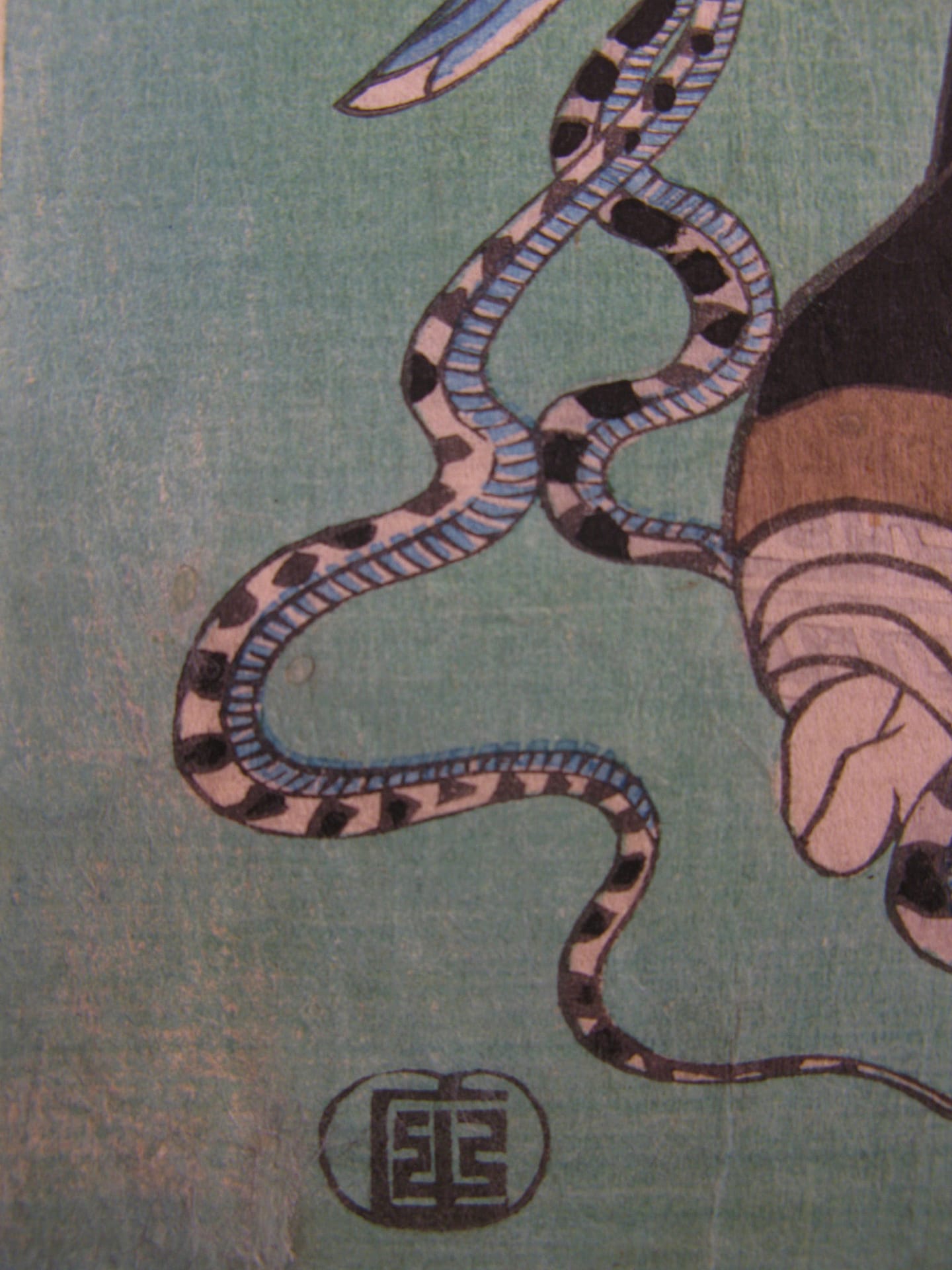
Signature: Signed on all three sheets Ichiyusai Kuniyoshi ga (一勇斎 國芳 画) with his Kiri seal on the centre sheet
Date: 8th month of 1851
Publisher: Hayashi-ya Shôgorô
Censor: Mera and Watanabe
Retail seal: shita uri (discreet sale). This appeared occasionally on prints between 3rd month 1850 and 12 month 1853 as an instruction to print shops to only display actor prints in a limited capacity. Placed on the centre and right sheet
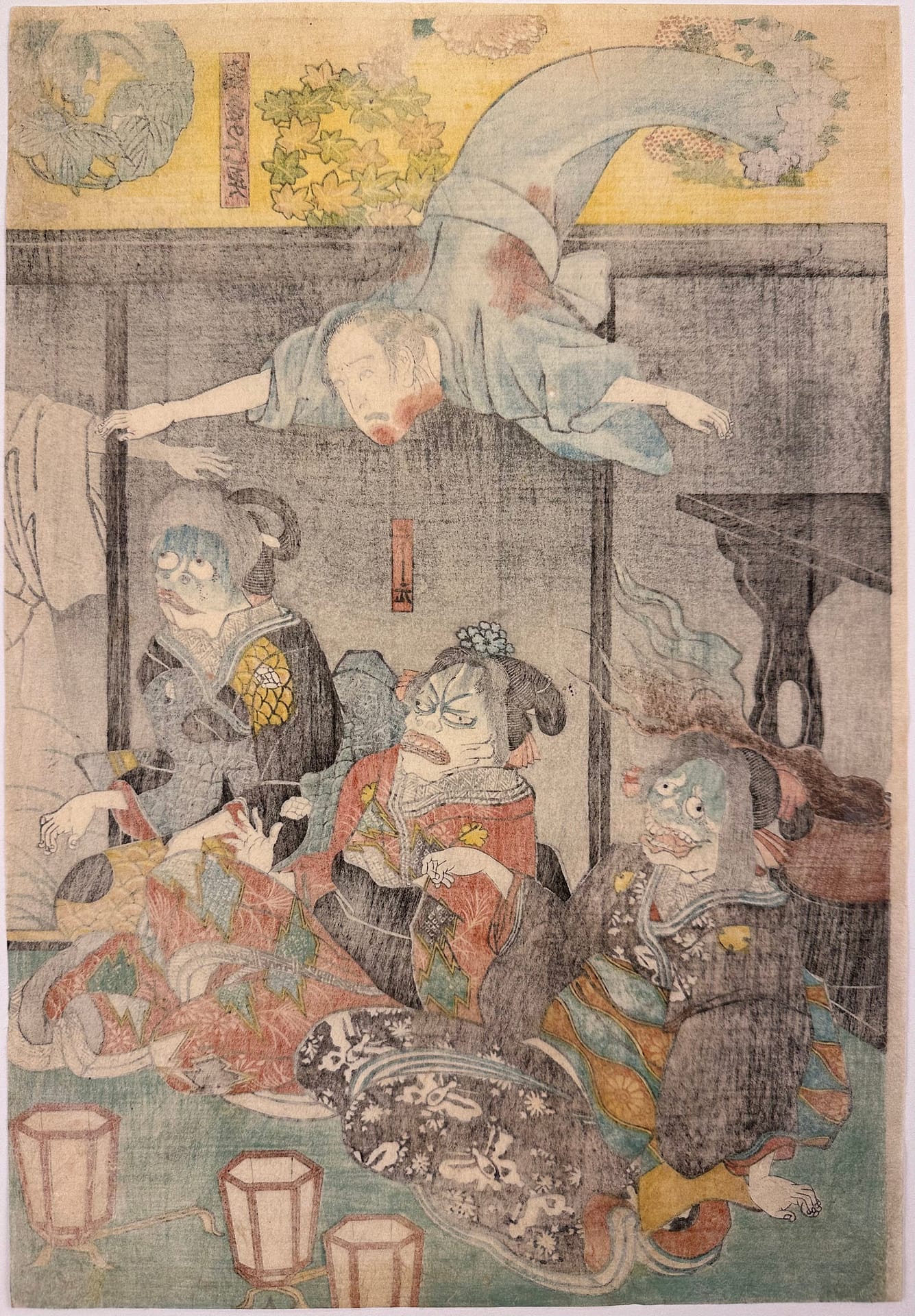
Condition: Good impression with wood grain visible in back ground screens. Good colour with some fading. Good condition based on extant examples, some wormage repaired, and rubbing and soiling. Untrimmed
Price: TBC
Literature n stuff:
- Andreas Marks; Japanese Yokai and other supernatural beings, page 160-61
- Timothy Clark; Kuniyoshi – from the Arthur R Miller collection, page238-, page238-39
Description: The triptych reproduced here shows haunting of Lord Masatomo, and is one of Kuniyoshi’s finest supernatural designs.
Sakura Sōgo, originally the village headman Kiuchi Sōgorō (1605–1653), became one of Japan’s most celebrated peasant martyrs after, according to legend, he risked his life by petitioning the Shōgun to relieve oppressive taxation in Sakura Domain. Executed along with his family, he vowed to return from the grave to avenge their deaths.
Because Tokugawa censorship prohibited dramatizing recent historical figures, Kabuki playwrights transformed him into the fictional Asakura Tōgo, while his persecutor, Lord Hotta Masanobu, became Orikoshi Masatomo. For more background refer to The tale of Asakura Togo’s ghost
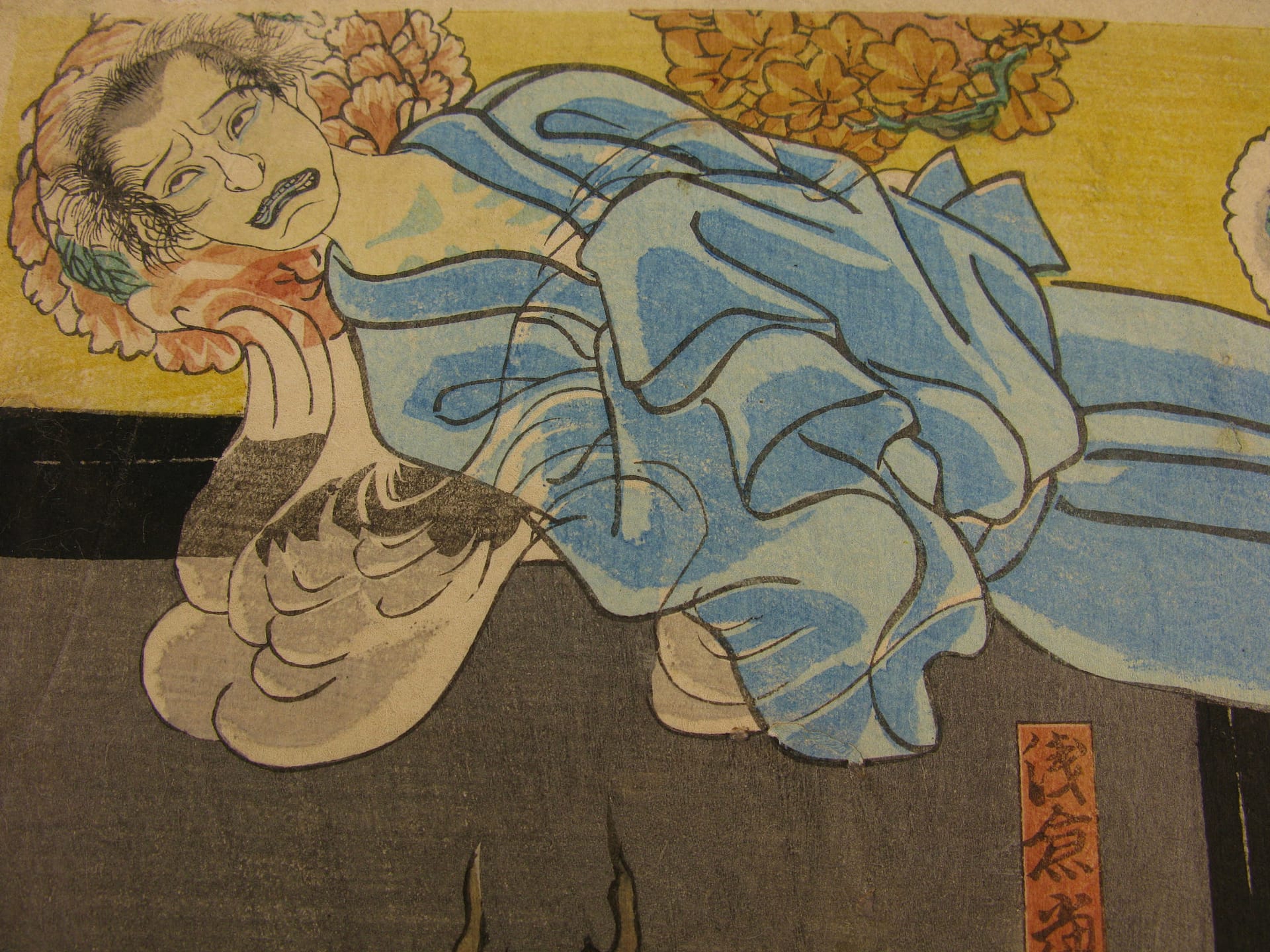
Asakura Tōgo dominates the composition, floating across the ceiling beams in the left and right sheets and appears in the folding screens in the background of the centre sheet, making him appear omnipresent.
The snakes coiling around Lord Masatomo reinforce themes of fear, corruption, and supernatural punishment. The pale clothing and purple headband indicating his ‘unwell’ state – his descent into madness.
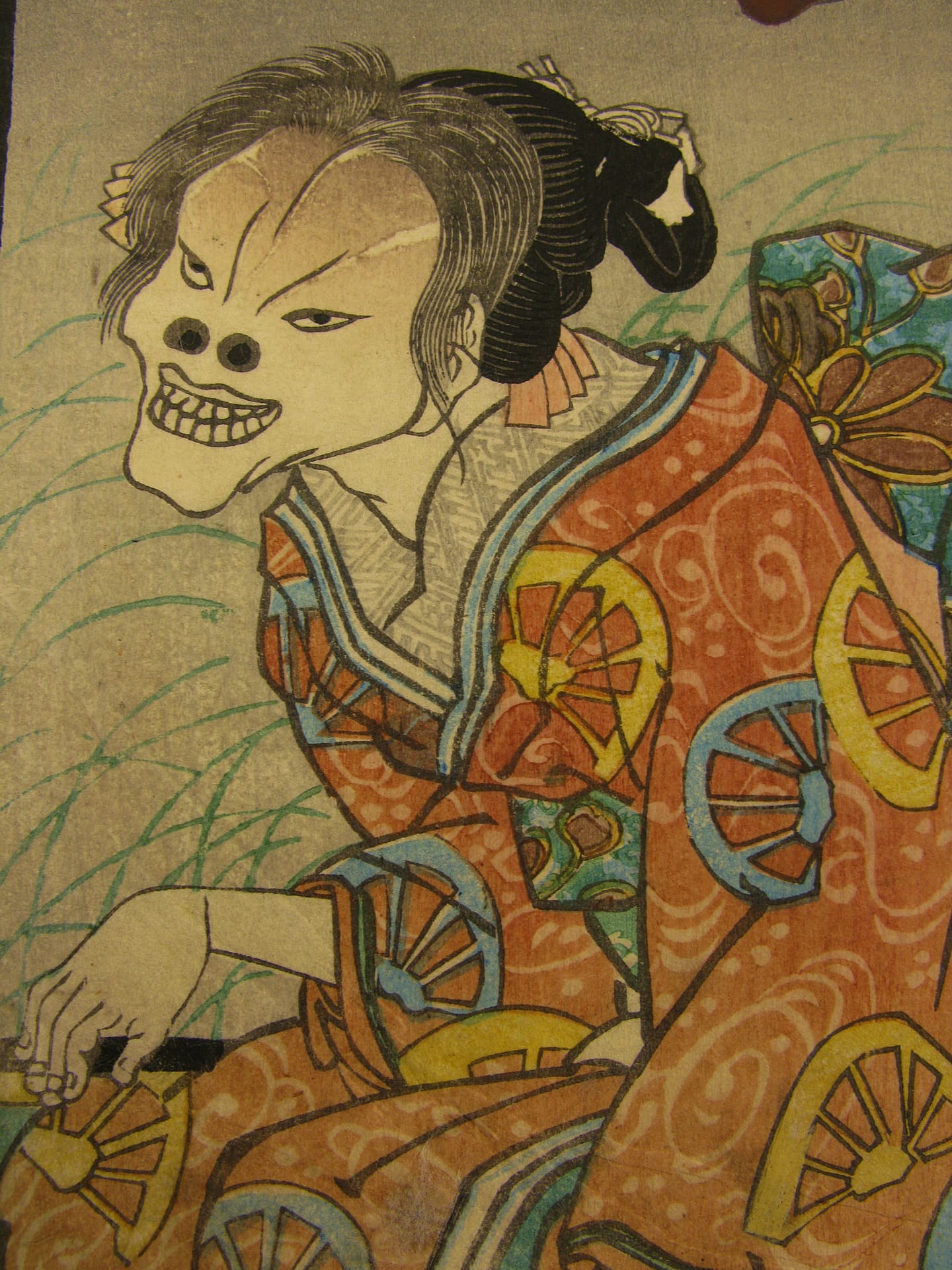
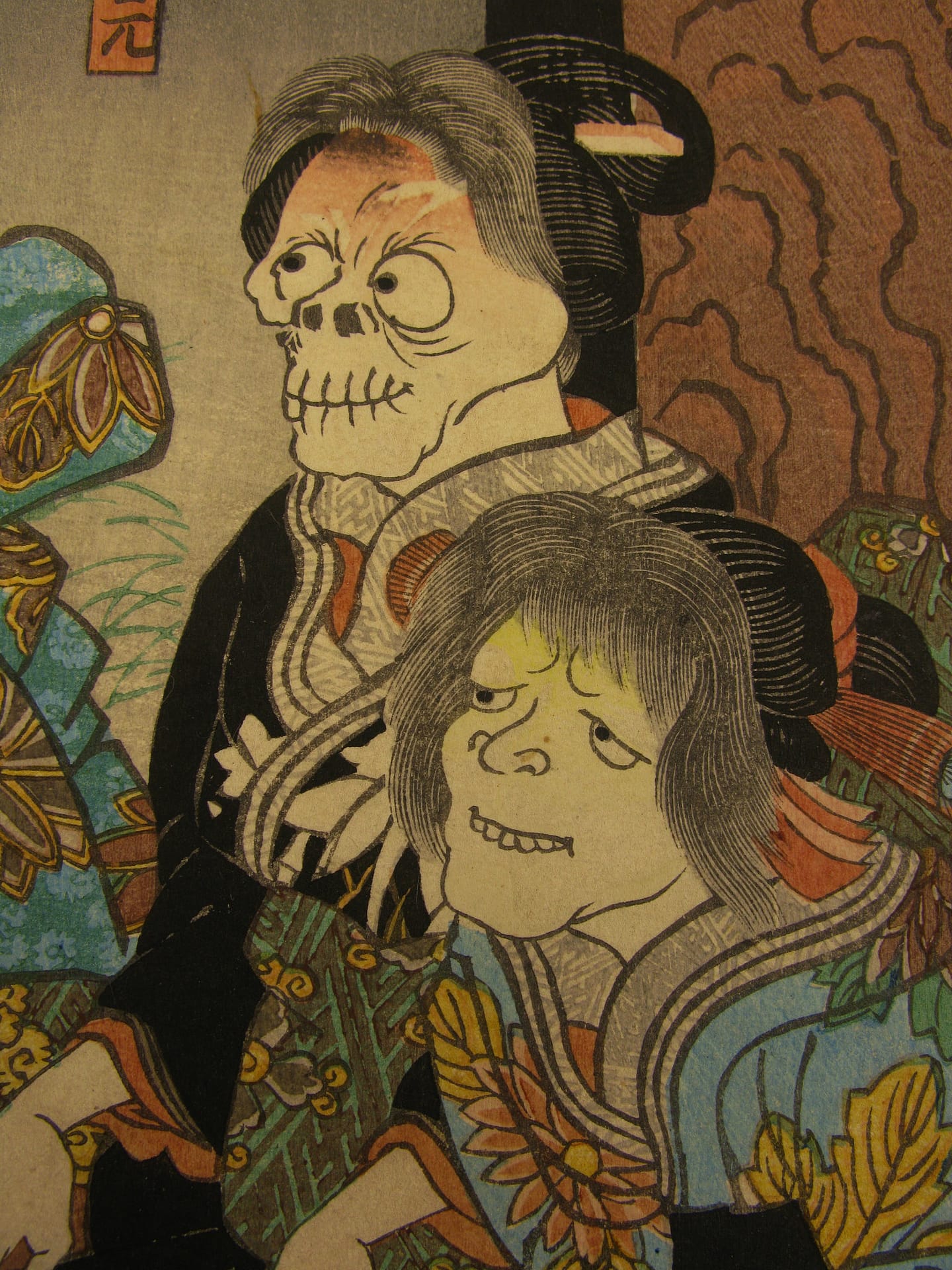
The frightened lady attendants (koshimoto) begin to take on skeletal or corpse-like faces, suggesting that terror itself is transforming reality.
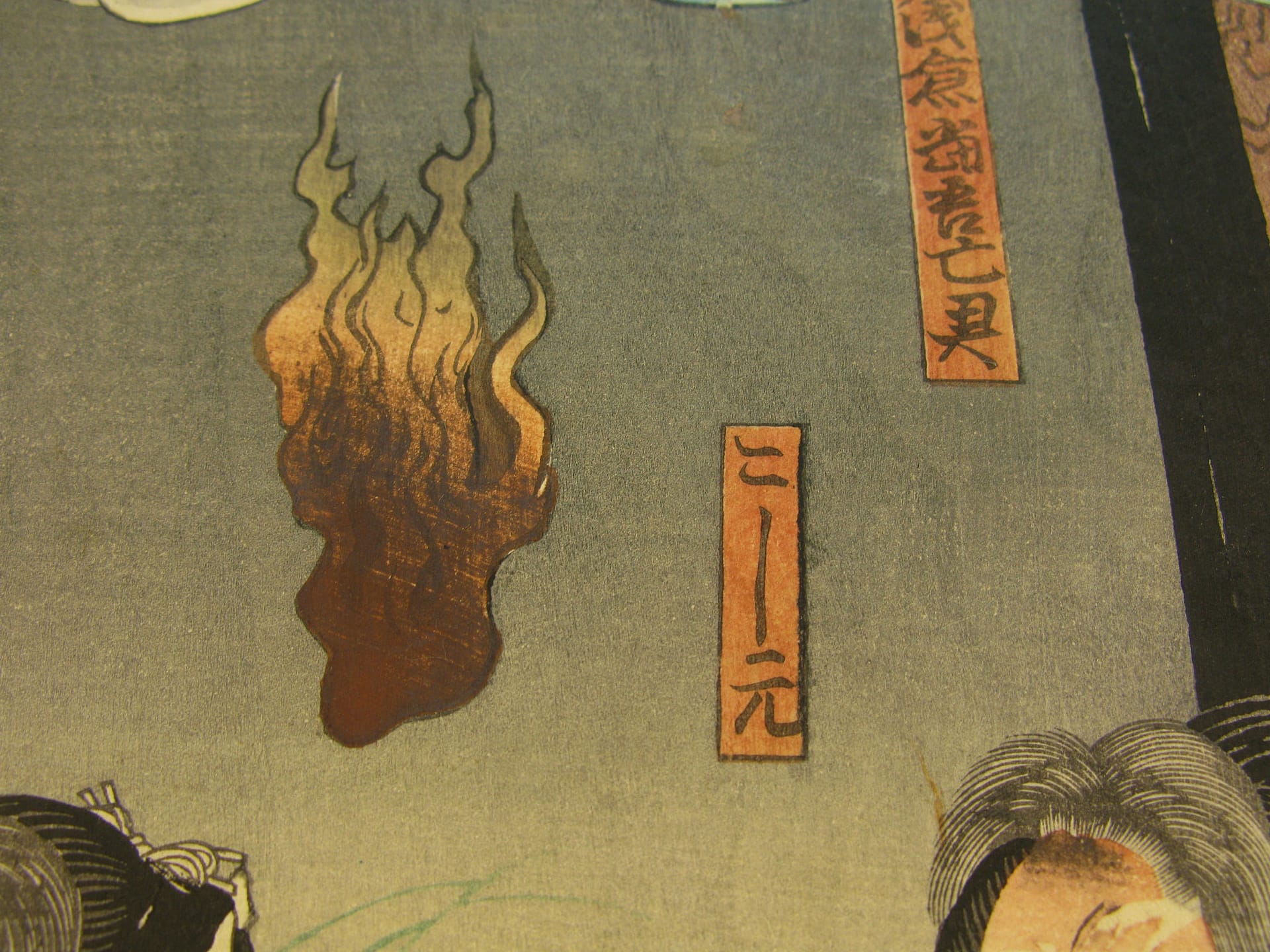
Hitodama (ghost flames: literally human soul) hover in the background, traditional signs of restless spirits.
The lord stands at the centre with his sword drawn, yet the weapon is useless against a moral rather than physical adversary.
The composition overwhelms the viewer with apparitions from every direction, conveying the inescapable nature of guilt. Rather than depicting a simple ghost story, Kuniyoshi visualizes the psychological collapse of a tyrant whose crimes have summoned supernatural justice.