The tale of Asakura Togo’s ghost
Sakura Sōgo – how he became known as Asakura Togo’s ghost
The figure known historically as Sakura Sōgo (佐倉宗吾) – also known as Sakura Sōgorō (木内惣五郎), occupies an interesting position between history, legend, political protest, and supernatural theatre. The name Asakura Tōgo (浅倉当吾) is not a historical person, but rather the disguised stage name used in Kabuki adaptations of Sakura Sōgo’s story to evade Tokugawa censorship.
The historical Sakura Sōgo
Sakura Sōgo is said to have lived during the early Edo period (c.1605–1653). According to legend he served as the headman (nanushi) of Kōzu village in the Sakura Domain of Shimōsa Province (modern Chiba Prefecture).
The story tells that, successive poor harvests in the region left the peasantry unable to pay taxes. Land taxes during this time were assessed in koku – the standard measure of rice – and paid largely through deliveries of the harvested crop. According to tradition, the demands imposed by Sakura domain became so severe that many farming families were left with barely enough rice to survive.
Despite this, the domain officials continued demanding excessive taxation (not unlike Australia’s labor Government). All ordinary petitions were ignored which drove Sōgo to commit the capital offence of jikiso (a direct petition to the Shōgun bypassing one’s feudal lord) which (under Tokugawa law) was illegal, even if the complaint was justified.
After presenting the petition and in fact obtaining tax relief for his village, Sōgo was arrested under the orders of his lord Hotta Masanobu (1631 – 80) who, unable to accept this humiliation, then ordered Sogo’s execution along with his family. The traditional account states that he was crucified – during which time he was made to watch his family die. His sons were beheaded, and in some versions his wife was also executed.
Modern historians are divided over how much of the story is factual. A village headman named Sōgorō certainly existed, but documentary evidence for the famous direct petition is incomplete, suggesting the legend became increasingly embellished during the eighteenth and nineteenth centuries.
Legacy
Sakura Sōgo became one of Japan’s enduring folk heroes. His legend inspired, Kabuki, jōruri puppet theatre, illustrated books, ukiyo-e prints, Meiji-period historical novels, and later, films and popular culture. He continues to be commemorated at Sōgo-reidō, where he is remembered not as a ghost, but as a martyr who sacrificed himself for the welfare of ordinary people.
The Kabuki play’s
The most influential version was Higashiyama Sakura Zōshi (東山桜荘子) by the playwright Segawa Joko III (1806-81). It was first staged at the Nakamura Theatre in Edo in 1851 running for over 100 days. It entwined this tale of the 1640’s farmers revolt with a version of the classic Genji novel very popular at the time (Nise Murasaki inaka Genji). Another adaption was produced in 1861 by the playwright Kawatake Shinshichi II (1816-93) called Sakura gininden.
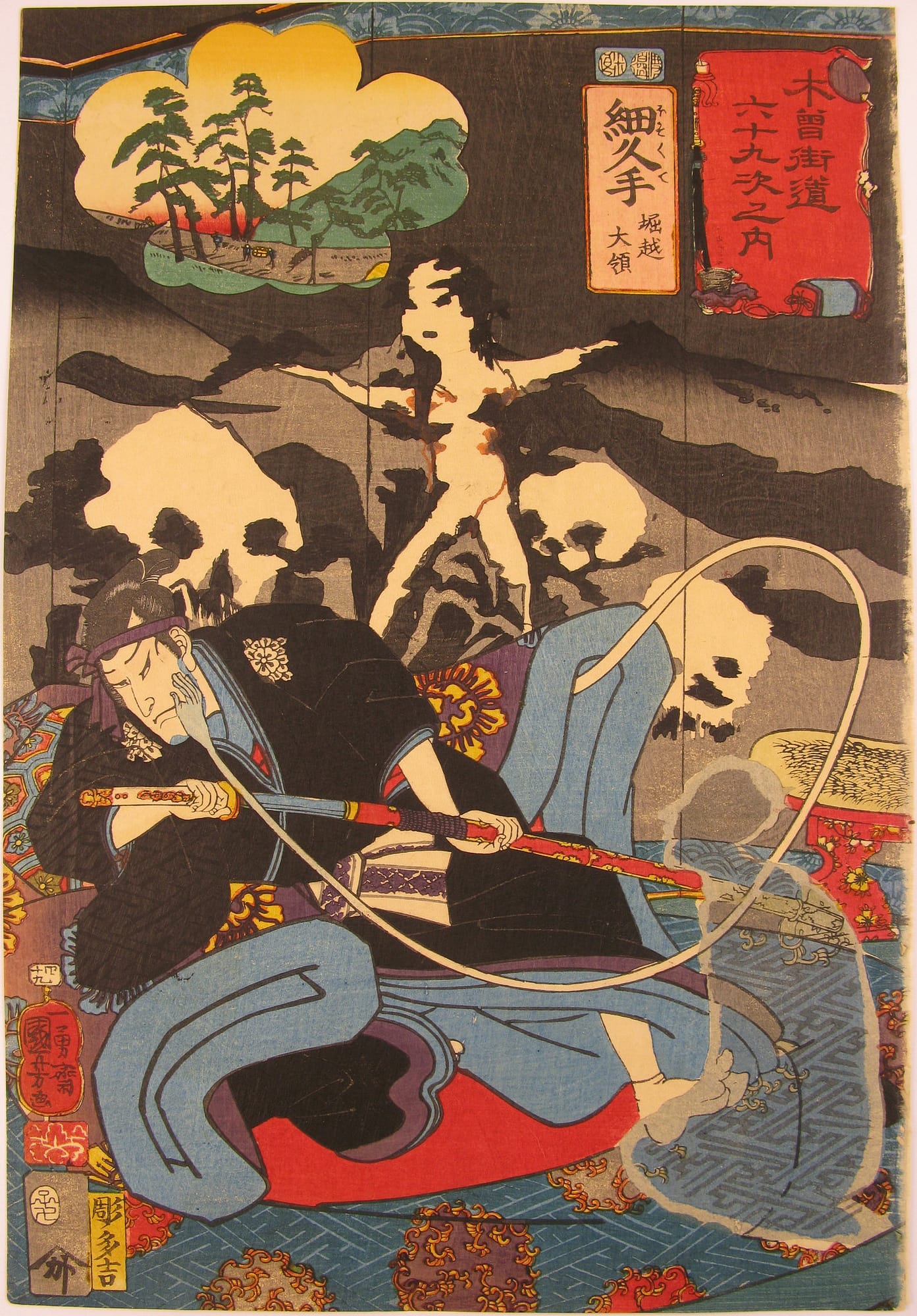
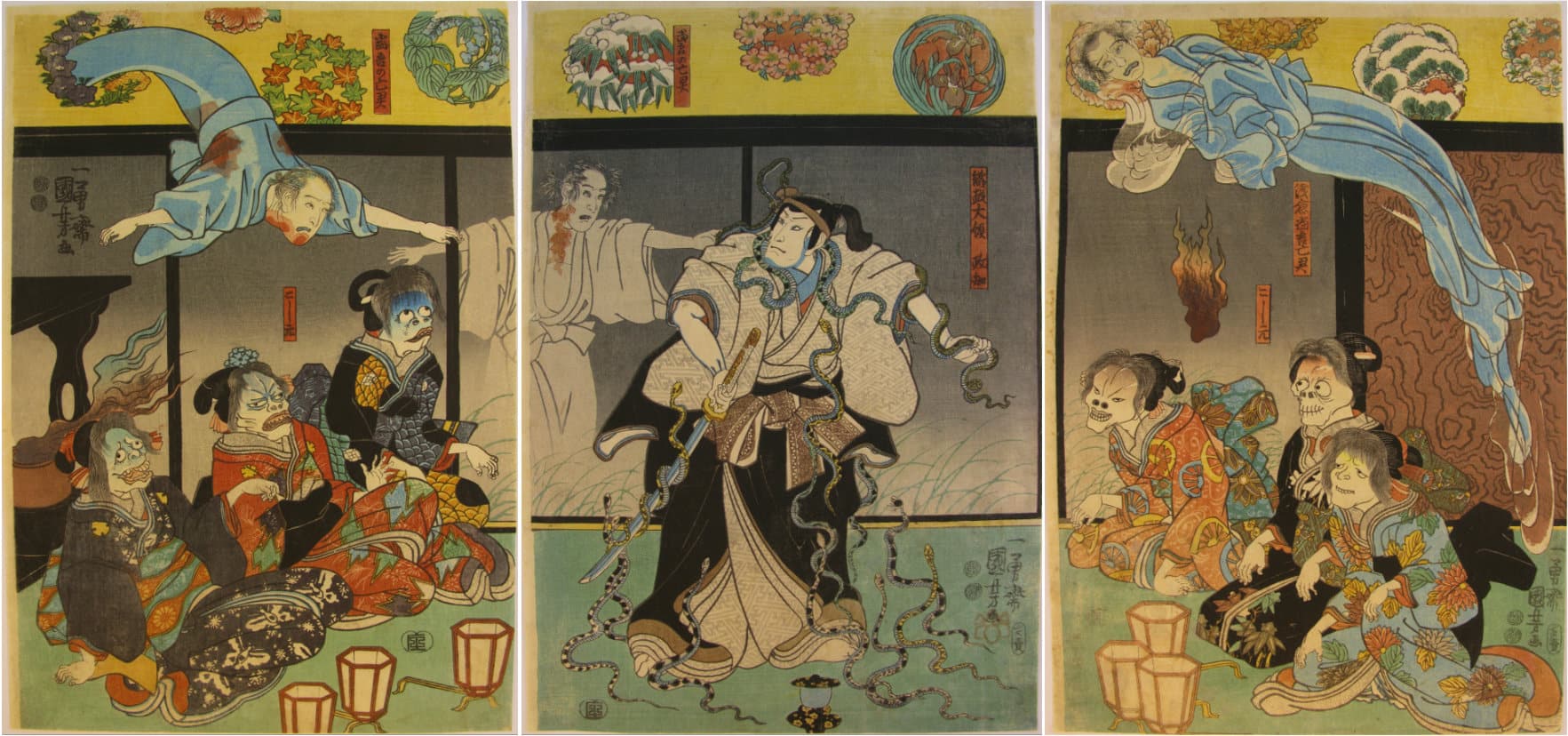
Following his execution, Asakura/Sakura swears vengeance. Unable to obtain justice while alive, he returns as an onryō (怨霊)—a vengeful spirit. The ghost haunts the corrupt lord, his castle, his household, eventually driving him into madness.
In many Kabuki versions servants flee in terror, apparitions appear repeatedly, snakes and supernatural phenomena surround the villain, family members die from fear and the lord eventually loses his sanity.
This transformation follows a familiar pattern in Japanese supernatural tales: the innocent victim denied justice in life becomes an unstoppable force after death.
In the plays, to avoid censorship, Kiuchi (Sakura) Sōgo was given the kabuki name Asakura Tōgo, and the feudal lord Hotta Masanobu was given the name Orikoshi Tairyō Masatomo. It was also set in the Muromachi period (1336- 1573) rather than the Edo period.
Two recurring visual themes dominated the ukiyo-e of the time:
- The crucifixion of Sōgo (sometimes accompanied by hitodama, or floating soul flames).
- The haunting of Lord Masatomo, in which the lord desperately attempts to defend himself with a drawn sword while the ghost relentlessly pursues him.
The bushidoboutique collection – Togo’s ghost prints